
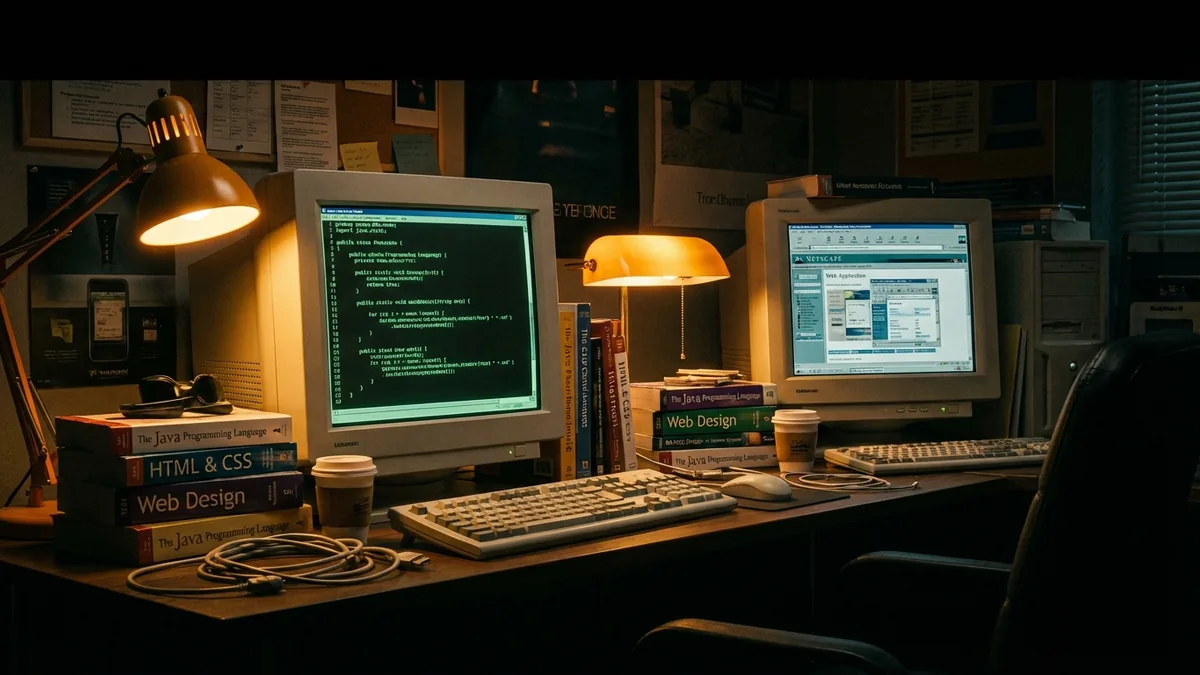
There are moments in a career that define how you think about technology, architecture, and the teams that build software. For me, one of those defining moments was my deep dive into Google Web Toolkit — GWT. I recently stumbled across my old blog, GWT Sushi, and it hit me like a wave of nostalgia. Between roughly 2009 and 2013, I was all-in on GWT, writing tutorials, building demos, wrestling with serialization edge cases, and genuinely believing this was the future of web development. Looking back, it was — and it wasn't. Here's the story.
What Was GWT?
Google Web Toolkit was an open-source framework released by Google in May 2006. The core promise was revolutionary for its time: write your front-end application in Java, and GWT's compiler would transpile it into highly optimized, cross-browser JavaScript. No more hand-writing JavaScript. No more browser compatibility nightmares. For Java developers — and there were millions of us — it felt like Google had unlocked a superpower.
GWT gave you a real type system, IDE support with refactoring and code completion, unit testing with JUnit, and the ability to share code between your server and client. It included a widget library, an RPC framework for client-server communication, history management for single-page apps, and internationalization support. Google used it internally for products like AdWords and Google Wave, which gave it serious credibility.

The Google Web Toolkit logo — a fixture of the late 2000s Java web ecosystem.
Why It Existed: The JavaScript Problem
To understand why GWT existed, you need to remember what web development looked like in 2006. JavaScript was a minefield. Every browser implemented it differently. Internet Explorer 6 was still dominant, and making anything work consistently across IE, Firefox, and the nascent Safari and Chrome was an exercise in frustration. jQuery was only just emerging. There were no module systems, no build tools worth mentioning, no TypeScript, no ES6.
Java, on the other hand, was the enterprise lingua franca. Companies had armies of Java developers, mature tooling, established patterns. GWT's pitch was simple: take your existing Java talent and let them build modern, Ajax-powered web applications without learning a new language. It was a bet that the tooling and language would matter more than the runtime. For a few years, it was a very good bet.
My GWT Life: Building in the Trenches
I started GWT Sushi as a developer blog to share what I was learning and to contribute to the GWT community. The blog's tagline was "Rolls of GWT, Dart, Java, Spring, Grails, Design Patterns and other pro web development goodies." In practice, it was me working through real-world problems and sharing the solutions.
The kinds of problems I was solving tell you a lot about the GWT ecosystem at the time:
- GWT UIBinder and composable widgets — I built and documented samples showing how to use GWT 2.0's UIBinder to separate visual layout from logic, and how to pass parameters between composite widgets. I contributed these to an open-source sample repository on Google Code.
- GWT-RPC serialization challenges — One of the most painful aspects of GWT was the serialization boundary. I wrote extensively about trying to send Google Data API (GData) objects from the server to the GWT client. The POJOs weren't serializable over GWT-RPC, which meant creating parallel data structures — pure boilerplate. I eventually found Piriti, an XML/JSON-to-POJO mapper that used XPath annotations and deferred binding to automate this.
- Google Apps Marketplace and SSO — I integrated GWT applications with Google's enterprise ecosystem, building single sign-on flows against the Google Apps Marketplace. This was a real-world test of framework maturity that most tutorials never covered.
- Dependency injection with GUICE — I explored using Google's GUICE framework within GWT applications, struggling with the right patterns for conditional logic and module configuration. This was cutting-edge for client-side Java at the time.
- Maven integration and build tooling — Getting external dependencies to compile properly with GWT's Java-to-JavaScript compiler was non-trivial. I documented solutions for Maven-based GWT projects.
- Community building — I curated a demos page highlighting third-party libraries like GWT-Platform (GWTP), called on developers to contribute samples, and maintained an open-source demo repository on Google Code.
It was an intense period. I was building production applications, educating myself publicly, and contributing to a community that felt genuinely exciting. We thought we were building the future.
Why GWT Declined
GWT didn't fail overnight. It eroded. Several forces conspired against it:
- JavaScript grew up. The language that GWT was designed to avoid became genuinely good. ES6, Node.js, npm, webpack, React, Angular, Vue — the JavaScript ecosystem underwent a Cambrian explosion. By 2013, writing JavaScript directly was no longer painful; it was powerful.
- The compilation tax. GWT's Java-to-JavaScript compilation was slow — painfully slow for large applications. Development cycles that should have been instant-feedback became wait-for-the-compiler exercises. The dev mode browser plugin broke repeatedly as browsers evolved, and Super Dev Mode, while an improvement, couldn't fully solve the feedback loop problem.
- Google moved on. In 2011, Google introduced Dart, a new language explicitly designed for web development. Key GWT engineers moved to the Dart team. Google Wave, the flagship GWT application, was cancelled. The signal was clear. By 2012, Google handed GWT to the open-source community — a generous act, but also an acknowledgment that it was no longer a strategic priority.
- The abstraction leaked. GWT's promise was that you didn't need to know JavaScript or the DOM. In practice, any non-trivial application required you to understand both, plus GWT's abstractions on top. You ended up needing to know Java, JavaScript, GWT's widget model, its RPC layer, its history system, and the browser. The cognitive load was enormous.
- The talent pool evaporated. As the broader industry moved toward JavaScript frameworks, finding developers who wanted to write Java-compiled-to-JavaScript became increasingly difficult. Hiring for GWT skills meant swimming against the tide.
I saw the writing on the wall myself. My last post on GWT Sushi was about Dart — Google's intended successor. I wrote: "As an avid GWT fan this is probably where GWT is heading, so I feel a need to get-up-to-speed in this area." Even then, I was already transitioning. As it turned out, Dart itself didn't replace GWT on the web — JavaScript did. Dart eventually found its home in Flutter for mobile, a completely different story.

Dart — Google's intended successor to GWT, which took a very different path.
The Engineering Leadership Lessons
Looking back from a CTO's chair, my GWT years taught me several lessons that have nothing to do with Java or JavaScript:
- Bet on the ecosystem, not the framework. GWT was technically impressive but fought against the direction of the web. When your framework's core value proposition is "avoid the platform's native language," you're making a bet that the native language won't improve. That's almost always a losing bet. As a CTO, I now evaluate technology choices by asking: are we swimming with or against the current?
- Developer experience is the ultimate moat. GWT's compilation times, debugging complexity, and dev mode fragility were constant friction. When React appeared with hot module reloading and instant feedback, the choice became obvious for developers. The lesson: if your tool makes developers slower, they will leave — no matter how architecturally elegant it is.
- Community contributions matter — even small ones. My blog was modest. The sample repository was small. But those contributions taught me how to communicate technical ideas, build in public, and think about developer audiences. Every engineering leader should spend time writing tutorials and sharing knowledge. It makes you a better architect and a better communicator.
- Know when to let go. I invested years in GWT. Walking away was hard. But one of the most important skills in engineering leadership is recognizing when a technology has peaked and having the courage to migrate. Sunk cost fallacy kills engineering organizations. The teams I've led since then have benefited from my willingness to say: "This served us well, but it's time to move on."
- Cross-pollination is real. GWT pioneered ideas — component-based UIs, type-safe client code, compiled-and-optimized output — that showed up later in TypeScript, React's JSX, Svelte's compilation model, and more. The technology "failed" but its ideas won. Understanding this pattern helps you evaluate new technologies: is this genuinely novel, or is it the proven idea from a dead framework, reborn in better clothes?
A Point in Time
GWT Sushi still sits there on Blogspot, a digital time capsule from an era when a Java developer could believe that the browser was just another compilation target. The posts are earnest, sometimes naïve, occasionally frustrated — the authentic voice of someone building things with the best tools available at the time.
I don't regret a single hour I spent in the GWT ecosystem. It made me a better engineer. It taught me about compilers, serialization boundaries, the DOM, browser quirks, community building, and the relentless pace of technology change. Most importantly, it taught me that the best technology doesn't always win — the best developer experience does.
If you're a CTO or engineering leader today, wrestling with whether to adopt that exciting new framework or stick with the tried-and-true platform, remember GWT. Remember that Google — Google — built it, used it, promoted it, and ultimately moved on. The lesson isn't that you shouldn't take technology bets. The lesson is that every bet has a shelf life, and your job is to know when the clock is running out.
Thanks for the rolls, GWT. 🍣