
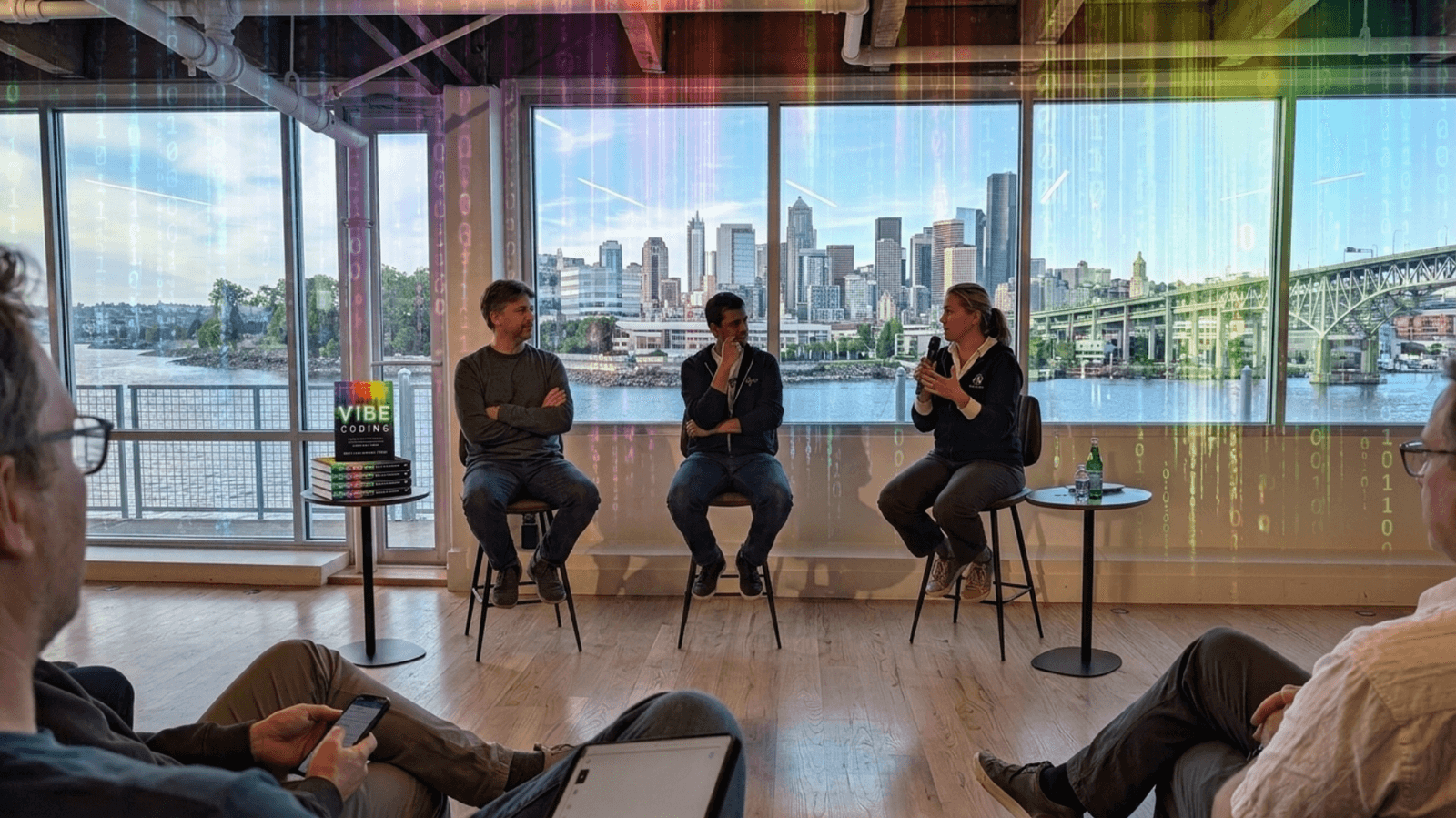
The evening opened with a question to the room: name one thing AI is not going to replace?
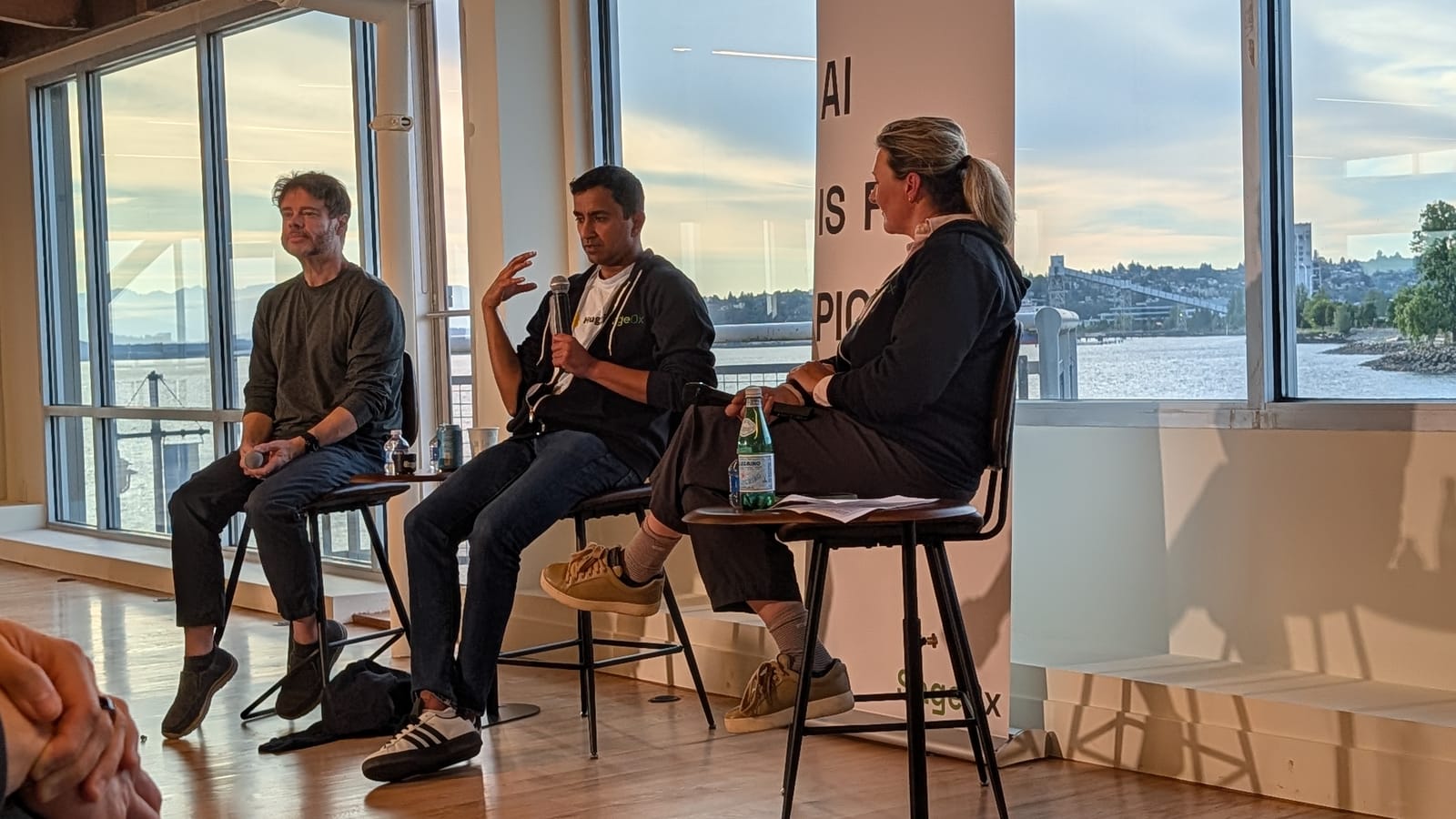
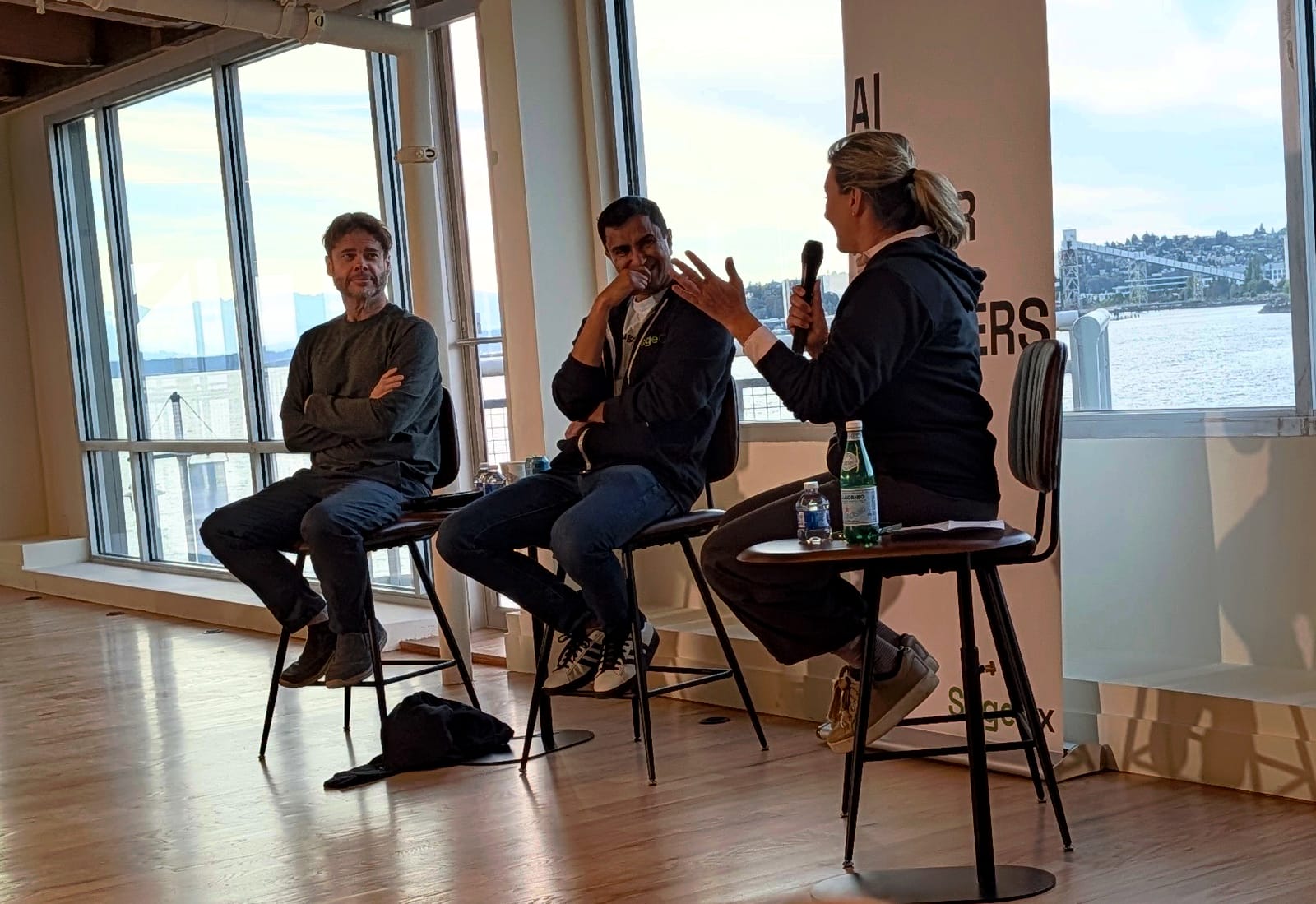
The occasion was a talk at AI House on Seattle's waterfront, billed as a look at the future of software with two people who have built at the front of it. Steve Yegge, veteran of Amazon and Google and one of the more provocative voices on vibe coding, and Ajit Banerjee, early AWS and EBS, Meta, Apple, founder of XetHub (acquired by Hugging Face) and now founder and CEO of SageOx, a Seattle startup that has just announced a $15M seed round. The conversation was moderated by Milkana Brace, SageOx's founder and CPO.
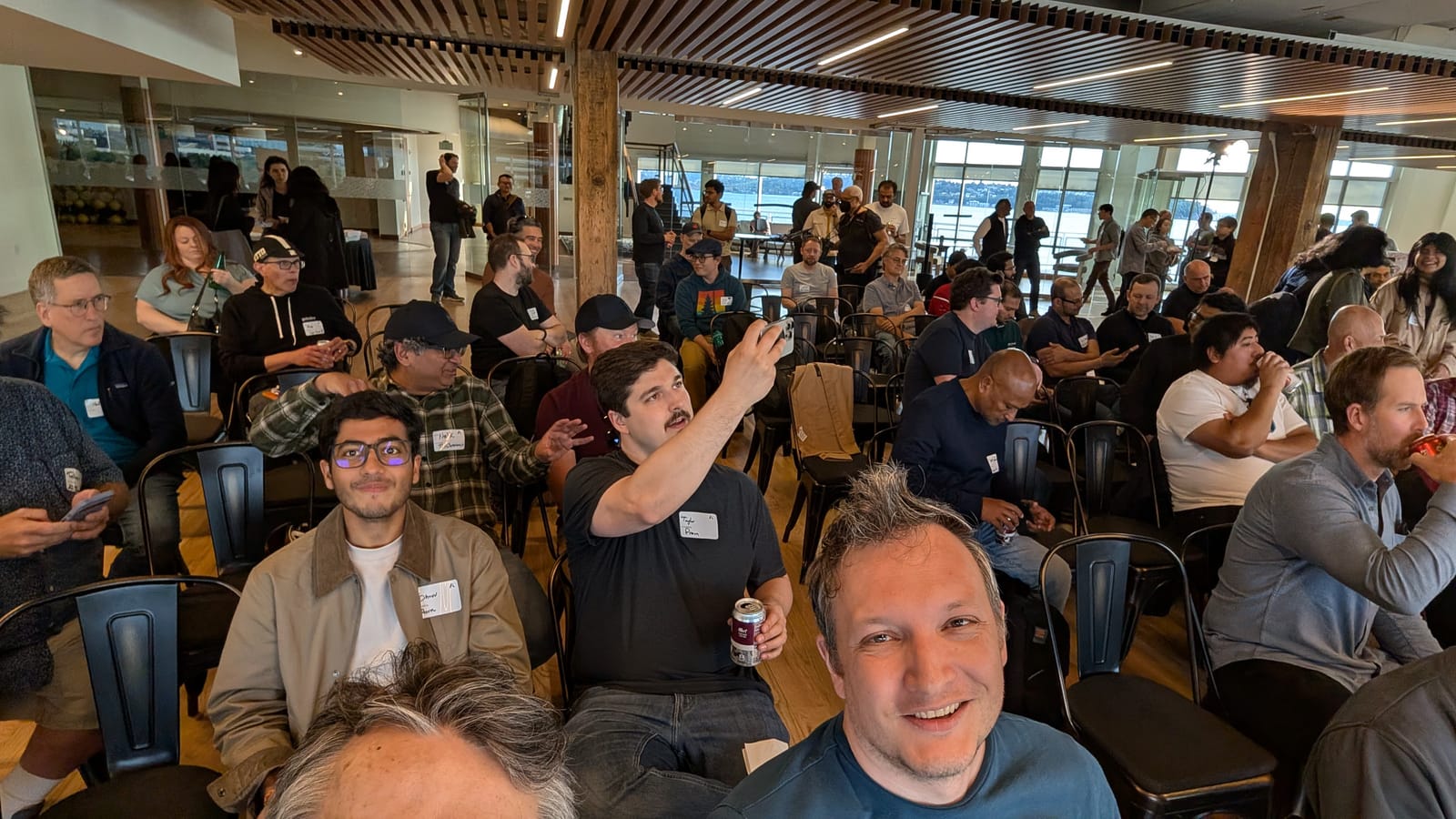
Normalization of volatility
Yegge opened by normalizing his own path through AI. Feelings of chaos and instability are experienced by everyone, including the people working at the bleeding edge. The framing was useful: The Agentic Era is exciting but can feel at times like staring into Pandora's box. Next he sketched a ladder of users. People who have never used AI and never will. People who use a single chat box. People running multi-agent setups. At a certain token window the human cognitive overload becomes too much. Past that point, the constraint is no longer the machine.
Ideas are the new bottlenecks
For the past two decades the work has been about making delivery faster: Agile, Shape-Up, Trunk-based development, CI, deployment automation. The implicit assumption was that writing and shipping code is the expensive, slow part. With coding becoming close to free, the constraint moves to the ideas pipeline. My hypothesis is that subject matter experts will be in greater demand to drive the ideas pipeline, partnering with engineers to orchestrate production-grade products. We can feel the shift in code review. When agents are producing the volume they now produce, reviewing all of it line by line stops being a sensible use of a human. The honest position is that reviewing that much output is not a control any more, it is theatre.
IDEs and Tooling are reorganising themselves around multi-agent workflows and the new constraints. Yegge's read is that the GitHub, Linear and PostHog layer collapses into something else, where agents create the issues, break down the tasks, plan the work, and store the context and the decisions alongside the code. I see this in my own repos already. Tools like beads embed the issue tracker in the repository, and the plans the agents generate live next to the code as documents. The work and the reasoning about the work are converging into one place. The day-to-day cost of this is window management. I move between a terminal session, an IDE, and a stack of markdown documents, and the orchestration overhead is real. I have started using a tiling window manager (Aerospace) just to take some of that load off. There is a clear gap for a tool that holds all of these surfaces without forcing you to babysit a hundred windows. SageOx is one bet on what that tool looks like. More on that below.
Role identity grief
Yegge was direct that there is a grief cycle running through people's careers. Specializations that were a moat a few years ago are gone. If you have good architectural instincts you can now build across the whole stack, which is liberating and also disorienting if your identity was built on one layer. The job market is unstable and he did not pretend otherwise.
Even the people ahead of the curve are only about six months ahead of everyone else. He advises to train your “AI gut”, put in the time to train your judgement for agent orchestration, he estimated roughly twelve months of experience. The whiplash is real, spec-driven development and the BMAD Method were everywhere six months ago. Something else has replaced them, and now the talk is all swarms and orchestration. Six months ago already feels like a previous era. I do not write much code anymore. I review code and architecture while the agent handles the tedious work, and even that feels old-fashioned. His filter for cutting through the noise is blunt, and I have adopted a version of it.
However world-class thinking has always been scarce, with or without AI. This hasn’t, yet, been commoditized. If you are in a room full of people thinking carefully about where this goes, you are already ahead, and that is a more durable position than any specific skill.
New moats and legacy SaaS
If software gets cheap to build, the obvious question for any CTO is what is left to defend. The speakers' answer was that value moves to data and context, not features. When thousands of tinkerers can build their own front ends and assemble the tool they personally need, the feature itself stops being defensible. What is hard to copy is the proprietary data that powers the tool, and the accumulated context of how a team actually works.
SageOx is a direct bet on this. The product pairs software with a hardware component, a listening device that sits with a team and captures the conversations and the context into a shared memory, alongside the chatter the agents are generating. The thesis is that when a team of five is each shipping ten PRs a day with agents, the volume buries the day-to-day insight. A shared context layer surfaces what matters back to both the humans and the agents: a new version of a library you depend on, a new standard for something you are doing, a decision made in another corner of the team that you need to know about. I have heard the "hardware as the moat" argument before, and this is a concrete version of it. Whether the device is the right form factor is an open question. The underlying claim, that durable value sits in proprietary context rather than in the code, is the part worth taking seriously.
There was a sharper version of this aimed at SaaS incumbents. The speakers were blunt that a lot of legacy software is, in their word, cooked. Twenty-year-old SaaS businesses whose moat is adoption and closed, proprietary file formats are exposed. The first-to-market advantage is no more. I expect to see a new generation of AI teams go after restrictive file-format incumbents. As customer frustration grows and users get more capable, they will build what they need rather than tolerate what they are handed.
So what are the future products and how do we get new ideas? The thought experiment I liked most: write the specification for a product that the current models cannot build yet, then re-run it against every new model as it ships. At some point one of them clears the bar, and you are six months ahead of everyone who had not written the spec. Develop the gut through experimentation, then trust it.
Yegge also offered a list of the roles that survive, three of them serious and one a joke. Builders. Security. The adults in the room keeping the business on track. And, delivered with a grin, the people who simply make a team better to be around. The joke had a real point inside it: when ideation is the bottleneck, the human-to-human skills that get a group to a good idea become the scarce input.
SDLC 3.0
If Agile is SDLC 2.0 then what is 3.0? The software fabrication pipeline is something we should think long and hard about. If my thinking around smaller teams embedded with subject matter experts is correct, then clear goals, autonomy and well-built loosely-coupled architecture is required to enable them to dominate. We discussed previously in “AI Doesn't Fix Your Org, It Amplifies It”.
One thought experiment from the event is worth running before you read my answer. If we 10x the volume of code and the defect ratio holds constant, do we 10x the bugs? Decide what success and failure look like in this new world first.
Take a moment to think about how that might affect your company, its teams, and customer perception.
Path 1 - The literal one. The defect ratio holds, volume goes up tenfold, defects go up tenfold, and you have built a faster machine for producing bugs. This is the failure mode worth naming, because it is the feature factory, and the feature factory was a poor way to build software long before any of this. Ten times the throughput only makes the consequences arrive ten times faster. Congratulations, your new bottleneck is customer perception, technical support and over allocating roadmap to keep-the-lights-on (KTLO) work.
Path 2 - AI Forward Teams. 10x is not all features. You utilize some additional bandwidth on paying down the defect ratio itself, automating chores, tweaking annoyances, adding more automated testing, greasing the CI/CD quality gates. Used that way, the extra capacity does not hold the defect ratio steady, it drives it down.
Which path a team lands on is not set by the tooling. It is set by how the team chooses to spend the capacity the tooling hands them. And the pull toward the first path is stronger now, not weaker. When code is cheap, the temptation to behave like a feature factory is more pronounced than ever, because the cost of shipping more has dropped while the discipline to ship better has not gotten any easier. The teams that come out ahead will be the ones that spend the surplus on quality, and the metric that tells you which path you are on is change failure rate, not raw output.
Fellow startup veteran and AI pioneer
I attended with Lucas Taylor, ex-Amazon and a startup veteran. Our kids attend school together and over many years we’ve discussed the ever changing AI landscape. Much of what was heard tonight resonated with both of us and tied directly to Lucas’s Cloche product.
Cloche turns agents into reliable, predictable executors that work across projects. The DSL enforces your standards, work continues in isolated containers and clean pull requests returned for review. The differentiator being flexible enough for your workflow patterns, increasing quality and reducing retroactive prompt-fixing. This tool directly addresses the evening themes tackling tooling collapse, issue tracking, code review; moving the human up the stack, tasked with approving outcomes rather than keystrokes.
Lucas is a software engineer building in the AI space, and, in his own words, a part-time cyborg, currently automating tax preparation at Aiwyn. He taught himself to program on his father's 286 at the age of ten and has been building ever since, across Python, Ruby, Rust, Kotlin and Java, on the principle that good code is written for clarity first and efficiency second, in that order. He writes about the things he builds, and the occasional strong opinion, at Perfect Lunacy.
The venue: AI House
AI House sits on Pier 70 on Seattle's waterfront. It is run by the AI2 Incubator, which came out of the Allen Institute for AI, and it operates as the gathering point for the Pacific Northwest AI community, a 400-plus capacity events space alongside the incubator's own companies. Before the space even opened, AI2 had incubated more than 40 companies worth over a billion dollars combined. The programming runs on themes that map almost exactly onto the talk: hype to deployment, agents and autonomy, developer experience and vibe coding, infrastructure and efficiency.
The portfolio is the more interesting signal. The pattern across it is vertical AI, founders with deep domain knowledge pairing it with models, and a notable run of acquisitions. From the companies page:
- WhyLabs (AI and LLM observability) and XNOR (low-power, edge AI), both acquired by Apple. XNOR was the roughly $200M edge-AI deal that came out of the same AI2 lineage.
- Lexion (contract and ops workflows), acquired by Docusign.
- Materia (agentic tax, audit and accounting), acquired by Thomson Reuters.
- Vercept (AI computer interface), acquired by Anthropic.
- Chipstack (chip development), acquired by Cadence.
- Kitt (conversational understanding), acquired by Baidu.
- BirchAI (call-centre automation), acquired by Sagility Health.
- Modulus (cell therapies for autoimmunity), acquired by Ginkgo Bioworks.
- MajorBoost (medical billing calls), acquired by Superdial, and MeetingFlow, the enterprise sales meeting assistant, acquired by Augment.
The still-building roster reads like a map of where applied AI is going by sector. Developer and agent tooling: Maestro (engineering insights), DevPlan (product intent to structured execution for humans and agents), Caddi and AZX. Security, governance and compliance: Emphere (Dockerfile security), GLACIS (verifiable AI governance receipts), Stratocloud (just-in-time access), Signify (AI-assisted compliance). Healthcare and life sciences: Ozette, Decipher, CalmWave (hospital ops), Aria (behavioural health), Health Elements, Preemptive. Commerce and operations: Envive (agentic commerce), Jinn Labs (retail), Unwrap (customer needs), Augment (buyer-seller deals), Outrun. Voice, audio and creative: WellSaid (voice avatars), Hearvana (hearing tech), Eidol AI (live vocals), Yoodli (communication coaching), Soundry AI. Legal, immigration and risk: Valar (legal risk), Casium (immigration), Friday Harbor (mortgage underwriting). Science and physical AI: Potato (autonomous science agents), Roboto (physical AI analytics), Moria (mining data), Cadstrom (circuit design). Plus the more consumer-facing Ollie (meal planning), Rem (commissions) and Stickerbox.
The takeaway from the wall of logos is the same as the takeaway from the talk. The defensible companies are not the ones with the cleverest model. They are the ones sitting on proprietary data and hard-won domain context in a specific vertical, which is exactly where the acquirers have been shopping.
Name one thing AI won’t replace?
My answer to the opening question was human-to-human contact. If ideation is the new bottleneck, the work of connecting people and validating which ideas are worth building only grows. Our connection to customers has always been the gold at the top of the idea funnel, and it matters more now, not less, as the engineering side runs short of fresh ideas. It will not replace the people who know which problems are worth solving. If teams get smaller and more cohesive, the personal connections inside a development pod matter more, not less.
There was also a fair amount of nervous excitement in the room about Mythos, the frontier model Anthropic previewed in April and then declined to release publicly after it found thousands of zero-day vulnerabilities in internal testing. Hearing experienced engineers describe a model as both thrilling and genuinely unsettling was its own data point about where we are.
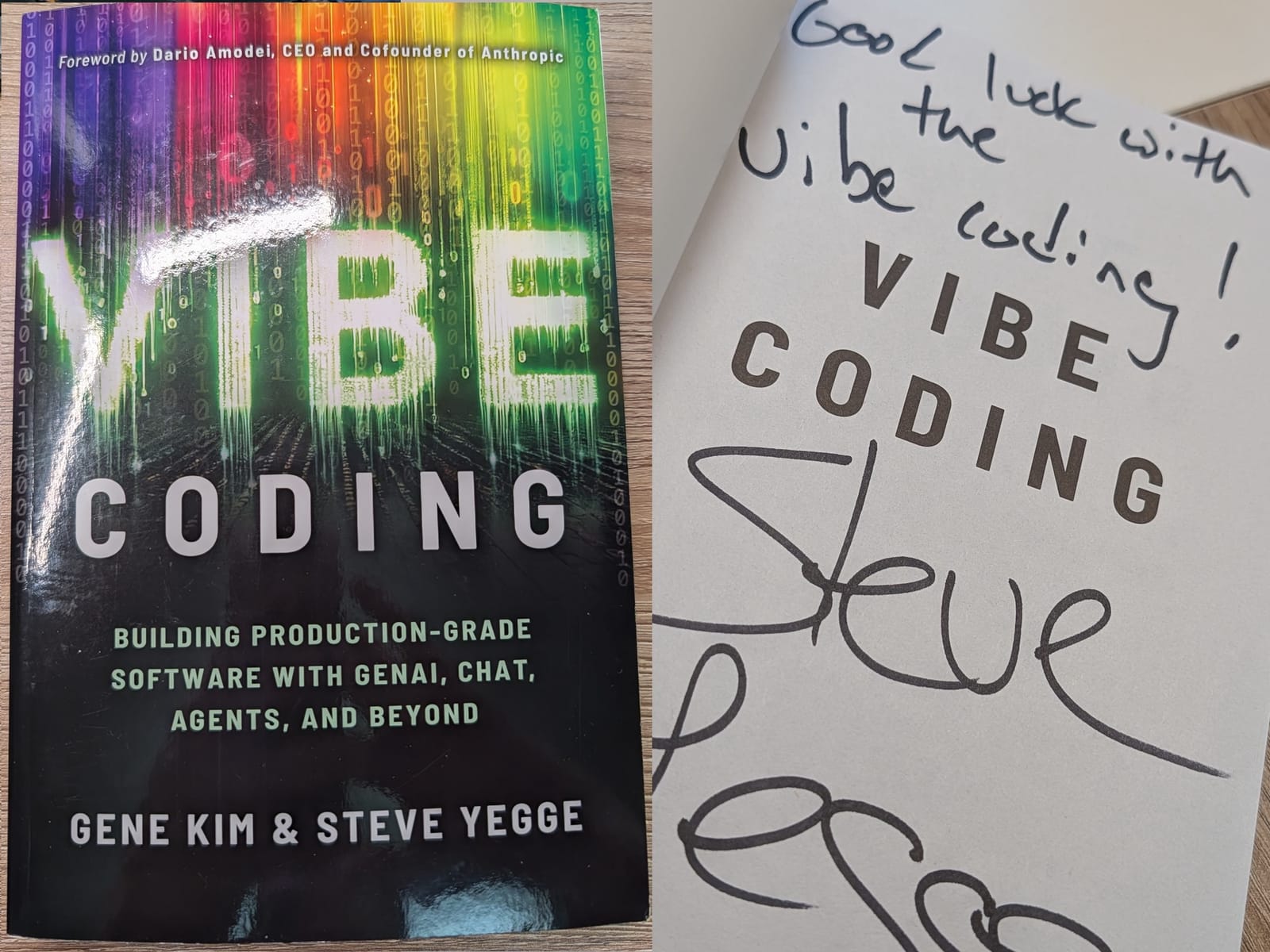
I will close on a small piece of luck. The judges liked my answer to the opening question, a theme I apparently shared with many of the other nine winners, and I won a signed copy of Vibe Coding, the book Yegge co-wrote with Gene Kim. Kim also co-authored Accelerate, which has been my blueprint for modernizing engineering organisations.
The chaos is real. The whiplash is normal. The discipline still matters, and so does world-class thinking.
Further Reading
- SageOx, "the hivemind for human-agent teams," plus the AI House event listing.
- DORA, on change failure rate as a core delivery metric.
- AI House, AI2 Incubator and the AI2 Incubator companies page.
- KUOW, on AI2 incubating more than 40 companies worth over $1B before AI House opened.
- GeekWire, on Apple's acquisition of XNOR.
- Anthropic, Claude Mythos Preview and Project Glasswing (7 April 2026), with reporting from Scientific American.