Skip to content

Four Signals

ai/ml / Lobsters

Multi-agentic Software Development is a Distributed Systems Problem (AGI can't save you)

Multi-agent software synthesis maps to distributed consensus: given a prompt P defining a program set Φ(P), coordinating agents to produce compatible components φ₁...φₙ requires agreeing on a single φ ∈ Φ(P), an invariant coordination problem with known impossibility results regardless of agent intelligence. The author advocates for choreographic languages—formalizing agent interactions with game theory—as essential tooling, rejecting the 'wait for AGI' mindset that ignores foundational distributed systems literature. This reframes orchestration frameworks like LangGraph and CrewAI as needing DS-inspired correctness guarantees, not just smarter models. You design multi-agent systems (LangGraph, CrewAI), so this shows coordination failures are fundamental distributed systems problems, not solved by model upgrades—you must build in formal coordination guarantees. Study distributed consensus algorithms and choreographic programming models to design verifiable multi-agent workflows, not just chain smarter LLMs.

MCP servers turn Claude into a reasoning engine for your data
ai/ml / The New Stack

MCP servers turn Claude into a reasoning engine for your data

MCP servers, built via Anthropic's open-source TypeScript or Python SDKs, connect private data to Claude by defining tools with Zod schemas for input validation. The protocol eliminates manual data entry workarounds, enabling Claude to reason over enterprise datasets like historical sales records directly within its context. As a senior engineer focused on AI agent orchestration, MCP servers provide a standardized, low-friction pattern to inject proprietary data into LLM reasoning loops—critical for building multi-agent systems that operate on real-time, domain-specific information without custom ETL pipelines. Build an MCP server using the TypeScript SDK with Zod-defined tools to expose your data sources to Claude for direct reasoning.

Fortress in a Box: Kubernetes Security for the Organizations That Can't Afford It
security / Dev.to

Fortress in a Box: Kubernetes Security for the Organizations That Can't Afford It

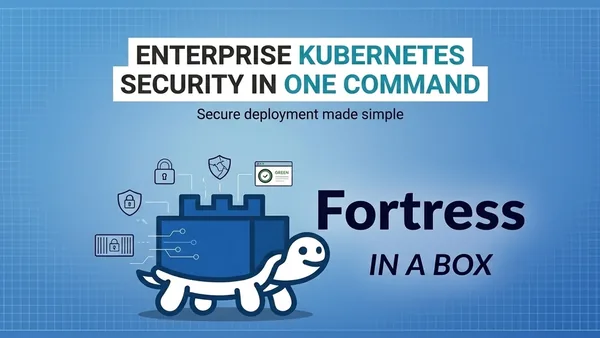
Fortress in a Box is a one-command Kubernetes security platform for NGOs, integrating Trivy for CI/CD scanning, Kyverno with six admission control policies, and Falco for runtime detection. It provides a free, open-source solution to prevent breaches like Red Cross's 515,000 record exposure, targeting organizations with no security budget. This matters to you as a senior engineer focused on cloud infrastructure and open-source tooling because it demonstrates a practical, packaged approach to Kubernetes security that can be adapted or inspire similar solutions in resource-constrained environments. Integrate open-source security tools like Kyverno and Falco into your Kubernetes deployments to automate threat detection and policy enforcement without requiring deep security expertise.

A cryptography engineer's perspective on quantum computing timelines
general / Hacker News (100+)

A cryptography engineer's perspective on quantum computing timelines

Google and Oratomic research demonstrates CRQC attacks on 256-bit elliptic curves requiring as few as 10,000 physical qubits via neutral atom connectivity. Experts Adkins/Schmieg cite a 2029 deadline while Aaronson invokes a nuclear fission analogy, indicating timelines have collapsed from decades to years. Immediate migration to post-quantum cryptography is critical, as even monthly key breaks threaten WebPKI and long-term data confidentiality. As a senior engineer architecting cloud and AI systems, quantum vulnerabilities directly compromise the cryptographic foundations of your infrastructure and APIs, demanding proactive architectural changes to protect user data. Prioritize integrating NIST's post-quantum cryptographic standards into your organization's TLS/SSL and code-signing pipelines within 12 months.

Git’s Magic Files
general / Lobsters

Git’s Magic Files

Git repositories use four committed 'magic files' to control behavior: .gitignore (pattern-based exclusion with precedence from directory to global), .gitattributes (file-specific handling like diff drivers, line endings, and GitHub Linguist overrides), .lfsconfig (shared Git LFS endpoint settings), and .gitmodules (auto-generated submodule configuration). These files travel with the code, ensuring consistent repository behavior across clones and critical for tools like git-pkgs to function correctly. As a senior engineer building developer tools or managing complex codebases, understanding these files is essential for creating tools that correctly interpret repository state and for standardizing team-wide Git configurations in cloud-native or multi-agent development workflows. Audit your repositories for proper .gitattributes and .lfsconfig usage to ensure consistent file handling and LFS behavior across all developer environments and CI/CD pipelines.

Is observability still an operations problem at your organization?
devtools / The New Stack

Is observability still an operations problem at your organization?

Dynatrace's April 16 webinar, featuring Sean O'Dell and David Beran, champions developer-led observability by granting engineers direct access to runtime telemetry—logs, traces, metrics, and user activity—for real-time debugging. This shift accelerates issue resolution and cuts escalations in distributed and AI-driven systems. Teams adopting these patterns see marked improvements in productivity and system reliability by embedding telemetry into the development lifecycle. As a senior engineer focused on AI/ML orchestration and developer tooling, this model enhances your ability to debug complex AI systems efficiently and integrate observability into your workflow, directly boosting productivity and reliability in cloud-native environments. Implement runtime telemetry access for developers to debug distributed and AI systems faster, reducing operational dependencies and improving software resilience from the start.

Every GPU That Mattered
general / Hacker News (100+)

Every GPU That Mattered

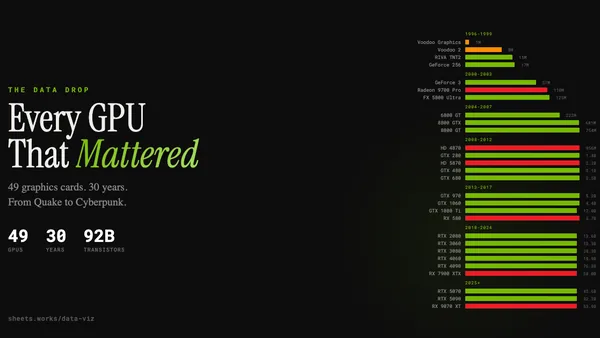
This interactive data story plots 49 pivotal GPUs across 30 years by release year and transistor count, mapping the shift from gaming graphics to AI acceleration. Each clickable dot exposes specifications, highlighting exponential compute density growth and architectural pivots like tensor cores. The visualization quantifies hardware trends critical for scaling ML workloads in cloud environments. As a senior engineer focused on AI/ML orchestration, understanding GPU transistor scaling and architectural shifts informs cost-effective cloud infrastructure decisions and performance tuning for agent-based systems. Incorporate transistor density and AI-specific core counts into your GPU selection criteria when designing scalable ML pipelines to optimize throughput and cost.