
Skip to content

Four Signals

OpenAI co-founder Greg Brockman takes charge of product strategy
ai/ml / TechCrunch

OpenAI co-founder Greg Brockman takes charge of product strategy

OpenAI co-founder Greg Brockman is officially leading product strategy, consolidating ChatGPT and Codex into a unified experience with API integration, as CEO of AGI deployment Fidji Simo remains on medical leave. This follows Sam Altman's "code red" to refocus on core ChatGPT, halting side projects like Sora and OpenA…

Why it matters

For a senior engineer building agent orchestration systems, this signals OpenAI's strategic pivot toward a unified agent platform that could redefine API design patterns and tooling choices.

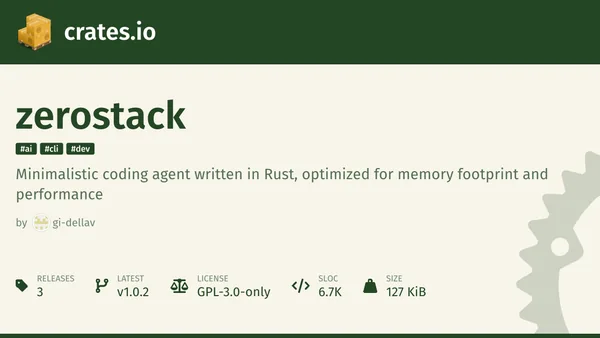
Zerostack – A Unix-inspired coding agent written in pure Rust
ai/ml / Hacker News (100+)

Zerostack – A Unix-inspired coding agent written in pure Rust

Zerostack is a new open-source coding agent written in pure Rust, inspired by Unix philosophy, now available as a Rust crate. The tool likely emphasizes simplicity, composability, and efficiency for code generation or assistance tasks. For a senior engineer focused on AI agent orchestration and developer tooling, this represents a potential new building block for agent workflows, especially if it integrates well with Rust-based systems or Unix-style pipelines. Evaluate Zerostack as a lightweight, composable coding agent for your agent orchestration stack, particularly if you value Rust performance and Unix design principles.

ai/ml / Hacker News (100+)

OpenAI and Government of Malta partner to roll out ChatGPT Plus to all citizens

OpenAI has announced a partnership with the Government of Malta to provide ChatGPT Plus subscriptions to all Maltese citizens, marking one of the first national-level rollouts of premium AI access. The initiative likely involves government-subsidized or free access to advanced AI tools for the entire population, with implications for digital infrastructure and public sector AI adoption. This sets a precedent for government-subsidized AI access at scale, which could influence how enterprise and public sector AI deployments are architected, especially around identity management, usage policies, and cloud infrastructure. Evaluate how national AI partnerships like this one might drive demand for scalable, secure multi-tenant AI infrastructure and agent orchestration patterns.

Neobank Monzo Builds Governed Data Mesh Across 100 Teams and 12000 dbt Models
ai/ml / InfoQ

Neobank Monzo Builds Governed Data Mesh Across 100 Teams and 12000 dbt Models

Monzo's governed data mesh, spanning 100+ teams and 12,000 dbt models, uses four modeling layers (landing, normalized, logical, presentation) with explicit interfaces and CI-enforced validation via their Modelgen CLI tool, cutting warehouse costs 40% and improving data delivery speed 25% while reversing cost growth. The bank is 30% through a company-wide migration to this approach. For a senior engineer building multi-agent systems and cloud infrastructure, this demonstrates how to scale distributed ownership with automated guardrails and interface contracts—directly applicable to managing cross-team data dependencies and agent orchestration pipelines. Adopt explicit data interfaces and CI-enforced validation (like Monzo's Modelgen) to manage cross-team dependencies in your data platform.

languages / Lobsters

My Thoughts on Bun's Rust Rewrite

Bun's Rust rewrite, completed by Claude AI in 6 days (6,755 commits, branch claude/phase-a-port) and merged without human review, inherits a foundation built with Zig—the author stresses Zig's role in Bun's early performance and that the rewrite is a business decision post-acquisition. Jarred admitted Rust's compiler cannot handle memory issues when re-entering JS boundaries, and the lack of human review means global invariants may be broken, posing future production risks. For a senior engineer building AI-driven tooling and evaluating startup tech stacks, this case exposes the critical gap between AI-generated code passing tests and maintaining global invariants—a risk amplified in production-grade infrastructure like a JS runtime. Never merge AI-generated code without thorough human review, especially when memory safety and cross-boundary invariants are at stake.