[GitHub Trending] ruvnet/RuView
Scored daily by a customisable AI persona to surface the most relevant engineering leadership news.
Innovative use of WiFi, but niche for senior engineer.
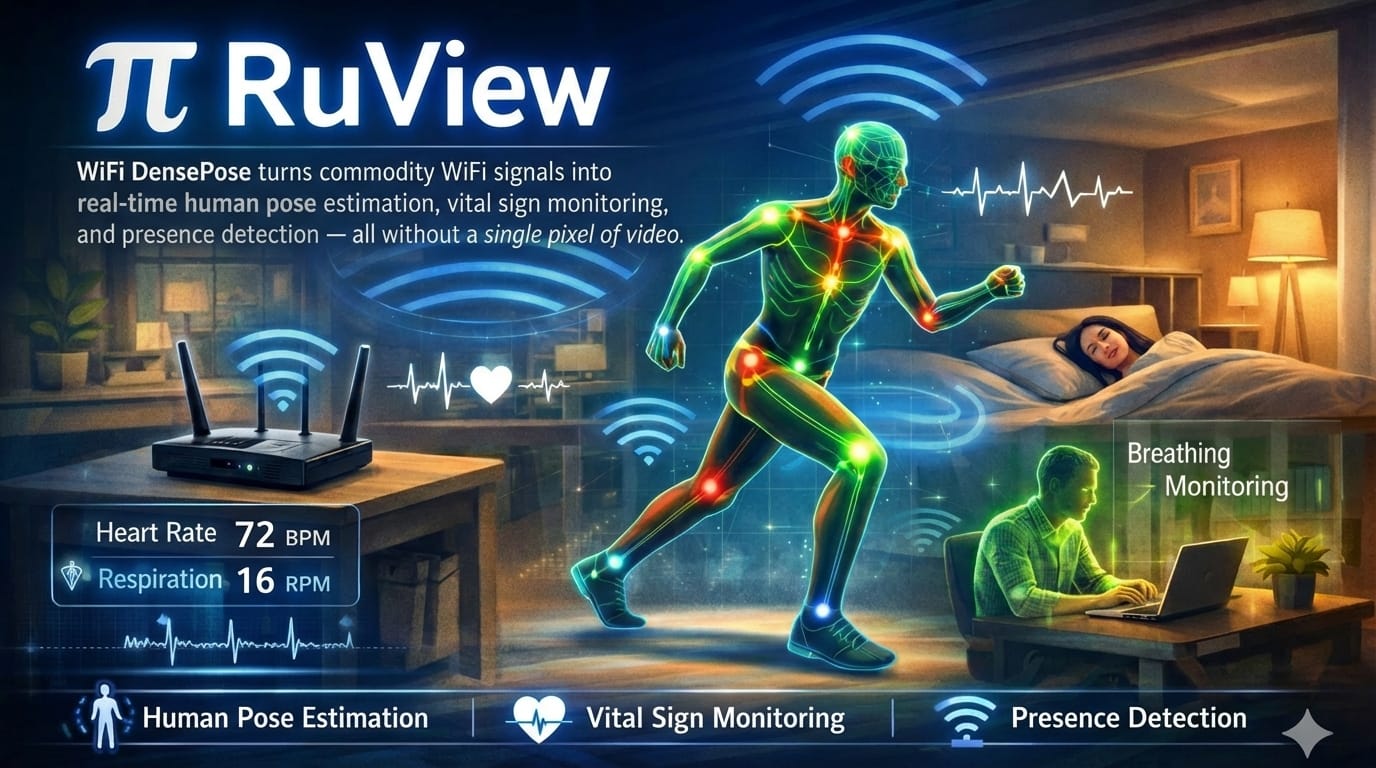
RuView is an open platform using ESP32-S3 sensors and Cognitum Seed edge AI to extract spatial intelligence from WiFi CSI, enabling through-wall presence, vital signs, and camera-free pose estimation (17 COCO keypoints via WiFlow at 171K emb/s). It runs fully offline on a $9+$140 BOM mesh, cryptographically attests measurements via Ed25519 chains, and uses neighbor routers as radar illuminators across 6 channels. Camera-supervised training targets 35%+ PCK@20 but evaluation phases are pending.
Evaluate RuView's ESP32 mesh and Cognitum Seed for low-cost, privacy-preserving spatial sensing in edge AI agent deployments.
For a senior engineer building AI/agent systems on edge, this demonstrates a practical open-source alternative to cloud-dependent sensing, spiking neural nets for real-time adaptation, and a hardware-software stack that could integrate with agent orchestration for physical world awareness.
π RuView Beta Software — Under active development. APIs and firmware may change. Known limitations: ESP32-C3 and original ESP32 are not supported (single-core, insufficient for CSI DSP) Single ESP32 deployments have limited spatial resolution — use 2+ nodes or add a Cognitum Seed for best results Camera-free pose accuracy is limited (PCK@20 ≈ 2.5% with proxy labels) — camera ground-truth training targets 35%+ PCK@20 ; the pipeline is implemented, but the data-collection and evaluation phases (ADR-079 P7–P9) are still pending, so no measured camera-supervised PCK@20 has been published yet