Skip to content

Four Signals

Agentic insights for modern tech teams

Google Gemma 4 12B nearly matches 26B benchmarks — and runs on your laptop
AI/ML / thenewstack.io

Google Gemma 4 12B nearly matches 26B benchmarks — and runs on your laptop

Google's Gemma 4 12B delivers near-26B benchmark performance (e.g., DocVQA) while running on laptops with 16GB VRAM, using a unified architecture that processes audio and images directly without separate encoders. This enables local multi-step reasoning and agentic workflows offline, though early feedback notes limited coding capabilities compared to Qwen models.

Why it matters

For a Solutions Architect focused on AI/ML and platform engineering, this means you can deploy capable multimodal AI locally on standard hardware, reducing cloud dependency for agentic workflows and enabling offline inference for edge or privacy-sensitive applications.

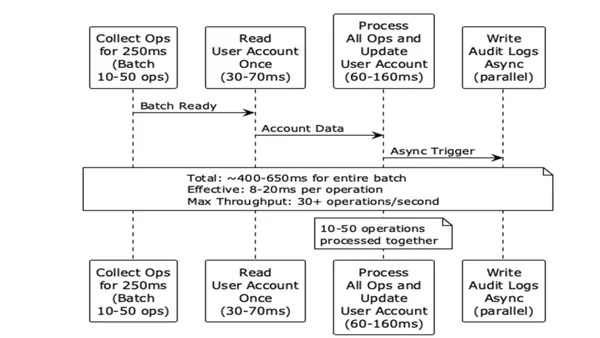
30+ Updates per Second per Account: Uber Scales Ledger Processing with Batching
General / infoq.com

30+ Updates per Second per Account: Uber Scales Ledger Processing with Batching

Uber's new ledger processing system uses 250ms batching and Redis coordination to handle over 30 updates per second per account under high contention, replacing per-request processing with batched atomic updates. The double-entry accounting model ensures consistency, and the three-stage workflow (grouping, atomic execution, persistence) cuts processing from hours to minutes while maintaining auditability.
Google LiteRT-LM Speeds Up Local Inference Up to 2.2x With Gemma 4 Multi-Token Prediction
Languages / infoq.com

Google LiteRT-LM Speeds Up Local Inference Up to 2.2x With Gemma 4 Multi-Token Prediction

Google's LiteRT-LM, built on LiteRT (formerly TensorFlow Lite), delivers up to 2.2x faster on-device inference for Gemma 4 by natively supporting multi-token prediction drafters with memory-local speculative decoding. Benchmarks show 1.8x-3.7x faster prefill and decode than llama.cpp, MLX, Cactus, and ONNX, while the Gemma 4 E2B model uses only 607MB on Apple mobile CPUs. The runtime adds Swift and JavaScript APIs, session management for KV cache persistence, and agentic features like constrained decoding and function calling.

Mastering the Latest TypeScript: What's New in 6.0 (and a Peek at 7)
Languages / dev.to

Mastering the Latest TypeScript: What's New in 6.0 (and a Peek at 7)

TypeScript 6.0 introduces native Temporal date/time types and Map.getOrInsert methods, eliminating common boilerplate and third-party dependencies, while serving as the bridge to TypeScript 7's Go-based compiler, which promises 10x speedups on large codebases. All TS6 features are forward-compatible with TS7.

Elixir v1.20 released: now a gradually typed language
General / elixir-lang.org

Elixir v1.20 released: now a gradually typed language

Elixir v1.20, led by José Valim, introduces a gradual set-theoretic type system that infers types without annotations, finding verified bugs and dead code with low false positives. Its dynamic() type supports compatibility and narrowing, enabling precise type recovery—passing 12/13 categories in the 'If T' benchmark. The work was done with CNRS and Remote, sponsored by Fresha and Tidewave.

Is Datacentre Sovereignty Important? Why I Built a 38,000-Ticker FinTech App with No Database
General / dev.to

Is Datacentre Sovereignty Important? Why I Built a 38,000-Ticker FinTech App with No Database

A developer built DividendFlow, a tax-aware compounding fintech app for 38,000+ US tickers, entirely without a database, auth provider, or AI. By serializing all user state into URL parameters, the app achieves sub-150ms edge rendering and zero latency — no database lookups needed. The deterministic TypeScript engine, running on Next.js 15 Server Components, avoids probabilistic errors (a 0.1% rounding error could compound to a $50,000 shortfall over 20 years) and ships zero calculation JavaScript to the browser.

Autonomous agents have met their biggest challenge yet: The database.
AI/ML / thenewstack.io

Autonomous agents have met their biggest challenge yet: The database.

Autonomous agents hit their hardest challenge in databases, where hallucinated queries or config changes can crash entire systems, says CMU's Andy Pavlo at Percona Live 2026. While coding agents easily replicate standard data structures like B+ trees, tuning agents for knobs and indexes remain siloed and struggle with the exponential configuration space. The ultimate 'double black diamond' is the query optimizer, which lacks clean open-source references and is deeply embedded in production systems.

Why AI Agents Fail at Real Browser Automation
AI/ML / dev.to

Why AI Agents Fail at Real Browser Automation

AI agents fail at real browser automation because they struggle with dynamic content, shadow DOM, and anti-bot measures like CAPTCHAs. Unlike tools such as Playwright that handle these natively, agents lack adaptive context understanding for complex user interactions, limiting reliability in production web automation.

Apple approves Poke as the first AI agent on its Messages for Business platform
AI/ML / techcrunch.com

Apple approves Poke as the first AI agent on its Messages for Business platform

Apple approved Poke as the first third-party AI agent on its Messages for Business platform, enabling consumers to interact with the agent via iMessage for tasks like planning and smart home control. Poke, which has relayed 100M messages since March, pays Apple a per-user fee—a new distribution cost for AI startups. The approval required months of compliance, including live support capability and clear AI labeling.

Navigating the Fog of War: Age of Empires, AI Agents, and the Rise of Dark Code
AI/ML / blog.waleson.com

Navigating the Fog of War: Age of Empires, AI Agents, and the Rise of Dark Code

Drawing from Age of Empires' fog of war mechanic, a TrueNorthCTO talk by Comper's CTO argues that AI-generated 'dark code' creates invisible threats in software systems. Comper's product ingests Git data onto a collaborative canvas, enabling both humans and AI agents to explore code landscapes and maintain visibility. The analogy stresses proactive system mapping to counter the velocity and opacity of AI-produced code.