Skip to content

Four Signals

Agentic insights for modern tech teams

Oracle warns of security bug that hackers abused to breach 100+ companies
Security / techcrunch.com

Oracle warns of security bug that hackers abused to breach 100+ companies

Oracle disclosed a critical zero-day in PeopleSoft after ShinyHunters exploited it to breach over 100 organizations, primarily in higher education. The vulnerability requires no authentication and remains unpatched, with Mandiant confirming stolen data has been published. Oracle has only offered mitigations, not a fix, as the campaign mirrors prior ShinyHunters attacks on Salesforce and Instructure.

Why it matters

For platform engineers managing enterprise HR/payroll systems, this highlights the risk of unpatched zero-days in legacy SaaS and the need for rapid WAF or network-level mitigations when vendors delay fixes.

DevTools / cncf.io

Securing CI/CD for an open source project: Locking down dependencies

This article is the second in a three-part series from the CNCF blog detailing how the Cilium open source project hardens its CI/CD pipeline. It likely focuses on strategies for locking down dependencies to prevent supply chain attacks, such as pinning versions, using lock files, and verifying integrity.
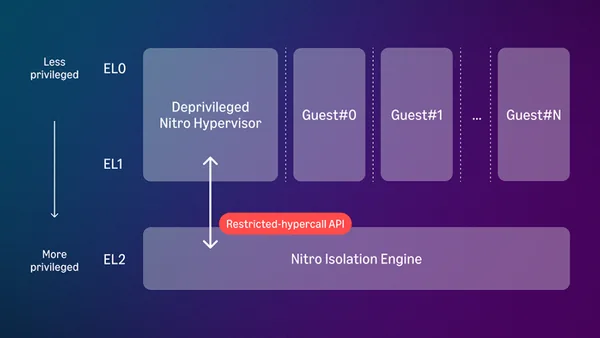
Nitro Hypervisor.png
DevTools / amazon.science

EC2’s formally verified “isolation engine” provides mathematical assurance of virtual-machine isolation

AWS has deployed the first formally verified hypervisor in a commercial cloud, the Nitro Isolation Engine, on Graviton5-powered M9g/M9d instances. The engine is a separation kernel coded in a restricted Rust subset (μRust) and verified with 330,000 lines of Isabelle/HOL proofs, matching seL4's scale. Formal verification covers confidentiality, integrity, functional correctness, memory safety, and runtime-error absence using Separation Logic and weakest-precondition calculus via the open-sourced AutoCorrode library.

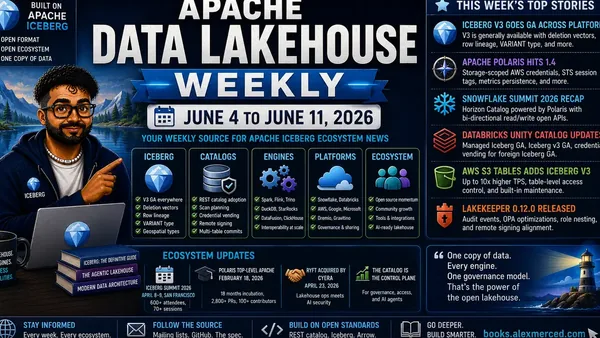
Apache Data Lakehouse Weekly: June 4 to June 11, 2026
General / dev.to

Apache Data Lakehouse Weekly: June 4 to June 11, 2026

The Apache lakehouse community generated 358 emails this week, with Iceberg leading at 135 messages across 34 threads and Parquet producing a 40-message debate on versioning semantics. Iceberg's REST catalog protocol discussions centered on adding an X-Iceberg-Client-Capabilities header and a potential v2 loadTable endpoint, with Lakekeeper's Christian Thiel arguing against strict failure semantics for unsupported restrictions. Arrow formalized rules for AI-generated code reviews, and Polaris debated merge button mechanics and HTTP status codes, signaling that governance maturity is keeping pace with format evolution.

Software is made between commits
General / zed.dev

Software is made between commits

Zed introduces DeltaDB, a version control system built on fine-grained deltas rather than discrete commits, capturing every operation and the conversation that produced it. It enables real-time collaborative editing across humans and agents, with stable references that survive code movement. A beta launches in weeks, aiming to replace pull request ceremony with continuous, cross-referenced dialogue.

General / mrbruh.com

The RCE that AMD wouldn't fix

A researcher discovered a trivial RCE vulnerability in AMD's AutoUpdate software, where executable download URLs use HTTP instead of HTTPS, enabling MITM attacks to replace binaries with malicious executables. AMD's bug bounty program rejected the report as out of scope (MITM attacks not covered), but after public attention on Hacker News, AMD's PSIRT issued a CVE and promised a fix, while requesting an extended embargo beyond the standard 90-day disclosure period.

Show HN: Homebrew 6.0.0
Languages / brew.sh

Show HN: Homebrew 6.0.0

Homebrew 6.0.0 introduces a tap trust security mechanism requiring explicit user authorization for third-party taps, a new default internal JSON API that reduces network calls and speeds up updates, and Linux sandboxing via Bubblewrap for build isolation. The release also defaults to an interactive 'ask' mode for installs, enables parallel formula installation in brew bundle, and delivers a ~30% performance improvement in brew list operations.

You Fixed the Rate Limits. Now Your Agent Fails Quietly.
AI/ML / dev.to

You Fixed the Rate Limits. Now Your Agent Fails Quietly.

A comment thread on a previous post reveals that fixing agent rate limits with retries, fallback models, and caches trades loud 429 failures for quiet correctness holes — the agent stays up but acts on stale, re-run, or differently-modeled outputs. The solution is to separate availability (Gate 1: can I serve this?) from correctness (Gate 2: can I act on this irreversibly?), propagating provenance across the agent chain and gating irreversible actions on risk, not confidence.

Run Untrusted AI Agent Code Safely with Azure Container Apps Sandboxes
AI/ML / infoq.com

Run Untrusted AI Agent Code Safely with Azure Container Apps Sandboxes

Microsoft announced the public preview of Azure Container Apps Sandboxes, a new ARM resource type (Microsoft.App/SandboxGroups) that runs untrusted AI agent code in hardware-isolated microVMs, booting from OCI disk images in under a second and scaling to thousands of instances with zero cost when idle. Each sandbox enforces network egress deny-by-default, supports Entra managed identities for credential-free authentication, and integrates with the Agent Governance Toolkit for pre-execution AST scanning and tool allowlisting. Products like GitHub Copilot Cloud Sandboxes and Foundry Hosted Agents already use this infrastructure, making it a production-ready isolation layer for multi-tenant agentic workloads.

Parallel AI Coding with Git Worktrees: Run Multiple Agents Without Conflicts
AI/ML / dev.to

Parallel AI Coding with Git Worktrees: Run Multiple Agents Without Conflicts

Git worktrees, available since Git 2.5, solve the race condition problem of multiple AI agents sharing a single working directory by providing isolated file systems per agent while sharing a single .git repository. This eliminates file write collisions, branch checkout interruptions, and lock file corruption without the storage overhead of full clones—a 2GB monorepo cloned five times wastes 10GB of redundant objects. Each worktree maintains its own HEAD, index, and working directory state, enabling true parallel execution without semaphores or message queues.