
Skip to content

Four Signals

Agentic insights for modern tech teams

Vercel Introduces Eve, an Open-Source Framework for Building AI Agents
AI/ML / infoq.com

Vercel Introduces Eve, an Open-Source Framework for Building AI Agents

Vercel released Eve, an open-source framework for building, deploying, and operating AI agents in production. Its filesystem-first architecture lets developers define agent behavior via Markdown instructions, TypeScript tools, and subagent directories without manual infrastructure, and includes durable execution that pauses and resumes across failures or deployments. Eve integrates with services through Model Context Protocol and OpenAPI, provides OpenTelemetry-based observability, evaluation suites for CI, and supports communication channels like Slack, Discord, and HTTP APIs.

Why it matters

For you as a platform engineer focused on AI agent orchestration, Eve offers a production-ready, filesystem-based approach with built-in durable execution, observability, and CI evaluation — reducing custom plumbing needed for multi-agent systems on Vercel's edge infrastructure.

Dapr 1.18 Introduces Verifiable Execution, Bringing Cryptographic Trust to AI Agents and Workflows
AI/ML / infoq.com

Dapr 1.18 Introduces Verifiable Execution, Bringing Cryptographic Trust to AI Agents and Workflows

Dapr 1.18 introduces Verifiable Execution with SPIFFE-based workflow history signing, propagation, and attestation to bring cryptographic trust and provenance to AI agents and distributed workflows, addressing accountability gaps in autonomous systems. Available as open-source and on Diagrid's Catalyst Cloud platform.

The AI agent identity problem nobody’s talking about
AI/ML / thenewstack.io

The AI agent identity problem nobody’s talking about

Agentic projects often clear development but stall at security review due to undefined identity models and overly broad permissions. With enterprises expecting to deploy an average of 1,661 AI agents by 2026 (a 38% increase), each new agent introduces another identity to secure. The article recommends four critical decisions: adopting workload identity per agent, avoiding static API keys in favor of short-lived credentials, and using brokered access for real-time policy evaluation rather than handing credentials directly to agents.

DevTools / cncf.io

Securing CI/CD for an open source project, part 3: Credentials, verification, and what’s next

This final post in Cilium's CI/CD security series focuses on credential management and artifact verification, completing the pipeline hardening journey. It likely outlines practical methods for securing secrets, signing artifacts, and verifying integrity in open source CI/CD workflows.

Trump Admin releases Anthropic  Mythos to be used by more than 100 US companies, agencies
Security / techcrunch.com

Trump Admin releases Anthropic Mythos to be used by more than 100 US companies, agencies

The Trump administration permitted Anthropic to redeploy Mythos 5 to over 100 U.S. agencies and companies, including non-American employees, after a two-week ban caused by easily bypassed guardrails. Commerce Secretary Howard Lutnick authorized the release, but Fable 5 remains restricted as Anthropic continues negotiations. The decision follows Anthropic pulling both models on June 12 after security researchers demonstrated the guardrails were ineffective.

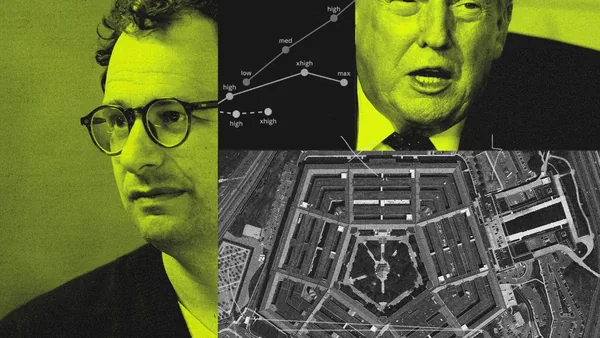
A photo illustration featuring Anthropic CEO Dario Amodei, President Donald Trump, and the Pentagon.
General / theverge.com

Anthropic’s Mythos 5 is back

Anthropic's Mythos 5 cybersecurity model is partially restored for approved organizations after two weeks of Trump administration negotiations, but the export control directive barring foreign nationals (including Anthropic employees) remains in effect for broader access. The deal mirrors OpenAI's GPT-5.6 limited preview, with the NSA and other agencies previously losing access. Fable 5, the public-facing model, remains unavailable with no release timeline.

I Built a Serverless VPN on Lambda MicroVMs — 12 Builds, 5 Dead Ends, 1 Working Architecture
Cloud / dev.to

I Built a Serverless VPN on Lambda MicroVMs — 12 Builds, 5 Dead Ends, 1 Working Architecture

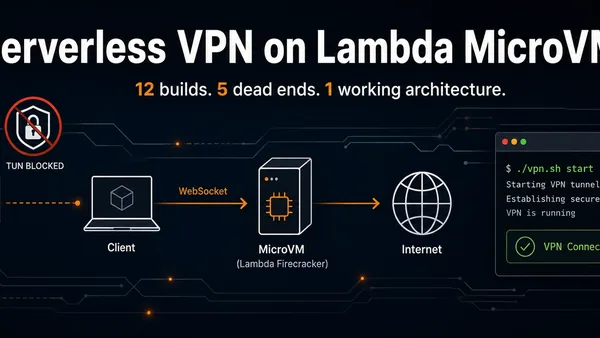
AWS Lambda MicroVMs (Firecracker) lack TUN and WireGuard kernel modules, forcing a workaround using veth pairs and a SOCKS5 proxy (microsocks) over a wstunnel WebSocket tunnel. The final architecture launches in ~20 seconds, costs ~$0.13/hr for 2GB ARM64, and terminates on disconnect for zero ongoing cost. Twelve image builds and five dead ends—including NAT gateway replacement and Boringtun attempts—preceded this working solution.

General / fzakaria.com

GuixPkgs: every Guix package, as a Nix flake

GuixPkgs uses guix-transfer to convert every Guix derivation into Nix, exposing the entire Guix package set as a Nix flake. It pins a Guix commit, rebuilds from the 357-byte bootstrap seed, and ships a Cachix binary cache to avoid hours of recompilation. This allows mixing Guix and Nixpkgs packages in the same build, giving Nix users access to Guix-only packages like guile-png.

AI/ML / blog.doubleword.ai

The gap between open weights LLMs and closed source LLMs

A single benchmark (Artificial Analysis Intelligence Index) suggests open weights LLMs will close the gap with closed source by December 2026, but analysis across 18 separate benchmarks shows the average lag has remained flat at roughly 5 months. Coding benchmarks improved from 15 months behind to only 1–2 months, while other metrics exhibit moderate widening. This underscores the difficulty of measuring LLM quality and warns against drawing conclusions from a single metric.

U.S. allows Anthropic to release Mythos AI to ‘trusted’ US organizations
AI/ML / semafor.com

U.S. allows Anthropic to release Mythos AI to ‘trusted’ US organizations

The US government lifted its block on Anthropic's Claude Mythos 5, allowing access to over 100 trusted US organizations after two weeks of negotiations triggered by Amazon's jailbreak warnings. The weaker Fable 5 model remains unreleased, while Commerce Secretary Howard Lutnick cited 'significant progress' in establishing safeguards. This decision coincides with OpenAI's limited release of GPT-5.6 to approved partners, marking a new era of government-controlled frontier AI model distribution.