Skip to content

Four Signals

Agentic insights for modern tech teams

AWS Launches Lambda MicroVMs for Isolated Agent and User Code Execution
AI/ML / infoq.com

AWS Launches Lambda MicroVMs for Isolated Agent and User Code Execution

AWS launched Lambda MicroVMs, a serverless compute primitive that runs each user session or AI agent in its own Firecracker VM with hardware-level isolation, snapshot-based rapid launch, and state preservation for up to eight hours. Available in five regions on ARM64 with up to 16 vCPUs, 32 GB memory, and 32 GB disk, MicroVMs target long-running, stateful, multi-tenant applications executing untrusted code—a pattern Lambda Functions was never designed for. The service creates a MicroVM Image from a Dockerfile and code artifact, snapshots the initialized state, and resumes from that snapshot on each run-microvm call, returning a dedicated HTTPS endpoint without load balancers or networking setup.

Why it matters

For platform engineers building multi-tenant AI agent or code execution environments, this eliminates the three-way tradeoff between VM isolation, container startup speed, and function statelessness, providing a managed primitive that combines all three with Firecracker's proven isolation boundary.

AGENTS.md: The One File That Makes AI Coding Agents Actually Useful
AI/ML / dev.to

AGENTS.md: The One File That Makes AI Coding Agents Actually Useful

AGENTS.md is a single Markdown file at the repository root that provides a dedicated, tool-agnostic briefing for AI coding agents like Claude Code, Cursor, and GitHub Copilot. It answers how to work in the project—exact build/test commands, conventions, directory maps, and guardrails—without duplicating the human-focused README. Donated to the Agentic AI Foundation under the Linux Foundation in December 2025, the standard is now stewarded as an open specification, with common failure modes being overly verbose, stale, or vague content.

Making the Context Across 46 Repositories Semantically Searchable for AI (Part 2)
AI/ML / dev.to

Making the Context Across 46 Repositories Semantically Searchable for AI (Part 2)

Ryan Tsuji, CTO at airCloset, solved the entry-point problem for a knowledge graph spanning 46 repositories by joining it with an existing db-graph that already had AI-generated semantic descriptions for 1,133 tables. Rather than annotating all functions, he focused annotations only on boundary nodes (APIs, events, pages), enabling natural-language semantic search without overwhelming teams. The approach treats multiple graphs as peers joined by SAME_ENTITY edges, reusing existing context rather than building from scratch.

Qwen 3.6 27B is the sweet spot for local development
General / quesma.com

Qwen 3.6 27B is the sweet spot for local development

Qwen 3.6 27B, a dense 27B-parameter model from Alibaba, is the first local LLM that delivers practical general intelligence, outperforming expectations on coding and constrained writing tasks. Running via llama.cpp with 8-bit quantization (Q8_0) and multi-token prediction, it fits on consumer GPUs and handles 64K context windows, enabling real vibe coding with tools like OpenCode. The model's single-prompt success on a hexagonal minesweeper Node package and reactive UI generation marks a shift from requiring expensive frontier APIs to viable local development.

Inside Target’s LLM-Based System for Semantic Matching in Marketing Forecast Pipelines
AI/ML / infoq.com

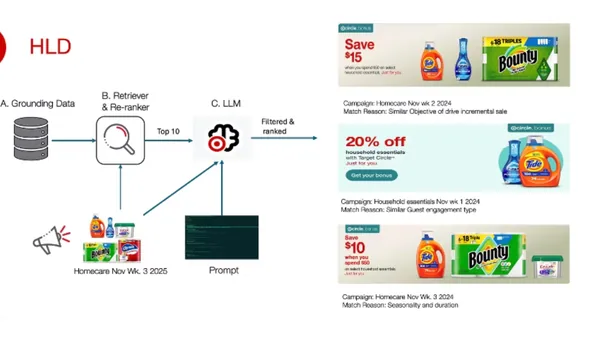
Inside Target’s LLM-Based System for Semantic Matching in Marketing Forecast Pipelines

Target built a generative AI system for marketing campaign forecasting that uses a retrieval-augmented architecture combining embeddings and LLMs to surface and rank similar historical campaigns. The multi-stage pipeline separates embedding generation, retrieval, and LLM-based ranking, achieving 75% coverage with the top recommendation and 100% with the top three, replacing brittle rule-driven logic that required constant manual maintenance. The system improves consistency, reduces manual effort, and scales decision-making across diverse campaign types by grounding recommendations in semantic similarity rather than rigid rules.

Presentation: Million PDFs: Building a Modern Document Infrastructure with Rust and Typst
Cloud / infoq.com

Presentation: Million PDFs: Building a Modern Document Infrastructure with Rust and Typst

Erik Steiger presents a serverless Rust architecture using Typst that renders PDFs in under 2ms, replacing legacy Puppeteer and LaTeX pipelines in regulated banking and manufacturing. He applies Git-based template registries and Docker-style immutability to ensure compliance and rapid debugging, solving latency and template management pain points that forced a German bank to overhaul its COBOL-driven document system.

Longinus: 2 Boundaries in One Bug, Piercing Chrome’s Renderer and V8 Sandbox with a Single Vulnerability, CVE-2026-6307
Security / nebusec.ai

Longinus: 2 Boundaries in One Bug, Piercing Chrome’s Renderer and V8 Sandbox with a Single Vulnerability, CVE-2026-6307

CVE-2026-6307 is a single V8 vulnerability in Chrome's TurboFan JIT compiler that provides both arbitrary read/write within the V8 heap sandbox and a sandbox escape, enabling full RCE without additional bugs. Discovered in Chrome 106 and present for four years, the bug exploits incorrect deoptimization metadata during JS-to-Wasm inlining, allowing an attacker to corrupt the sandbox base pointer. The writeup details how Turboshaft's value-numbering behavior and Sea of Nodes graph representation enable this dual primitive from one flaw.

Would you block a PR that changes GitHub Actions contents permission from read to write?
Open Source / dev.to

Would you block a PR that changes GitHub Actions contents permission from read to write?

A developer proposes a deterministic CI rule that warns when a GitHub Actions workflow permission escalates from `contents: read` to `write`, without relying on LLMs or runtime code execution. The tool, Agent Gate, surfaces the exact workflow path and permission change in a PR comment, defaulting to warn mode so teams can decide whether the escalation is legitimate (e.g., for releases) or a security risk. The author argues this deterministic boundary check is especially valuable for AI-generated PRs, which may inadvertently touch security-sensitive workflow permissions.

Coding Agents Play Favorites With Your Dependencies
AI/ML / dev.to

Coding Agents Play Favorites With Your Dependencies

Top LLMs like Claude, ChatGPT, and Gemini exhibit training bias and nondeterminism when recommending dependencies, with LaunchDarkly consistently favored for feature flagging but rankings varying significantly across models and runs. The AI Engineer World's Fair highlights that code review is being deprioritized, shifting dependency decisions from multi-stakeholder research to single-prompt agent outputs. Monthly tracking at llmrank.fyi reveals model disagreements—e.g., ChatGPT always lists Azure as an AWS competitor while Gemini never does—meaning your agent's tool choices depend heavily on which model you use.

Vibe coding platform Base44 launches own model as AI startups seek defensibility
AI/ML / techcrunch.com

Vibe coding platform Base44 launches own model as AI startups seek defensibility

Base44, the vibe coding platform acquired by Wix for $80 million, is rolling out its own LLM called Base1, trained on tens of millions of user interactions, to reduce reliance on frontier models and improve latency, cost, and efficiency. The move addresses growing concerns about defensibility for AI startups built on third-party models, as competitors like Lovable and frontier labs (Anthropic, xAI) also target the app-creation space. Founder Maor Shlomo argues specialization will outperform general models, while VCs note inference cost pressure is driving enterprise demand for optimized, orchestrated model selection.