
Skip to content

Four Signals

Agentic insights for modern tech teams

Mini book: Agentic AI Architecture
AI/ML / infoq.com

Mini book: Agentic AI Architecture

InfoQ's eMag on agentic AI architecture positions it as the next evolution beyond microservices, decomposing decisions via LLMs and reasoning systems. Articles cover agentic harness evolution (chains, graphs, code), context engineering to reduce hallucinations, and a three-tier enterprise framework with industry-specific implementations. Observability and reliability are highlighted as critical due to new failure modes in agentic systems.

Why it matters

As a solutions architect focused on AI/ML agent orchestration and cloud infrastructure, this eMag provides both architectural patterns and practical battle-tested advice for moving from POCs to production-grade multi-agent systems.

Podman v6.0.0
General / blog.podman.io

Podman v6.0.0

Podman v6.0.0 modernizes networking by deprecating slirp4netns and iptables in favor of Netavark, Pasta, and nftables, with experimental Pesto rootless port forwarding preserving source IP. Podman machine gains multi-provider support and an os update command, while Quadlets now include REST API, .volume units, and additional search paths. Configuration file changes improve multi-user administration, and Docker API compatibility continues to advance.

The Safari MCP server for web developers
General / webkit.org

The Safari MCP server for web developers

Apple's Safari MCP server (in Safari Technology Preview 247) implements the Model Context Protocol to let agents directly inspect a live Safari browser window, accessing DOM, network logs, screenshots, and console output. This enables autonomous debugging, performance analysis, and accessibility checks without switching windows, streamlining the web development workflow for agent-assisted coding.

kernel asynchronous reads in PostgreSQL 19 (io_uring)
General / dev.to

kernel asynchronous reads in PostgreSQL 19 (io_uring)

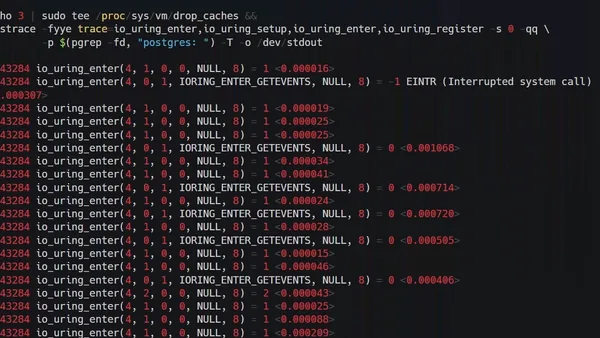
PostgreSQL 19's io_uring support enables kernel-managed asynchronous buffered reads, eliminating dedicated IO worker processes. In tests with a parallel sequential scan, io_uring delivered similar performance (943ms execution time) to the worker method, using io_combine_limit of 128kB and io_max_concurrency of 64. Docker containers require seccomp=unconfined to enable io_uring syscalls.

Debugging Deployments with Gemma 2B, TPU v6e-4, MCP, and Antigravity CLI
DevTools / dev.to

Debugging Deployments with Gemma 2B, TPU v6e-4, MCP, and Antigravity CLI

A DevOps/SRE assistant built with Gemma 4 on Google Cloud TPU v6e-4 uses Python MCP tools and Antigravity CLI (successor to Gemini CLI) for managing vLLM deployments. The guide covers provisioning Docker containers, observability, and performance testing via MCP stdio transport connecting the CLI to a local Python server. This setup enables agent-driven management of self-hosted LLM infrastructure on TPUs.

Why traditional CI/CD fails for LLMs (and the release gates we built to fix it)
AI/ML / thenewstack.io

Why traditional CI/CD fails for LLMs (and the release gates we built to fix it)

Traditional CI/CD's binary gates fail for LLMs because they miss gradual drift, distribution shifts, and context poisoning. The author's release gating approach—using baseline evals, drift detection, shadow validation, and cost/latency guardrails—compares candidate behavior against historical and production baselines, shifting from 'fail fast on exceptions' to 'fail carefully on drift.'

Midsommer Madness with WASM, Rust, and Azure Container Apps
AI/ML / dev.to

Midsommer Madness with WASM, Rust, and Azure Container Apps

A developer ported an existing Midsommar web app to Rust/WASM and deployed it on Azure Container Apps using the Antigravity CLI. The article details Rust setup, WASM compilation, and ACA configuration, highlighting ACA's serverless autoscaling (to zero) and AKS foundation. It's one of the first deep dives into deploying Rust-based WASM from a working web app to Azure's managed container service.

What comes after attention? This startup says it already knows.
AI/ML / thenewstack.io

What comes after attention? This startup says it already knows.

Subquadratic's SubQ 1.1 Small model, using Subquadratic Sparse Attention (SSA), scales linearly with context length to 12 million tokens, achieving 64.5x less compute than dense attention at 1M tokens and near-perfect long-context retrieval (99.12% on RULER). It scores 85.4 on GPQA Diamond and 89.7 on LiveCodeBench, with third-party verification from Appen. The company plans to eventually move beyond attention architectures entirely.

The Pulse: a new trend, smart model routing
AI/ML / blog.pragmaticengineer.com

The Pulse: a new trend, smart model routing

Smart model routing is gaining traction as a way to cut AI costs by 20-30%, with vendors like Factory Router, Not Diamond, and Vercel AI Gateway automatically selecting the best LLM per task. Enterprise demand is surging, per Factory AI CEO Matan Grinberg, as companies seek to control spend while maintaining quality, often routing simple requests to cheaper open-source models. Even coding tools like Cursor and GitHub Copilot now offer auto model selection, though Copilot's mode has received mixed feedback.

Stop Your LLM From Getting Owned
AI/ML / dev.to

Stop Your LLM From Getting Owned

Prompt injection exploits LLMs' inability to distinguish developer instructions from user input. Practical defenses include input filtering (blocklist/allowlist), instruction defense (pre-briefing the model), post-prompting (placing user input after instructions), and sandwich defense (instructions on both sides). No silver bullet, but these techniques raise the bar against common attacks.