Skip to content

Four Signals

Agentic insights for modern tech teams

AI Governance for Engineering Teams: Guardrails, Budgets, and Audit Logs That Actually Scale
AI/ML / dev.to

AI Governance for Engineering Teams: Guardrails, Budgets, and Audit Logs That Actually Scale

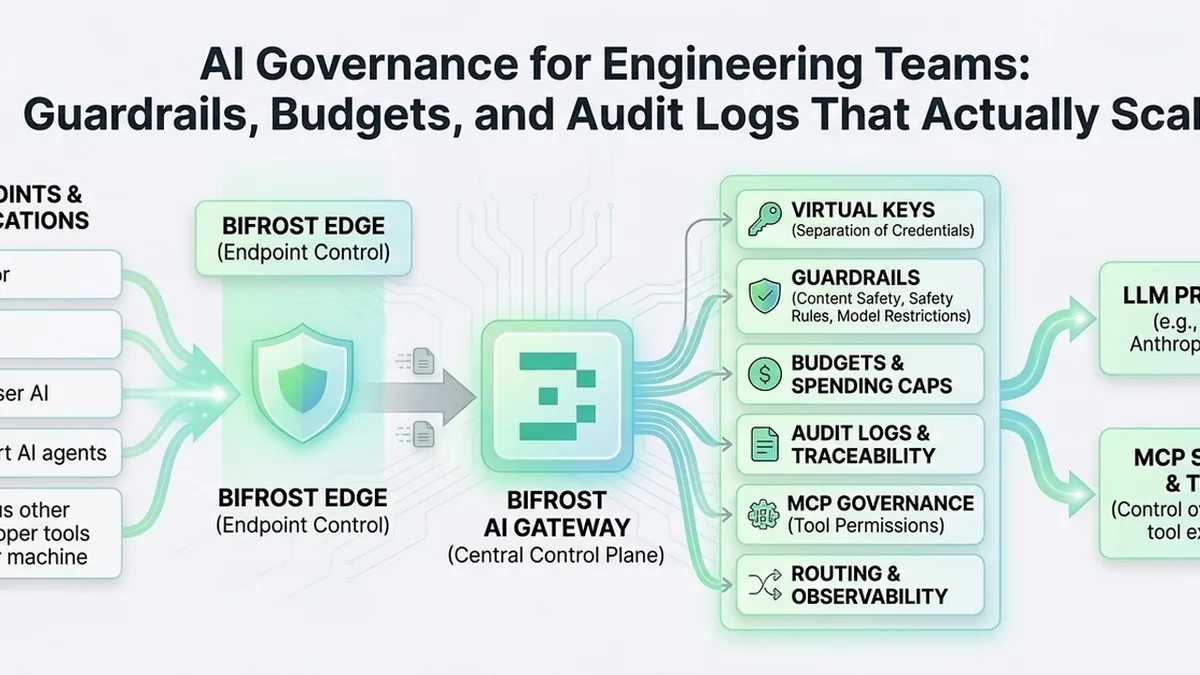
AI governance failures stem from unmanaged sprawl, not bad models. Bifrost AI Gateway introduces a centralized control plane that enforces guardrails, budgets, and audit logs across all LLM providers, MCP servers, and internal APIs. This architecture replaces fragmented per-application policies with a single layer for routing, permissions, and cost tracking, enabling teams to scale AI adoption without losing security or compliance.

Why it matters

As you orchestrate multi-agent systems and integrate LLMs into production pipelines, a centralized gateway like Bifrost prevents the operational debt of ungoverned AI access, giving you consistent policy enforcement and observability across models and tools.

Observability Design for the AI Era — Application / Infrastructure / CI / LLM, Each in Its Own Shape (Part 1)
AI/ML / dev.to

Observability Design for the AI Era — Application / Infrastructure / CI / LLM, Each in Its Own Shape (Part 1)

airCloset CTO Ryan Tsuji splits observability into four shaped surfaces—application (OTel + Loki + Tempo), infrastructure (metrics), CI (logs + alerts), and LLM (metrics + structured records)—to make telemetry AI-consumable, avoiding the context-window drowning and hallucination that raw logs cause. Each surface is optimized for specific AI queries: real-time production exploration, resource health, breakage history, and cost/usage tracking. The key discipline is uniform log/trace shapes across all services, enabling AI tools like MCP to cross-service query with patterns like `{service_name="<service>"} |~ "error"`.
Reporting a 19+ Years Hidden Linux Kernel Zero-Day for Google kernelCTF: CVE-2026-43456
Security / gmo-cybersecurity.com

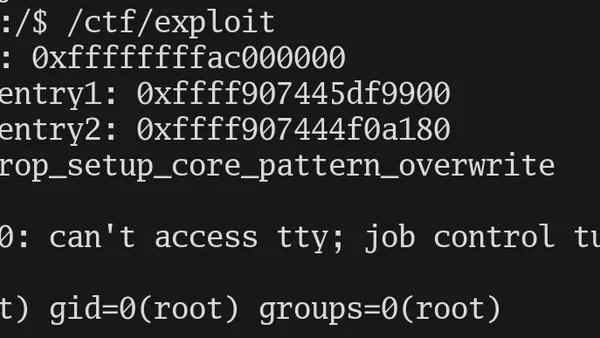
Reporting a 19+ Years Hidden Linux Kernel Zero-Day for Google kernelCTF: CVE-2026-43456

A type confusion vulnerability in the Linux kernel's net/bonding subsystem, introduced in 2007 and fixed in March 2026, remained exploitable for over 19 years. Assigned CVE-2026-43456, it allows unprivileged users with CAP_NET_ADMIN to achieve reliable privilege escalation within one second at over 99% success rate. The discoverers earned over $80,000 from Google's kernelCTF bug bounty for reporting the flaw, which affects kernels from 2.6.24 through 6.12.77.

My React Search Box Froze on Every Keystroke. I Fixed It by Stealing Python's #1 Scope Rule.
Languages / dev.to

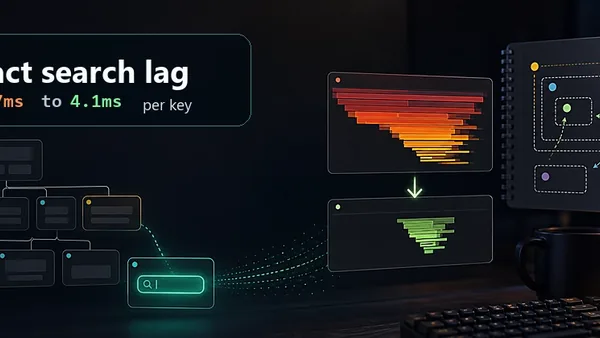
My React Search Box Froze on Every Keystroke. I Fixed It by Stealing Python's #1 Scope Rule.

A React dashboard's search box suffered 300ms input lag because the `searchQuery` state lived in the top-level `Dashboard` component, causing every keystroke to re-render all 150 children including unrelated headers, sidebars, and footers. The fix was moving state down into a `SearchableDataGrid` wrapper that only contains the search bar and data table, reducing render cost from 142.7ms per keystroke to well under 16ms. The author draws a parallel to Python's scoping rule: don't put state in a wider scope than necessary, just as you wouldn't use a global variable for a local concern.

Eliminating Go bound checks with unsafe
General / blog.andr2i.com

Eliminating Go bound checks with unsafe

Go developers can use unsafe pointer arithmetic to eliminate bound checks the compiler cannot remove on hot paths, reducing instructions, branches, and cache pressure. The post demonstrates how conventional bound check elimination (BCE) works via range proofs like `i <= len(a)-8`, then shows unsafe techniques for cases where the compiler cannot prove safety. A real-world `matchLen` function example illustrates BCE-driven refactoring that removes redundant bounds checking in tight loops.

Rebuilding my C Redis clone in Rust taught me more Rust than any tutorial
Languages / dev.to

Rebuilding my C Redis clone in Rust taught me more Rust than any tutorial

Rebuilding a C Redis clone in Rust teaches the language more effectively than tutorials because the design is already solved, shifting focus entirely from what to build to how Rust wants it built. Key differences emerge immediately: Rust's standard library eliminates the need to hand-roll data structures like dynamic strings and hashmaps, and its enum-based dispatch with exhaustive matching prevents the runtime bugs that C's switch statements silently allow. The author argues that reimplementing a known project in a new language isolates the language as the only variable, making every difference a pure signal about Rust's semantics.

I needed cross-platform screen capture in Rust, so I built pinray
Languages / dev.to

I needed cross-platform screen capture in Rust, so I built pinray

Pinray is a new Rust crate providing a unified API for cross-platform screen and system audio capture, directly wrapping native OS APIs (DXGI, ScreenCaptureKit, PipeWire, XDG Desktop Portal) without depending on ffmpeg or large frameworks. It delivers raw video and audio frames with rich metadata—timestamps, pixel format, stride, sequence numbers, and dropped-frame notifications—addressing gaps in existing crates like xcap (missing stride/pixel format) and scap (unmaintained, PipeWire 0.8.0 dependency issues). The crate supports Linux (Wayland/X11), macOS 12.3+, and Windows 10+, with a builder pattern for capture sessions and backend auto-detection.

AWS Expands DevOps Agent with AI-Powered Release Management to Validate Code Before Production
AI/ML / infoq.com

AWS Expands DevOps Agent with AI-Powered Release Management to Validate Code Before Production

AWS expanded its DevOps Agent with preview release management features—Release Readiness Review and Autonomous Release Testing—that validate code changes before production. The agent builds a knowledge graph of cross-repository dependencies, enforces natural-language-defined engineering standards, and generates change-specific test plans executed in production-like environments. Findings surface in GitHub, GitLab, or IDE integrations like Kiro and Claude Code, targeting the bottleneck where AI-generated code outpaces human review and validation.

The ‘first’ AI-run ransomware attack still needed a human
AI/ML / techcrunch.com

The ‘first’ AI-run ransomware attack still needed a human

Sysdig documented the first known 'agentic ransomware' attack, JadePuffer, where an AI agent autonomously executed a breach, lateral movement, file encryption, and ransom note generation. However, a human still provisioned the infrastructure, chose the victim, and supplied pre-obtained database credentials, contradicting claims of zero human oversight. The agent exploited a known Langflow vulnerability to access a MySQL server, encrypted 1,300 records, and self-corrected a failed login in 31 seconds, but the specific model driving it remains unidentified.

Presentation: Designing AI Platforms for Reliability: Tools for Certainty, Agents for Discovery
AI/ML / infoq.com

Presentation: Designing AI Platforms for Reliability: Tools for Certainty, Agents for Discovery

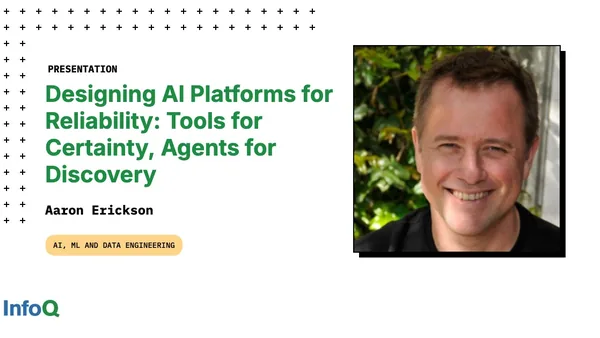
NVIDIA's Aaron Erickson advocates for a hybrid AI platform architecture that pairs deterministic tools (for reliability) with agentic discovery (for exploration), using techniques like LLM-as-a-judge test pyramids to validate agent behavior. He warns against the 'paradox of choice' in agent design and shares lessons from building a ChatGPT plugin for org chart restructuring, which evolved into an event-based multi-agent system. The talk emphasizes that production-grade AI systems require purpose-built agent hierarchies and rare-context handling, not just throwing tokens at problems.