Skip to content

Four Signals

Agentic insights for modern tech teams

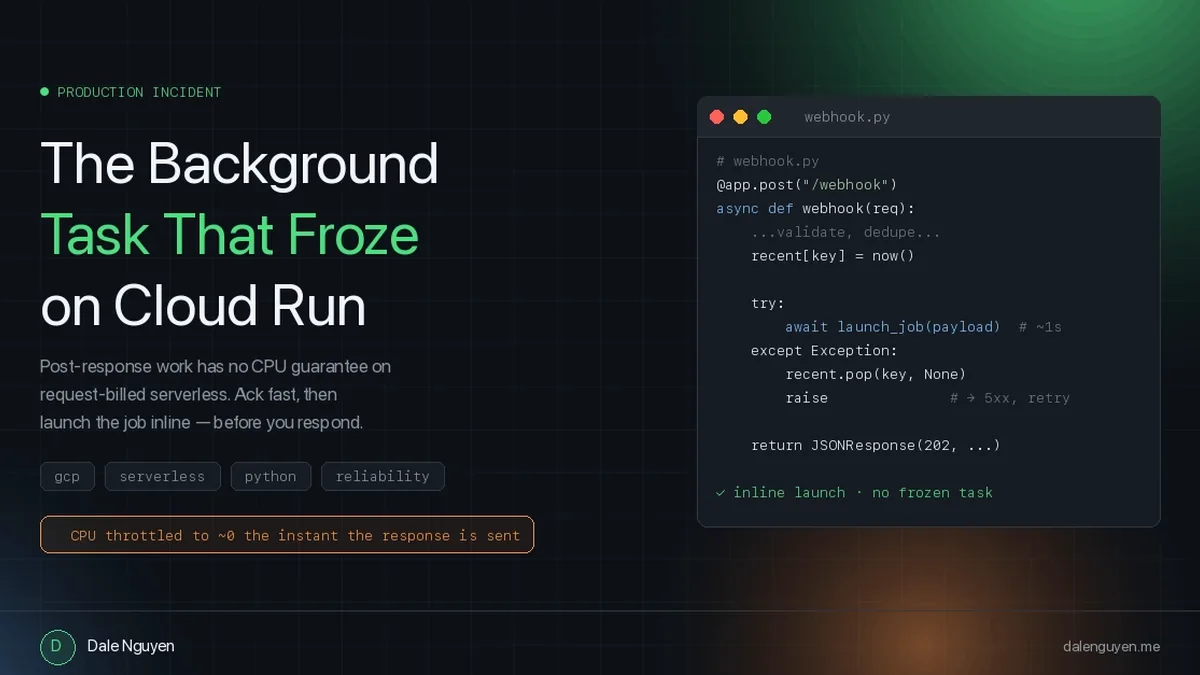
The Background Task That Froze: A Serverless CPU-Throttling Mystery
Cloud / dev.to

The Background Task That Froze: A Serverless CPU-Throttling Mystery

On Cloud Run with default request-based CPU mode, post-response background tasks (e.g., FastAPI's `BackgroundTasks` or `asyncio.create_task`) freeze after the HTTP response is sent because the platform throttles CPU to near zero between requests. The frozen task only resumes when another request arrives, causing unpredictable delays or silent data loss if the instance scales to zero. This behavior is invisible in logs because no error is thrown — the event loop simply isn't scheduled.

Why it matters

For engineers building serverless agents, webhook handlers, or event-driven services on Cloud Run, this subtle CPU-throttling trap can cause non-deterministic latency and dropped work that's hard to debug, especially in low-traffic or bursty environments.

What running Kubernetes across millions of clusters taught AWS about zonal failures
Cloud / thenewstack.io

What running Kubernetes across millions of clusters taught AWS about zonal failures

Running Kubernetes across millions of clusters taught AWS that 'gray' zonal failures — where a zone is impaired but not fully down — are more dangerous than complete outages because default automated scaling converts them into regional outages. Amazon EKS applied the principle of static stability to prevent cascading terminations triggered by health checks and Auto Scaling groups, and built an automated weight-shift mechanism that moves control plane activity out of an impaired zone within two minutes.

Why retrieval quality is becoming the defining challenge in AI agent architecture
AI/ML / thenewstack.io

Why retrieval quality is becoming the defining challenge in AI agent architecture

Retrieval failures—not LLM weaknesses—cause most agent errors, as context-building steps like search, grep, or API calls determine answer quality. Examples include Specstory's chatbot missing trade-off discussions and AnkiHub's study assistant flooding prompts with irrelevant cards. The fix requires per-step traces (input, output, relevance labels) and evals, as shown in Mixedbread's OfficeQA-Pro benchmark where better search tools reduced tool calls and improved answers.

Slack Introduces Agent Driven End-to-End Testing to Improve Resilience in UI Test Automation
AI/ML / infoq.com

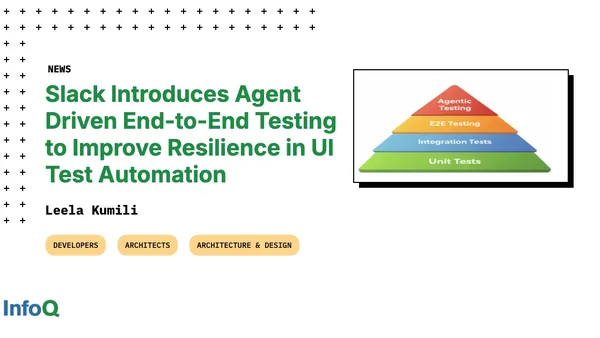
Slack Introduces Agent Driven End-to-End Testing to Improve Resilience in UI Test Automation

Slack engineers have introduced agentic testing, where AI agents execute end-to-end tests from high-level objectives rather than fixed step sequences, dynamically adapting to UI or structural changes to reduce brittleness. The approach includes constraints, execution traces, and focuses on targeted debugging or exploratory testing rather than frequent CI runs due to cost, while deterministic tests remain the primary mechanism for regression validation.

Your AGENTS.md Is Already Stale — And Your Agent Trusts It Completely
AI/ML / dev.to

Your AGENTS.md Is Already Stale — And Your Agent Trusts It Completely

Stale AGENTS.md files are more dangerous than stale READMEs because coding agents obey them with full confidence, executing wrong build commands or skipping guardrails. The fix is to write every line as a verifiable fact—a real command, file, or constraint—and update the file in the same PR as code changes. Auto-generated instruction files actually reduce task success by padding with plausible-but-wrong requirements that agents over-obey.

I Built a Neural Gate for My AI Agent — Layer 2 of Self-Verification
AI/ML / dev.to

I Built a Neural Gate for My AI Agent — Layer 2 of Self-Verification

Yuhao Lin built GateGuard, a three-layer verification stack for AI agents that replaces file-system checks with neural gates measuring constraint penetration, not just arrival. Layer 1 mechanical gates validated across 150 tasks cut violation rates from 55.9% to 0.7%, while Layer 2 neural gate v2 uses DeepSeek's logprobs=True to compute token probability deltas (>0.3 units) indicating active influence. Roadmapped v3 trains linear probes on Qwen2.5-1.5B residual streams to detect early decay, addressing that 7 audited frameworks lack neural-layer fidelity checking and 34 growth-logs showed 55.9% violations pre-GateGuard.

Make AI Agents See Your Website
AI/ML / dev.to

Make AI Agents See Your Website

AI coding agents like Codex, Cursor, and Claude struggle with human-written docs, often guessing and producing broken code. The llms.txt standard, proposed by Answer.AI's Jeremy Howard, provides a public, text-first Markdown index at a canonical URL to guide agents to installation guides, API references, examples, and migration notes. Major platforms including OpenAI, Anthropic, Cloudflare, Stripe, and Vercel have adopted it, and tools like Mintlify auto-generate it, reducing agent hallucinations and keeping AI-generated code correct.

An image of Tim Cook
AI/ML / theverge.com

Apple sues OpenAI for allegedly stealing hardware secrets

Apple sued OpenAI alleging a systematic theft of trade secrets by former Apple employees now at OpenAI, including hardware chief Tang Tan and engineer Chang Liu. The lawsuit claims Liu accessed confidential hardware files after leaving, coached a colleague to evade security, and that OpenAI directed staff to bring proprietary artifacts to interviews. Apple further accuses OpenAI of poaching over 400 ex-Apple staff and exploiting its supply chain partners to replicate decades of hardware innovation.

Apple sues OpenAI over alleged trade secret theft
AI/ML / techcrunch.com

Apple sues OpenAI over alleged trade secret theft

Apple sued OpenAI over trade secret theft, alleging former employees like Chief Hardware Officer Tang Tan and engineer Chang Liu stole confidential hardware designs and recruitment tactics. The complaint claims OpenAI's leadership directed the theft to build a competing AI-agent smartphone, aided by its $6.5B acquisition of Jony Ive's io. Apple seeks an injunction barring use of the stolen trade secrets.

AI/ML / wired.com

AI Found a Root Bug in Linux That Everyone Missed for 15 Years

Nebula Security's AI-driven tool VEGA discovered GhostLock (CVE-2026-43499), a use-after-free bug in the Linux kernel since 2011 that lets any logged-in user escalate to root, escape containers, and was 97% reliable in testing. The flaw, earning a $92,337 bounty, shipped in all major distributions; while patched in April, Ubuntu 24.04, 22.04, and 20.04 LTS remained vulnerable as of early July, requiring defenders to verify fixes.