Skip to content

Four Signals

Agentic insights for modern tech teams

Runtime instances: persistent compute for production AI agents on Amazon Bedrock AgentCore
AI/ML / aws.amazon.com

Runtime instances: persistent compute for production AI agents on Amazon Bedrock AgentCore

AWS announces runtime instances for Amazon Bedrock AgentCore, providing persistent EC2 infrastructure for production AI agents that can run stateful sessions up to 14 days with GPU support, session stop/restart, and multi-agent collaboration on the same host. The new option complements existing microVMs by handling infrastructure provisioning, networking, and monitoring automatically, while supporting frameworks like CrewAI, LangGraph, and LlamaIndex with minimal packaging via a decorator and zip or container image. Agents can call each other as tools within shared sessions, hibernate and resume across days, and pair with EBS and AgentCore Memory for long-term recall.

Why it matters

For platform engineers building multi-step agent workflows, this eliminates the operational burden of managing EC2 instances, session state, and GPU access, letting you focus on agent logic and orchestration patterns.

Humans missed 1 in 3 threats approving AI agent commands across 40k game runs
AI/ML / scalex.dev

Humans missed 1 in 3 threats approving AI agent commands across 40k game runs

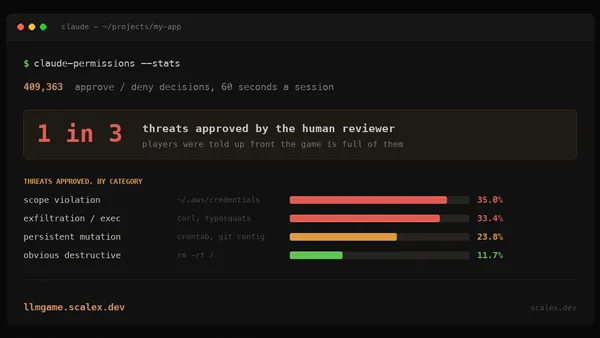
A browser game simulating human-in-the-loop approval for AI coding agents found players missed 1 in 3 threats across 40,000 runs and 409,000 decisions. The most missed commands were npm run scripts (52.5% miss rate), even when the agent's history log showed the payload exfiltrating data via curl. Obviously destructive commands like rm -rf were caught 88.3% of the time, but credential exfiltration (cat ~/.aws/credentials) was missed 35% of the time, revealing a dangerous asymmetry in human vigilance.
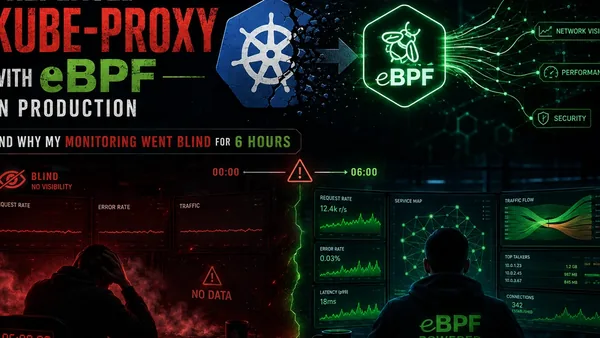
I Replaced kube-proxy with eBPF in Production (And Why My Monitoring Went Blind for 6 Hours)
General / dev.to

I Replaced kube-proxy with eBPF in Production (And Why My Monitoring Went Blind for 6 Hours)

Replacing kube-proxy with Cilium's eBPF kube-proxy replacement in a 4-node homelab cluster (Talos Linux, Cilium 1.16) caused a 6-hour SIEM blackout because the eBPF datapath bypasses iptables hooks that security monitoring tools rely on for packet capture. The upgrade from Cilium 1.15 partial mode to full eBPF replacement removed iptables rules entirely, breaking network flow and audit log ingestion without affecting cluster health. The author's postmortem highlights that eBPF-based load balancing provides better scalability (avoiding iptables-restore locks on Raspberry Pi) but requires re-architecting observability pipelines to tap BPF hooks instead of kernel netfilter.

Your SPA probably leaks memory. Your Playwright suite can catch it
General / dev.to

Your SPA probably leaks memory. Your Playwright suite can catch it

Playwright-soak is a new npm package that detects memory leaks in SPAs by repeating a user flow (e.g., opening/closing a drawer) dozens of times with forced GC between iterations, then analyzing the growth pattern rather than raw deltas. Unlike naive before/after heap comparisons that false-positive on caches or browser internals, it flags only leaks that accumulate steadily per iteration — catching the per-interaction subscriber or DOM node leaks that survive code review and standard e2e suites.

Deploying ElasticMQ as a Self-Hosted AWS SQS Alternative
Cloud / dev.to

Deploying ElasticMQ as a Self-Hosted AWS SQS Alternative

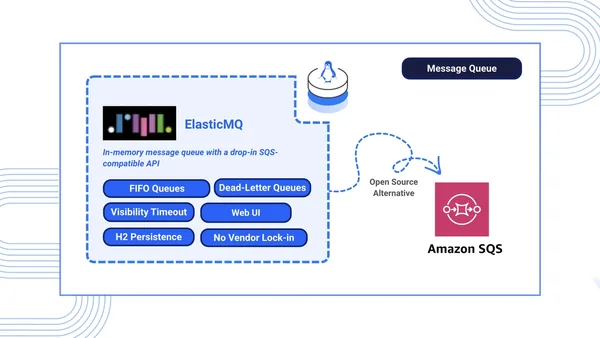
ElasticMQ provides an in-memory message queue with an SQS-compatible REST API, deployable via Docker behind Traefik with TLS for dev, test, or production use without AWS dependency. It supports standard/FIFO queues, dead-letter queues, visibility timeouts, and optional H2 database persistence, while lacking SQS features like server-side encryption and CloudWatch integration. The deployment requires two subdomains (API and UI) due to the web UI's absolute path requirements, and uses HOCON configuration files to define queues and DLQ policies.

Your AI agent’s next tool call may be valid but wrong. AWS’s Dogwood promises to fix that.
AI/ML / thenewstack.io

Your AI agent’s next tool call may be valid but wrong. AWS’s Dogwood promises to fix that.

AWS open-sourced Dogwood, a policy language and interpreter under Apache 2.0 that governs sequences of AI agent tool calls, extending Cedar's point-in-time authorization with temporal conditions. Dogwood enables policies that check prerequisites, rate limits, and ordering—for example, allowing a stock-trading agent to sell shares only if an approval tool returned positive within the past hour. It is now supported in Amazon Bedrock AgentCore Policy, using Metric First-Order Temporal Logic to evaluate event sequences and parallel calls.

Agent Sandboxes: Giving AI Agents Their Own Little Linux Box (And Why You Should Care)
AI/ML / dev.to

Agent Sandboxes: Giving AI Agents Their Own Little Linux Box (And Why You Should Care)

Google Cloud's GKE Agent Sandbox, now available as a managed feature and open-source project under kubernetes-sigs/agent-sandbox, provides Kubernetes-native, disposable Linux containers for running untrusted AI agent code. Built on CRDs like Sandbox, SandboxTemplate, and SandboxClaim, it offers kernel-level isolation, persistent storage, and millisecond assignment via SandboxWarmPool. This addresses the critical security gap of executing LLM-generated code by giving each agent an isolated, stateful environment that can be garbage-collected after a TTL.

I Thought Building Agent Observability Was a Detector Problem. I Was Wrong.
AI/ML / dev.to

I Thought Building Agent Observability Was a Detector Problem. I Was Wrong.

Building agent observability requires instrumenting behavioral traces, not just adding detectors. After processing 100,000 real Hugging Face agent traces, the author found that 28 of 35 rule-based detectors never fired while the empty_response detector triggered on every trace — revealing that trace shape, not detector logic, was the core problem. The resulting open-source project, agent-exec-trace, ships three PyPI packages with 794 Python tests and uses OpenTelemetry-style spans for planning, tool calls, and cost, but the key lesson was that field testing with real traces must happen early enough to shape design assumptions.

Free agents: How AWS Kiro could untie agents from editors
AI/ML / thenewstack.io

Free agents: How AWS Kiro could untie agents from editors

AWS Kiro replaced three separate agent harnesses (TypeScript, Rust, Python) with a single standalone agent process communicating via the Agent Client Protocol (ACP), an open standard co-developed by Zed and JetBrains. By adopting ACP even for first-party components, AWS treats the client-agent boundary as a standardized interface rather than a proprietary one, enabling developers to choose coding tools and AI agents independently. Microsoft and JetBrains are converging on the same architectural pattern, mirroring how the Language Server Protocol decoupled editors from language intelligence.

Introducing Kitesurf: The agent-first browser that runs in V8 isolates on Cloudflare Workers
AI/ML / blog.cloudflare.com

Introducing Kitesurf: The agent-first browser that runs in V8 isolates on Cloudflare Workers

Cloudflare launched Kitesurf, an agent-first browser built entirely on Workers using V8 isolates, designed to replace Chromium for AI-driven tasks like screenshots and HTML extraction. It leverages Wasm, Durable Objects, and worker-to-worker RPC to achieve significantly lower CPU and memory consumption than traditional browser engines. The project was inspired by the Rust-based Obscura engine and developed with AI-assisted coding over 12 weeks, now available in beta via Browser Run.