Skip to content

Four Signals

Agentic insights for modern tech teams

Mojo 1.0
General / modular.com

Mojo 1.0

Modular released Mojo 1.0, marking the language's transition from rapid development to a stable, production-ready foundation for ecosystem growth. The release completes language simplification—unifying variable declarations with `var`, consolidating closures, and standardizing the Pointer type—while adding Python-style lambda syntax and improved memory safety diagnostics via reference invalidation detection. With over 200 contributors landing 1,100+ pull requests on the open-sourced standard library, Mojo 1.0 now powers Modular's commercial infrastructure (MAX and Modular Cloud) and promises additive changes during the 1.x lifecycle.

Why it matters

For platform and AI engineers evaluating next-gen systems languages, Mojo 1.0 offers a stable, Python-compatible alternative for high-performance GPU/accelerator code without sacrificing developer experience, directly relevant to building performant AI inference pipelines and infrastructure tooling.

TDD inside the agent loop - theater or actual value?
AI/ML / martinfowler.com

TDD inside the agent loop - theater or actual value?

Birgitta Böckeler's exploratory evaluation of TDD within AI agent loops found no clear quality improvement over non-TDD workflows, with Opus 4.8 often ranking non-TDD solutions slightly higher in design and test quality. Using Sonnet 4.6 for generation and Opus for blind judgment across three greenfield business logic tasks, mutation scores showed no meaningful difference between approaches. The study cautions that human-centric TDD practices may not translate to agentic coding, though sample size and greenfield scope limit generalizability.

Pi Agent vs Claude Code After 100 Hours of Real Use 🔥
AI/ML / dev.to

Pi Agent vs Claude Code After 100 Hours of Real Use 🔥

Pi, an open-source terminal coding agent built by libGDX creator Mario Zechner as a reaction to Claude Code's complexity, uses only four tools (read, write, edit, bash) and a minimal system prompt, yet outperformed Claude Code on a tool-use benchmark (20/30 vs 16/30 tasks passed) at one-seventh the cost ($0.028 vs $0.195 per success). Despite Pi winning on flexibility, cost, and transparency—supporting 300+ models and TypeScript extensions—Claude Code remains the daily driver for most due to its polished guardrails, predictable $20/month pricing, and multi-agent features. The practical recommendation is to use Claude Code for everyday work and Pi for custom, cost-sensitive, or local-model workflows.

Nvidia Nemotron 3.5 Lightning and NeMo Switchyard
General / blogs.nvidia.com

Nvidia Nemotron 3.5 Lightning and NeMo Switchyard

Nvidia released Nemotron 3.5 Lightning, a 30-billion-parameter mixture-of-experts open model optimized for high-volume agentic AI workloads, delivering up to 4x faster output and 30% faster task completion versus peers. Alongside it, Nvidia open-sourced NeMo Switchyard, a routing library that directs requests across a mix of open, proprietary, and Nvidia models without application rewrites. Early adopters include CrowdStrike for cybersecurity, Harvey for legal, and CodeRabbit for code review, with the model deployable across RTX PCs, DGX systems, and cloud.

General / eme64.github.io

Performance impact of Alignment

Memory alignment critically impacts SIMD vectorization performance, especially when accesses cross cacheline boundaries, forcing the CPU to split loads/stores into two operations. While most modern CPUs handle unaligned access with minimal penalty, crossing a cacheline boundary creates additional memory unit traffic that can bottleneck compute-bound workloads. The author details how Java object alignment (8-byte) differs from vector alignment requirements (e.g., 64-byte for 16 ints), and notes that strict-alignment architectures require compiler-proven alignment for correctness, complicating auto-vectorization.

I Showed My CISO Kiro Crew: Here's the Security Model That Got It Approved
AI/ML / dev.to

I Showed My CISO Kiro Crew: Here's the Security Model That Got It Approved

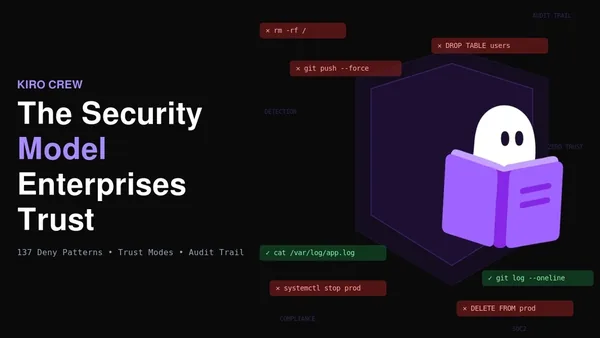
Kiro Crew, an AI agent for incident response, uses an 8-layer security model that allows autonomous read-only investigation (checking logs, configs, git history) while blocking destructive actions like service restarts or direct pushes to main. In a simulated P1 on a payment platform (FinPay), the agent identified a database connection pool reduction from 50 to 5 in 23 seconds, then proposed safer alternatives when blocked. The fix was applied via an approved branch push with three human clicks, demonstrating a pattern of autonomous investigation, confident proposals, and gated execution.

Databricks acquires Electric to give every AI agent its own Postgres database
AI/ML / thenewstack.io

Databricks acquires Electric to give every AI agent its own Postgres database

Databricks on Tuesday announced that it’s acquiring Electric, the startup behind the WASM-based Postgres project PGlite and the Electric sync engine, as The post Databricks acquires Electric to give every AI agent its own Postgres database appeared first on The New Stack .

MCP Goes Stateless, and Developers Ask Whether That Just Makes It an API Again
AI/ML / infoq.com

MCP Goes Stateless, and Developers Ask Whether That Just Makes It an API Again

The MCP 2026-07-28 specification removes protocol sessions, replacing them with stateless requests that carry version, client identity, and capabilities per call. Two new required HTTP headers—Mcp-Method and Mcp-Name—expose tool-level metadata to gateways, rate limiters, and WAFs without parsing the JSON-RPC body, enabling per-method or per-tool routing and throttling. Server-initiated requests shift to Multi Round-Trip Requests, and authorization tightens with RFC 9207 issuer identification and canonical server URIs, while Dynamic Client Registration is deprecated.

The Mechanical vs. The Semantic: What Happens When AI Memory is Wrong?
AI/ML / dev.to

The Mechanical vs. The Semantic: What Happens When AI Memory is Wrong?

A controlled experiment on a 50K LOC Python codebase tested how AI agents handle poisoned memory, revealing that a 'Lazy Agent' reading memory first adopted 100% of false facts, while even an 'Honest Agent' that checks code first still adopted 12% of false facts when the code was silent on the matter (e.g., claiming use of Celery when no task queue exists). The memory system was purely add-only, with no delete or refute capability, meaning once a false fact was stored it persisted across sessions. A follow-up 'Verify-On-Read' mechanism closed the final 12% contamination gap by cross-referencing memory claims against code before accepting them.

Nobody Alerts on Silence: Wiring Sentry Into an LLM Pipeline
AI/ML / dev.to

Nobody Alerts on Silence: Wiring Sentry Into an LLM Pipeline

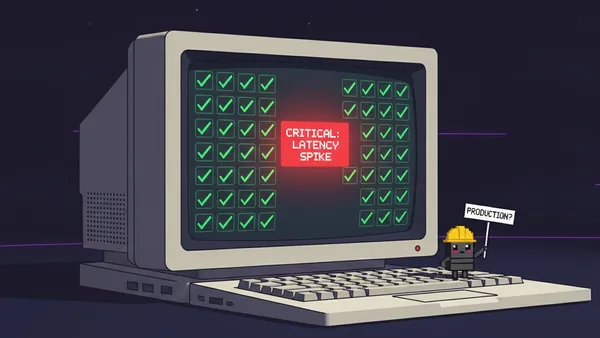
An open-source .NET LLM pipeline (TextStack) had zero production observability because its OTLP exporter pointed at a profile-gated dashboard that never runs in production, meaning every span was fired into a closed socket. The fix wires Sentry into the API and background worker, adding route-reason spans (why a provider was chosen), throttled alerts for expensive tasks landing on the default provider, a startup readiness probe with circuit breaker for dead providers, and an environment-tag fix to prevent laptop traffic from masquerading as production. The integration immediately caught two latent bugs: EF Core SQL leaking into breadcrumb messages past a green-tested scrubber, and a race condition on reading-progress upserts causing duplicate key violations that lost users' place in books.