Skip to content

Four Signals

Agentic insights for modern tech teams

Extensible Software in the age of LLMs | Jeremy Morrell
AI/ML / jeremymorrell.dev

Extensible Software in the age of LLMs

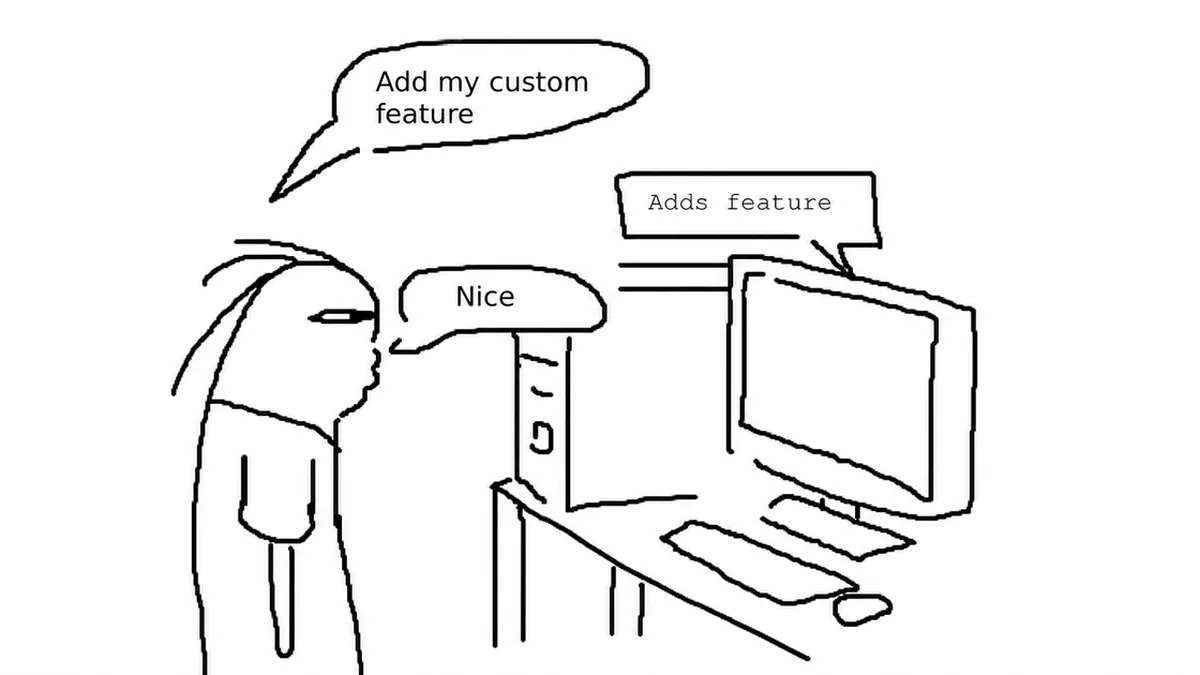
LLMs radically lower the cost of building custom software extensions, enabling a new class of extensible web apps where users can personalize behavior through natural language requests. Current web software serves the top of the demand curve but leaves a long tail of unmet needs; LLM-native platforms like Pi demonstrate a pattern where a solid core is endlessly customizable by asking. Cloudflare's Dynamic Workers and modern sandbox primitives provide the security and deployment infrastructure to make this safe and scalable on the web.

Why it matters

For a solutions architect focused on developer experience and platform engineering, this shifts the design paradigm from building monolithic features to creating extensible cores that leverage LLMs for user-driven customization, directly impacting how you architect SaaS platforms and internal tools.

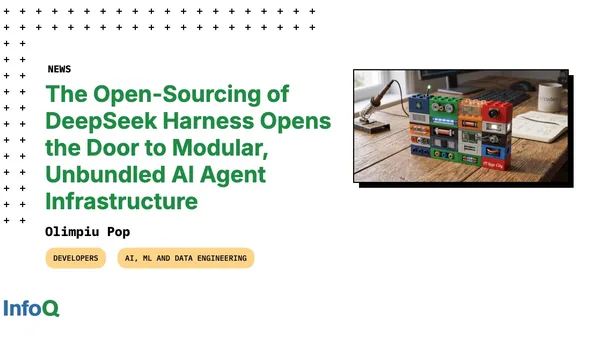
The Open-Sourcing of DeepSeek Harness Opens the Door to Modular, Unbundled AI Agent Infrastructure
AI/ML / infoq.com

The Open-Sourcing of DeepSeek Harness Opens the Door to Modular, Unbundled AI Agent Infrastructure

DeepSeek released the developer preview of DeepSeek Harness (dsh), an MIT-licensed open-source execution runtime for building autonomous AI agents. Built on the Cordis meta-framework with a micro-kernel architecture, it decouples model adapters, tool registries, sandboxing, session state, event dispatchers, and UIs into independent plugins configurable via YAML or JSON. The runtime includes an append-only event log for full execution trajectory inspection, replay, and benchmarking, and ships with four baseline configurations: Standard, Code, Minimal, and Creator modes.
Agent Memory: Everything It Remembers Has the Same Authority, and That Is the Bug
AI/ML / dev.to

Agent Memory: Everything It Remembers Has the Same Authority, and That Is the Bug

Coding agents fail not from insufficient memory but from treating all stored facts with equal authority. The useful split is between evidence (what happened) and policy (what should happen), further organized into three layers: shared project truth, role memory, and episodes. Without tracking both 'recorded at' and 'valid from/until' timestamps, agents overwrite facts instead of closing them, losing the context needed to explain past code or warn about superseded patterns.

I Deliberately Destroyed My Kubernetes Cluster at 2 AM. Here's What Died First.
Cloud / dev.to

I Deliberately Destroyed My Kubernetes Cluster at 2 AM. Here's What Died First.

A chaos engineering experiment on a 4-node bare-metal Kubernetes homelab (Talos Linux, Cilium, Longhorn, ArgoCD) using Chaos Mesh revealed that Prometheus data on emptyDir was lost within 60 seconds of pod-kill chaos, and PostgreSQL was repeatedly disrupted despite StatefulSet recovery. The test exposed that Longhorn's three-replica assumption and Cilium's network resilience were untested until actual node failure, highlighting the gap between theoretical resilience and real-world recovery metrics.

PostgreSQL for Everything
General / raphaelbauer.com

PostgreSQL for Everything

PostgreSQL's longevity and active community have made it a versatile database capable of replacing specialized systems like full-text search engines (e.g., Lucene/Solr) and time-series databases (via TimescaleDB), simplifying infrastructure by eliminating data sync and maintenance overhead. The author, a CTO, advocates using PostgreSQL for diverse workloads—from web analytics to JSON document storage—citing its modern features (partitioning, CTEs) and broad cloud support as key enablers. This approach reduces operational complexity, allowing teams to focus on feature development rather than managing multiple data stores.

Migrating from spatie/laravel-permission to Redis: A Production Playbook
General / dev.to

Migrating from spatie/laravel-permission to Redis: A Production Playbook

A production playbook details migrating from spatie/laravel-permission to a Redis-backed alternative, laravel-permissions-redis, for Laravel apps where authorization checks are a measurable share of database load. The migration replaces per-request lazy-loading of role and permission relations (roughly 4 queries) with an O(1) SISMEMBER check against a Redis SET, reducing authorization queries by about 75% and avoiding full cache reloads on permission changes. The post covers pre-migration audits (grepping for specific API calls, handling teams vs. multi-tenancy), a dry-run command, and rollback steps, noting that the 1.3-1.4x wall-clock improvement on SQLite is a wash against networked databases—the real win is offloading the database.

Why I Tell My AI Coding Agent: "Prefer Dart Over Python"
AI/ML / dev.to

Why I Tell My AI Coding Agent: "Prefer Dart Over Python"

A developer advocates configuring AI coding agents to prefer Dart over Python for temporary scripts, citing Dart's zero-ceremony execution that avoids Python's environment hell (PEP 668, virtualenvs, pip vs. uv confusion). Dart's batteries-included core library (dart:io, dart:convert, dart:async) and single pubspec.yaml manifest enable first-run success without dependency guessing, while sound static typing in Dart 3 catches LLM-generated type errors before execution.

An open source rival to Claude Managed Agents just launched
AI/ML / thenewstack.io

An open source rival to Claude Managed Agents just launched

TrueFoundry launched TrueForge, an open-source agent harness positioned as a direct alternative to Anthropic's Claude Managed Agents. The platform lets engineers build, deploy, and govern production AI agents on any model or MCP server, claiming a 50% reduction in agent operating costs by avoiding vendor lock-in. CEO Nikunj Bajaj argues that managed agent providers have misaligned incentives, as they profit from token volume rather than cost optimization, and that the harness layer—controlling model selection, context, and sandboxing—is a strategic control point enterprises should own.

Binance now lets AI agents trade, but keeping them in check is largely up to users
AI/ML / techcrunch.com

Binance now lets AI agents trade, but keeping them in check is largely up to users

Binance launched Agent OS, a platform letting AI agents analyze markets and execute trades on behalf of its 300M+ users via sub-accounts with granular permissions. The system integrates with OpenAI's ChatGPT/Codex, Anthropic's Claude Code, and Cursor through its Model Context Protocol (MCP), but Binance cannot see agent reasoning—only resulting trades—and relies on users to set limits via sub-accounts that block withdrawals by default. Agent OS also supports on-chain activity via Agentic Wallet with daily caps ($50K swaps, $100K DeFi, $20 x402 payments), while trading sub-accounts have no separate Binance-imposed loss limits.

AI-generated Rust compiles perfectly. That’s the scary part.
AI/ML / thenewstack.io

AI-generated Rust compiles perfectly. That’s the scary part.

Canonical is funding University of Bristol researchers to build a system that uses LLMs to translate legacy C code (AppArmor, snap-confine) into safe Rust, then verifies behavioral equivalence via fuzzing and formal program analysis. The key challenge is that AI-generated Rust can compile perfectly while introducing logic errors that conventional tests miss, especially when the translator relies on unsafe blocks to carry C constructs forward. The system uses symbolic repair to detect and fix mismatches, aiming to produce Rust that is both memory-safe and behaviorally identical to the original.