Skip to content

Four Signals

Agentic insights for modern tech teams

Mix and Match: One Agent, Three Clouds, One Protocol
AI/ML / dev.to

Mix and Match: One Agent, Three Clouds, One Protocol

A developer built the same research agent on Google ADK, AWS Bedrock (Strands), and Microsoft Agent Framework, then connected all three via the A2A protocol to a single coordinator. The project found that while A2A v1.0 handles cross-framework interoperability on the wire, the real differences lie in each platform's tool-binding API, credential mechanisms, and serving stack—not the protocol itself. To produce a valid comparison, the author controlled for everything except the framework and model, including using the same search tool across all three instead of each vendor's native retrieval.

Why it matters

For engineers building multi-agent systems, this demonstrates that A2A solves the wire-level handshake but leaves platform-specific tooling, hosting, and auth as the actual integration cost—critical knowledge when choosing between hyperscaler agent frameworks.

Mix and Match: Serving an ADK Agent to AWS and Azure
Cloud / dev.to

Mix and Match: Serving an ADK Agent to AWS and Azure

Google's ADK agent, deployed on Cloud Run, can serve requests from AWS Bedrock and Azure Container Apps via the A2A protocol, but the ADK's own RemoteA2aAgent client fails because to_a2a() writes the internal bind address (0.0.0.0:8080) into the agent card instead of the public HTTPS URL. The error surfaces as a misleading AttributeError about status_code, masking the real transport failure. The project demonstrates multi-cloud agent interoperability using A2A v1.0 with no shared credentials, running three agents on three clouds coordinated by a single orchestrator.

One directory is the task manager my agents share
AI/ML / dev.to

One directory is the task manager my agents share

A directory of markdown files serves as the shared task queue for multi-agent systems, using frontmatter states (pending, taken, done, dropped) and a generated board.md for visibility. Each entry includes an acceptance test and requires evidence of passing, preventing false completions. The same queue handles both human and automated agents without translation, with a snooze field capped at one week and a risk severity that ignores snoozing.

I Ran 170 Agent Goals for $0.49. The Field Test Found 10 Issues That Unit Tests Never Would.
AI/ML / dev.to

I Ran 170 Agent Goals for $0.49. The Field Test Found 10 Issues That Unit Tests Never Would.

A field test of the PlannerCritic agent engine across 170 goals at $0.49 found zero issues in v0.2.1, but only because code review caught all 41 bugs before the LLM ran. In v0.1.0, the same test found 10 issues—including harness bugs, prompt gaps, and design flaws—that unit tests missed entirely, such as 57 of 65 assertion files being in the wrong format with no error. The arc shows the field test evolving from a diagnostic tool into an immutable regression gate, where zero failures now signals rigorous pre-release review rather than a broken harness.

Build a Mini Engineering Graph With TypeScript and GitHub
DevTools / dev.to

Build a Mini Engineering Graph With TypeScript and GitHub

This tutorial demonstrates building a TypeScript CLI that constructs an in-memory engineering graph from GitHub pull request data, using nodes for repositories, PRs, files, and people connected by relationships like AUTHORED, MODIFIED, and REVIEWED. The approach requires no graph database, vector database, or AI model — just the GitHub API and TypeScript — to surface insights like who has experience with a file or which files change together. The CLI runs queries such as listing experts for a file or finding related files, with all data rebuilt on each command from up to 10 recently closed PRs.

I built a robot that applies for jobs. The hard part was proving it worked.
General / dev.to

I built a robot that applies for jobs. The hard part was proving it worked.

A developer spent eight hours debugging a job-application browser agent, only to find the root cause was a misread HTML element (textarea vs. input) that took two minutes to fix locally. The real lesson was that production runs are expensive verifiers, not debuggers, and most bugs originated from broken telemetry—metrics that read our own typing instead of the widget's state, watchdogs that reset their own signals, and alarms computed over rolling windows. The key insight: an absence in data is not evidence until you prove the instrument was armed before, during, and after the event.

Google's HEIR Aims to Make Homomorphic-Encrypted Inference a One-Click Capability
AI/ML / infoq.com

Google's HEIR Aims to Make Homomorphic-Encrypted Inference a One-Click Capability

Google open-sourced HEIR, a compiler toolchain that compiles pre-trained PyTorch models to operate on homomorphically encrypted data, enabling private inference without exposing inputs or proprietary models. HEIR uses an intermediate representation to abstract complex operations across dialects, but performance remains a key concern: community benchmarks show 1000x overhead for basic operations, though LLMs may fare better due to reliance on addition and multiplication over branching. Google has not yet published HEIR's relative speed for LLMs, and the current workflow requires manual steps via torch_mlir to export models to MLIR.

How I Actually Code with Claude Code: My Real Workflow on a Real Project
AI/ML / dev.to

How I Actually Code with Claude Code: My Real Workflow on a Real Project

There are two kinds of articles about coding with AI. The ones that generate a sorting function and...

Cloudflare OS: Cloudflare's Open-Source Corporate AI Platform Built on a Capability-Based Model
AI/ML / infoq.com

Cloudflare OS: Cloudflare's Open-Source Corporate AI Platform Built on a Capability-Based Model

Cloudflare open-sourced Cloudflare OS, an enterprise AI platform that instantiates isolated, user-specific application instances within V8 isolates via its workerd runtime, enabling non-technical users to safely modify code with generative AI. The capability-based model enforces enterprise policies by controlling access per instance, preventing cross-tenant data leaks even when users freely customize their apps. The platform emerged from internal scaling challenges where employees built unvetted AI workflows, leading to a human-staffed triage system that revealed needs for strict context management and dynamic permission isolation.

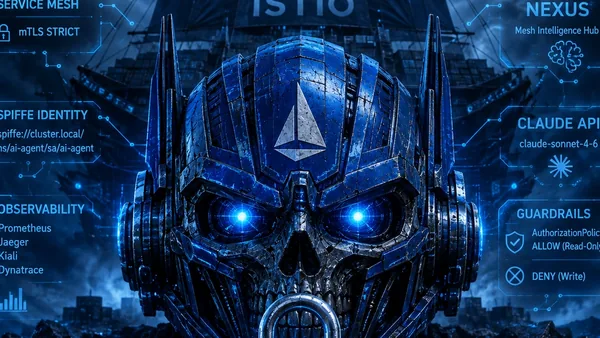
When AI Agents Meet Zero Trust: Building NEXUS on Istio Service Mesh
AI/ML / dev.to

When AI Agents Meet Zero Trust: Building NEXUS on Istio Service Mesh

NEXUS - Mesh Intelligence Hub is an AI-powered operations agent on Amazon EKS inside an Istio service mesh, designed to observe everything and propose solutions without being able to touch workloads. It enforces zero trust by running with a SPIFFE cryptographic identity, mTLS in STRICT mode, and explicit DENY policies blocking access to application workloads, limiting blast radius even if compromised. Every 30 seconds it polls Prometheus for error rate and p99 latency, then submits structured queries to Claude Sonnet 4.6 via Anthropic API, producing JSON output with severity, root cause, remediation steps, and a 'cannot do' scope boundary.