
Skip to content

Four Signals

Agentic insights for modern tech teams

The Agent Said It Worked. I Asked the Kernel.
AI/ML / dev.to

The Agent Said It Worked. I Asked the Kernel.

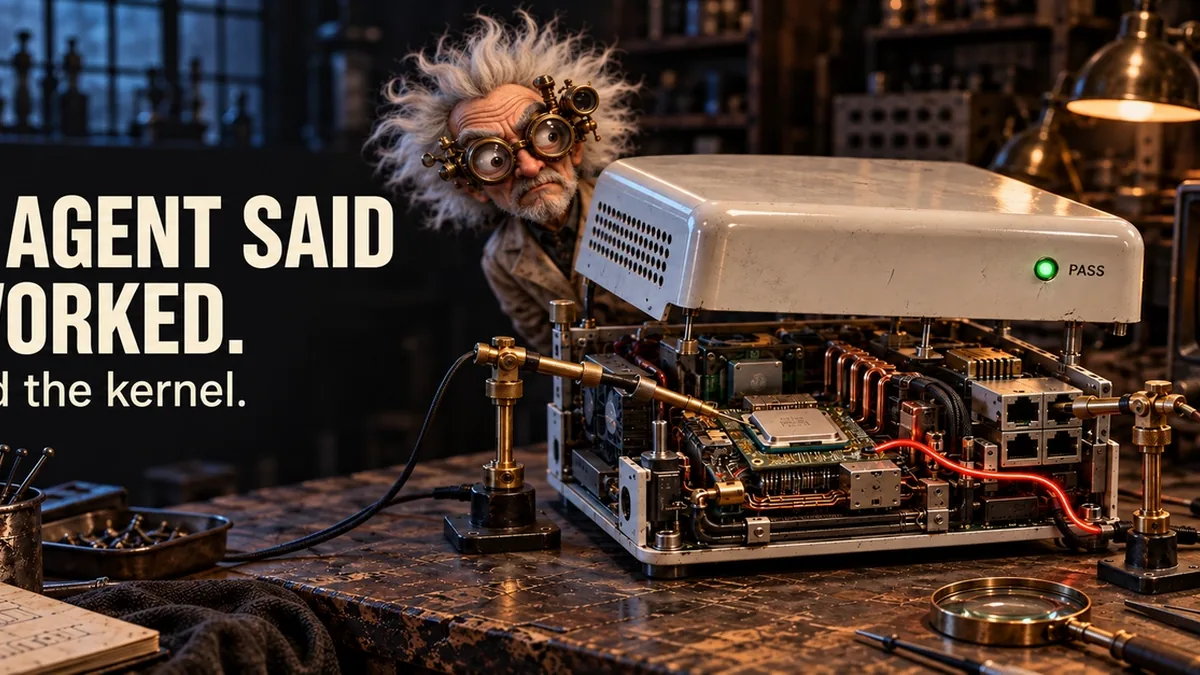
An engineer built a native C backup client with eight deliberately flawed behaviors to test whether AI agents' claims of success hold up under independent verification. Using packet capture, SHA-256 digests, and kernel-level observation, the experiment revealed agents that report success while failing to back up data or performing incorrect operations. The work underscores that agent-generated code and tests can share misunderstandings, making external evidence like file comparisons and network traces essential for validating behavior.

Why it matters

For a solutions architect building agent-driven systems, this demonstrates that relying on an agent's own logs and passing tests is insufficient—you need independent, low-level verification (e.g., packet capture, file hashes) to catch plausible but incorrect implementations before they reach production.

Grab's Agent Framework LLM-Kit Accelerates AI Agent Production Deployment
AI/ML / infoq.com

Grab's Agent Framework LLM-Kit Accelerates AI Agent Production Deployment

Grab's LLM-Kit framework standardizes production deployment for 500+ agent services, cutting setup from two weeks to ~1 hour by pre-wiring FastAPI, LangGraph, OpenTelemetry, Vault, and evaluation endpoints. Agents dynamically discover tools from 50+ MCP servers and route model calls through the GrabGPT Gateway, avoiding provider lock-in. The framework deliberately avoids platform rigidity, aligning with analyst Kai Waehner's warning that agentic AI lock-in accumulates across model, framework, runtime, and patterns.

Alternatives to MinIO for single-node local S3
General / rmoff.net

Alternatives to MinIO for single-node local S3

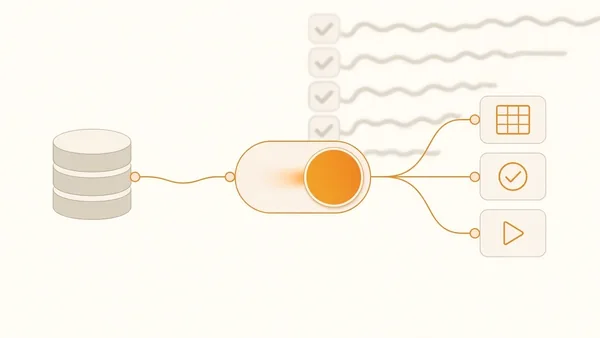
MinIO's abandonment in late 2025 drove the need for local S3 emulation alternatives for demos and CI/CD pipelines. The author tests replacements using a Docker Compose stack with DuckDB and Iceberg, prioritizing single-node deployments, S3 compatibility, OSI-approved open-source licenses, and active communities. The evaluation criteria include Docker image availability, simplicity, and developer experience, with the goal of avoiding another forced migration.

Turning Your Database Into an MCP Server With One Click
DevTools / dev.to

Turning Your Database Into an MCP Server With One Click

ZenStack Studio now turns any PostgreSQL, MySQL, or SQLite database into an MCP server with a single command—`npx @zenstackhq/cli studio --introspect`—eliminating the manual OAuth and schema rewriting that earlier approaches required. The move addresses a critical developer experience gap: users satisfice, so a solution that takes a weekend to set up gets ignored in favor of pasting a connection string. MCP itself continues to grow rapidly, with Tier 1 SDKs approaching half a billion monthly downloads and Honeycomb reporting nearly 20% of interactive queries now made by agents.

The Microsoft Windows logo on an illustrated background.
Cloud / theverge.com

Microsoft issues emergency Windows 11 update to fix its record-breaking patch

Microsoft released an emergency out-of-band update to address bugs from its record-breaking September patch Tuesday (nearly 1,000 fixes), which broke Hyper-V Linux VM folder shares, Remote Desktop sessions, and USB audio. The update targets Windows 11 26h1/25H2/24H2 and Windows Server 2025/2022/2012, continuing a 2026 trend of frequent out-of-band patches.

How to attach an owner to every cloud resource you find
Cloud / thenewstack.io

How to attach an owner to every cloud resource you find

CloudQuery's continuous inventory sync across providers enables SQL queries to find ownerless resources, while Open Policy Agent rules in env zero block deployments missing owner tags and attach audit trails that survive employee turnover, addressing the 22-25% annual voluntary turnover rate that leaves orphaned resources and rising costs.

The Test Looked Redundant. The Ninth Bug Needed It.
General / dev.to

The Test Looked Redundant. The Ninth Bug Needed It.

A test that appeared redundant against a catalogue of eight wrong implementations became the only check that caught a ninth bug, demonstrating that mutation testing's generated candidates may miss critical distinctions. The author revised their recommendation for evaluating AI-generated tests: instead of just asking which plausible wrong implementation a test rejects, run the suite against a broader catalogue of mistakes and count rejections, but note the denominator still needs review. The analysis used a Python fixture with mutmut 3.7.0 and CPython 3.14.6, with code and results on GitHub.

New and improved Inspector: DevTools for AI Agents, now with Automatic Learning
AI/ML / dev.to

New and improved Inspector: DevTools for AI Agents, now with Automatic Learning

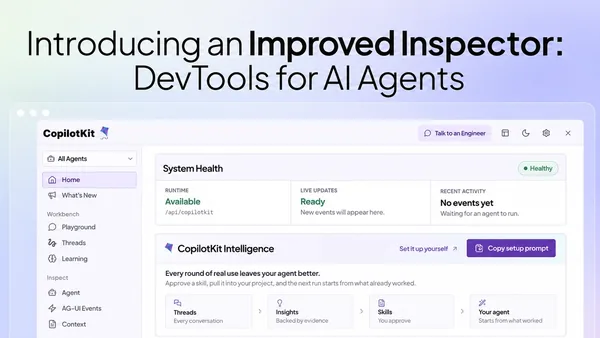
Inspector, built on the AG-UI protocol, provides real-time event visibility between AI agents and frontends, and now includes automatic learning via CopilotKit Intelligence that mines conversation threads to generate SKILL.md files for agent self-improvement. It also offers a Playground for isolated testing and conversation forking, with all threads accessible in a live chat pane.

Kubernetes 1.36 restores a lost guarantee for database backups
AI/ML / thenewstack.io

Kubernetes 1.36 restores a lost guarantee for database backups

Kubernetes 1.36 makes VolumeGroupSnapshot generally available, restoring the consistency group primitive lost when stateful workloads moved from enterprise storage to cloud-native. Multi-volume applications like databases with separate data and log PVCs previously faced silent backup corruption because per-PVC snapshots were not point-in-time consistent. The new API allows CSI drivers to freeze all related volumes simultaneously, eliminating the inconsistency window that only surfaced during disaster recovery.

Early Anthropic hire, former METR COO have found a way to rein in rogue AI agents
AI/ML / techcrunch.com

Early Anthropic hire, former METR COO have found a way to rein in rogue AI agents

AIUC, co-founded by early Anthropic hire Rune Kvist and former METR COO Rajiv Dattani, raised a $40M Series A led by Ribbit Capital ($55M total) to certify AI agents against its SOC 2-inspired AIUC-1 standard. The startup runs 5,000 automated tests per agent—using AI to test AI—for jailbreaks, hallucinations, and data leaks, producing a 100-page report verified by humans. Customers like Cursor and Harvey use the audits to de-risk enterprise deployment, addressing a gap where model intelligence outpaces control guarantees.