Skip to content

Four Signals

Agentic insights for modern tech teams

ZCode, the GLM coding agent, silently uploads your Git history
AI/ML / tokenstead.ai

ZCode, the GLM coding agent, silently uploads your Git history

ZCode, the closed-source GLM coding agent from Z.ai, silently encrypts and uploads the user's entire workspace—including full .git history, reflogs, and LFS assets—to Alibaba Cloud OSS using envelope encryption (AES-256-CTR with RSA-OAEP key wrapping where the private key lives only on Z.ai's servers). A reverse-engineering walkthrough by developer ferstar showed a 313MB archive from a 345MB workspace, with the .git directory comprising 86.6% of the payload, and that no toggle settings prevent the upload. The incident drew over 276,000 views and widespread calls not to trust closed-source AI harnesses, especially since GLM's open weights lead many to wrongly assume the runtime is also open.

Why it matters

For engineers building on local AI or using closed-source coding agents, this demonstrates that the harness layer can silently exfiltrate years of engineering history (including deleted secrets, unreleased plans, and internal configs) without user control, undermining any assumption of privacy from model weight openness.

AI/ML / hacktron.ai

A heap overflow and SSO misconfiguration to compromise OpenAI internal repos

Researchers chained a libheif heap overflow in OpenAI's Discourse forum (community.openai.com) with an SSO misconfiguration to take over employee ChatGPT/Codex accounts, gaining access to internal GitHub repos. The exploit, disclosed via Bugcrowd, was fixed within 14 hours; OpenAI paid a $6,500 bounty. The libheif vulnerability (part of the 'HEIF Heist' investigation) also impacts Slack, Meta, GitHub Enterprise, and Node.js frameworks like Next.js and Astro.

Inside TypeScript-go: Concrete AST Nodes, Shared State, and Tree Traversal
DevTools / dev.to

Inside TypeScript-go: Concrete AST Nodes, Shared State, and Tree Traversal

TypeScript 7's Go port (microsoft/typescript-go) models AST nodes using a design that avoids a single oversized struct with optional fields. Instead, it uses Go interfaces and concrete node types for each kind (Call, Identifier, Number) to enforce type safety—shared fields like position and parent are embedded, while kind-specific fields (e.g., Arguments for Call) are isolated. This approach prevents invalid field combinations at compile time, a common pitfall in compiler data models.

Bonsai 2 27B: Near-Lossless Compression in a 9x Smaller Footprint
AI/ML / prismml.com

Bonsai 2 27B: Near-Lossless Compression in a 9x Smaller Footprint

Bonsai 2 27B, based on Qwen3.8 27B, uses ternary {−1,0,+1} weights with FP16 scaling to achieve 1.76 bits per weight and a 5.9GB footprint—9x smaller than full-precision while retaining 98.2% aggregate benchmark performance. Released under Apache 2.0 with a 262K-token context window, it reaches 143 tokens/second on RTX 5090 and 46.8 on M5 Max, making it viable for local coding agents, multimodal workflows, and private document analysis. This closes the retention gap from 95% to over 98% versus the prior Bonsai, pushing low-bit models toward practical losslessness for deployment.

DoorDash Uses Multi Agent LLMs to Clean up 60,000 Feature Flags
AI/ML / infoq.com

DoorDash Uses Multi Agent LLMs to Clean up 60,000 Feature Flags

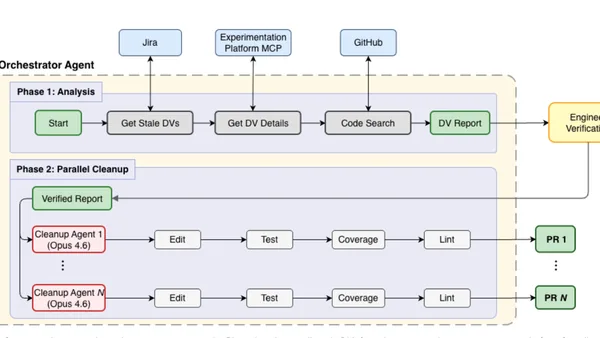
DoorDash deployed a multi-agent LLM system on Google's Agent Development Kit, using Claude Sonnet for orchestration and Claude Opus for cleanup in isolated Git worktrees, to automate removal of stale feature flags across 623 repositories. The system handles dependency-injected wrappers that require changes across 5-20 files per flag—a pattern Uber's Piranha couldn't address—and produced 45 usable pull requests from 50 evaluated flags, averaging 13.8 minutes and $4.79 per cleanup versus 1-2 hours manually. No bugs or regressions were reported, and DoorDash plans to add confidence scoring and post-cleanup code quality passes.

videoframe_18541
AI/ML / theverge.com

Claude Code relaunches Projects to manage multiple AI agents in the cloud

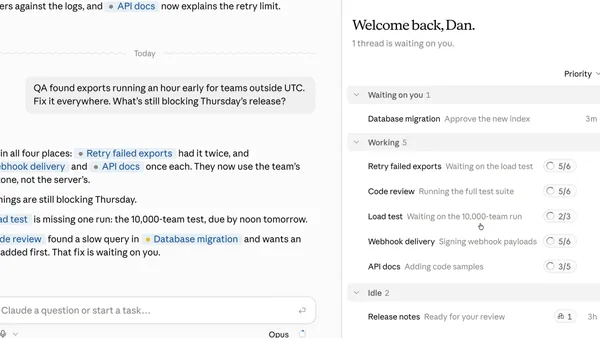
Anthropic's Claude Code relaunched Projects, enabling orchestration of multiple AI agents in the cloud with shared memory, goals, and file libraries. Each project uses threads—cloud sessions on separate repo branches—coordinated by a coordinator agent, with merge conflict resolution for overlapping code. Threads can further split work via subagents, loops, and workflows. The beta is available for select Pro and Max subscribers, with plans to expand to Team, Enterprise, and other Claude products.

What If Your Coding Agent Could Remember What It Learned Yesterday?
AI/ML / dev.to

What If Your Coding Agent Could Remember What It Learned Yesterday?

Attic is an open-source knowledge persistence tool that lets AI coding assistants like Claude Code and Codex CLI save discoveries across sessions, preventing repeated investigations of the same bug or architectural insight. It stores findings as a searchable library with a lightweight catalog index kept in context, so agents retrieve relevant knowledge without bloating the prompt. The tool addresses the common problem of stale memories after context compaction, making reasoning from past sessions reusable.

Open-weight models now handle a majority of tokens on Vercel’s AI Gateway. But Anthropic still takes 64% of the spend.
AI/ML / thenewstack.io

Open-weight models now handle a majority of tokens on Vercel’s AI Gateway. But Anthropic still takes 64% of the spend.

Open-weight models now handle 56% of tokens on Vercel's AI Gateway, up from 7% in December 2025, driven by cheaper providers like DeepSeek, Moonshot AI, and Z.ai. Despite this volume, Anthropic's models still command 64% of spending, with its share never falling below 61% since December 2025. The average price per token dropped 23.2% in August, reflecting the cost advantage of open-weight models, though enterprise adoption remains early according to Vercel CEO Guillermo Rauch.

Node.js 26.9 turns node:ffi on by default at 37 nanoseconds a call
AI/ML / dev.to

Node.js 26.9 turns node:ffi on by default at 37 nanoseconds a call

Node.js 26.9.0 enables node:ffi by default, allowing C function calls at ~37ns per invocation—7-8% slower than N-API addons but 15-20% faster for bulk buffer operations like summing 10M floats. The change eliminates node-gyp dependencies and the experimental flag, though the module remains experimental and unsafe (wrong signatures crash the process). This shifts the tradeoff: FFI wins on convenience and data-heavy workloads, not per-call performance.

Researchers used Anthropic’s Claude to hack into OpenAI
AI/ML / techcrunch.com

Researchers used Anthropic’s Claude to hack into OpenAI

Security researchers at Hacktron AI used Anthropic's Claude Opus 5 to chain two vulnerabilities—a libheif memory bug in Discourse forum software and a subsequent account takeover—to access OpenAI employee ChatGPT and Codex accounts, earning a $6,500 bug bounty. The exploit succeeded only after Opus 5 was released, as Opus 4.8 failed to produce a working exploit, highlighting how rapidly improving AI models can lower the barrier for sophisticated attacks. The libheif bug had been patched months earlier but lacked a CVE identifier, leaving Discourse running the vulnerable version.