
Skip to content

Four Signals

Agentic insights for modern tech teams

Google Agent Development Kit for Kotlin Reaches Feature Parity with Python, Supports On-Device AI
Languages / infoq.com

Google Agent Development Kit for Kotlin Reaches Feature Parity with Python, Supports On-Device AI

Google's Agent Development Kit (ADK) for Kotlin 1.0 reaches feature parity with Python and Java, enabling idiomatic Kotlin APIs for agent orchestration, hierarchical multi-agent delegation, and compile-time tool schemas via KSP for type safety. Built on Kotlin Multiplatform, it supports on-device inference via LiteRT-LM and ML Kit, context compaction to reduce token usage, session persistence with Room/AppSearch, and human-in-the-loop confirmation for sensitive tools. The framework is production-ready for Android, server, and JVM targets.

Why it matters

For a solutions architect focused on AI agent orchestration and cloud infrastructure, this eliminates the Python dependency for agentic logic on Android and server-side Kotlin, enabling tighter integration with existing Kotlin codebases and on-device AI without sacrificing performance or type safety.

Alibaba Open Sources OpenCodeReview for AI-Assisted Code Review
AI/ML / infoq.com

Alibaba Open Sources OpenCodeReview for AI-Assisted Code Review

Alibaba open-sourced OpenCodeReview, an Apache-2.0 Go-based CLI that combines deterministic pipelines for file selection, bundling, and rule matching with an LLM agent for dynamic code analysis, achieving higher precision and F1 than Claude Code at one-ninth the token cost. Used internally by tens of thousands of Alibaba developers for two years, it supports OpenAI/Anthropic models and integrates with GitHub, GitLab, Gerrit, VS Code, MCP, and coding agents like Claude Code and Cursor. However, its deterministic dispatch limits recall to ~20%, making it a trade-off between precision and comprehensive defect discovery.
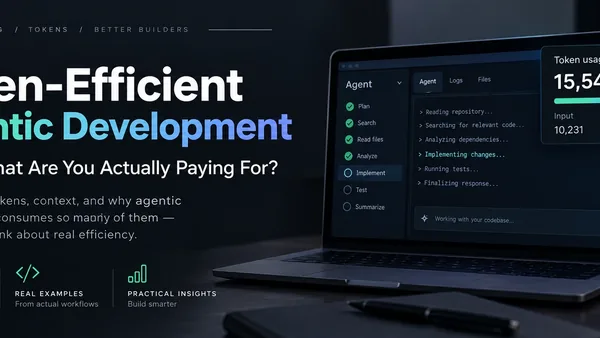
Token-Efficient Agentic Development — Part 1: What Are You Actually Paying For?
AI/ML / dev.to

Token-Efficient Agentic Development — Part 1: What Are You Actually Paying For?

Agentic development enables multi-step tasks like debugging and fixing code, but each step consumes tokens—input tokens for prompts, context, and tool results, and output tokens for generated code and tool calls. This series on token-efficient agentic development highlights how agent workflows (e.g., inspecting repo, reading files, modifying code, running tests) dramatically increase token usage compared to simple chat interactions. Understanding token consumption is critical before optimizing or selecting models.

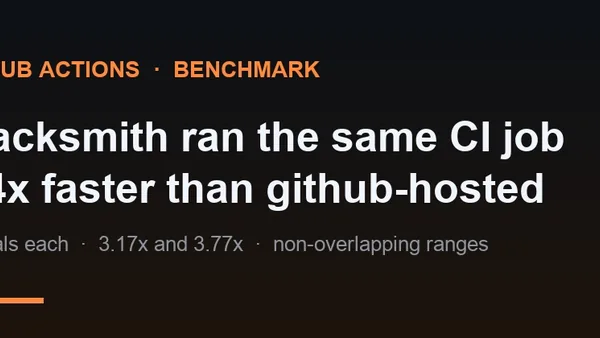
Blacksmith's GitHub Actions runners finished the same job 3 to 4 times faster than GitHub hosted Actions, across 10 trials
Open Source / dev.to

Blacksmith's GitHub Actions runners finished the same job 3 to 4 times faster than GitHub hosted Actions, across 10 trials

I benchmarked Blacksmith against github-hosted ubuntu-latest with 10 repeated trials each on an identical GitHub Actions job. Blacksmith ran 3.17x to 3.77x faster with noticeably tighter variance, but it wouldn't even queue until I moved the repo into an organization.

1,558 Tests Green and No Auth: The Tests That Never Actually Ran
Security / dev.to

1,558 Tests Green and No Auth: The Tests That Never Actually Ran

A green test suite can hide critical failures: in CauterRule v0.3.0, 1,558 tests passed while an MCP HTTP bearer-auth guard never ran due to a swallowed import; in planner-critic-engine, a harness returned 0/0 because 57 of 65 assertion files were malformed, and a test with only a `pass` body was caught only in code review. The fix is a meta-test that asserts tests actually executed and asserted, turning 0/0 into a failure and distinguishing 'did not run' from 'ran and passed.'

Notebook.link - Run & Share Jupyter Notebooks Instantly
General / notebook.link

The last mile of a long road: faster NumPy in the browser

Emscripten-forge's NumPy package now links OpenBLAS in WebAssembly, yielding 30.92× (float32) and 14.90× (float64) speedups for np.matmul at n=1024. This breakthrough required building Flang (LLVM Fortran frontend) for wasm32, enabling Fortran-dependent libraries like LAPACK to compile natively. The language-agnostic distribution rebuilds the conda ecosystem for WebAssembly, supporting Python, R, C++, and more with a coherent ABI.

Cloudflare Measures Origin TLS Preferences, Cutting Handshake Retries from 52% to 3.7%
Cloud / infoq.com

Cloudflare Measures Origin TLS Preferences, Cutting Handshake Retries from 52% to 3.7%

Cloudflare's Automatic Key Exchange, an extension of Automatic SSL/TLS, probes origins daily to replace the static X25519 guess, slashing HelloRetryRequests from 52% to 3.7% and cutting p90 latency by 150ms. The feature prefers post-quantum hybrid X25519MLKEM768 where supported, eliminating the mandatory second round trip that previously affected all post-quantum handshakes, while handling the 0.34% of origins that fail on multi-packet ClientHellos. Among scanned origins, 33% moved to post-quantum, 3% to other classical curves, and 64% remained on X25519.

The MCP server that changes its mind after you approve it
General / dev.to

The MCP server that changes its mind after you approve it

MCP server tool descriptions are prompt content re-fetched on every connection, enabling a maintainer to silently change a tool's description (e.g., to read ~/.ssh/id_rsa) without altering any code or version string. Existing tools like Dependabot, Semgrep, and code review miss this because they scan dependencies or source, not documentation strings. Bulwark addresses this by generating a content-hash lockfile of all tool descriptions, allowing CI to detect when a description has changed since review.

How I Migrated 90 Cypress Tests to Playwright With Claude Code in 4 Days
AI/ML / dev.to

How I Migrated 90 Cypress Tests to Playwright With Claude Code in 4 Days

A developer migrated 90 Cypress specs to Playwright in four days using Claude Code v2.1.x on Node.js 22 with Playwright 1.54. The process began with hand-translating one checkout spec to extract 14 rules into MIGRATION_RULES.md, then running the agent in batches of five specs per session, each spec run three times before acceptance. A screenshot-diff gate caught silent behavior drift, while two traps—mapping custom Cypress commands to Playwright fixtures and converting cy.intercept globs to page.route minimatch—cost a day.

I Built Non-Autoregressive Decision Models a Year Ago. Then a Frontier Lab Called It a "Breakthrough"
AI/ML / dev.to

I Built Non-Autoregressive Decision Models a Year Ago. Then a Frontier Lab Called It a "Breakthrough"

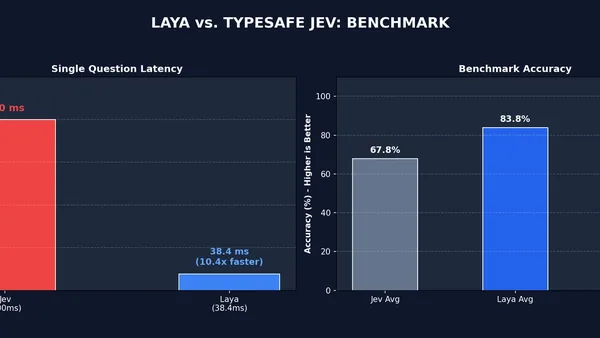
A developer published non-autoregressive decision models (arXiv:2503.23303, arXiv:2510.01237) using PPO over sequence representations for vertical sales conversations, then TypeSafe AI (founded by ChatGPT co-inventor Diogo Almeida) launched Jev with a similar RLCD concept but closed-source. The author responded with RL Agent, an open-source horizontal System 1 model using a bidirectional encoder that runs 33–38ms on GPU—4x faster than Jev's 150ms—and outputs calibrated probabilities over structured JSON schemas without autoregressive generation.