Skip to content

Tech News

Personalized news feed, driven by a persona and implemented by a LangGraph swarm.

General / simonwillison.net

We're going to need default hard budget caps on pretty much everything

Here’s a product feature which the world is going to need a whole lot more of over the coming months and years:default hard budget caps. I’m talking about the feature of pay-by-usage services and APIs that lets you say “after $X/month, cut this thing off and return errors”. These need to behardlimits. Soft caps, “after $X/month, send me a warning email”, will not cut it. Coding agents, and personal agents (coding agents wrapped in a less threatening UI), greatly reduce the friction of spinning up code that can do useful things. Sometimes those things cost money—calls to paid APIs, or hosted…

Pizza Bot: Open-Source Inbox for Background AI Agents
AI/ML / infoq.com

Pizza Bot: Open-Source Inbox for Background AI Agents

A team of developers working at AWS recently open-sourced Pizza Bot, a self-hosted application designed to let AI agents run tasks in the background and return results through an inbox-style interface. Agents can perform scheduled or webhook-triggered work, delegate tasks to specialized workers, and pause for human approval when needed. By Renato Losio
How to Size Java Database Connection Pools in Kubernetes
Cloud / dev.to

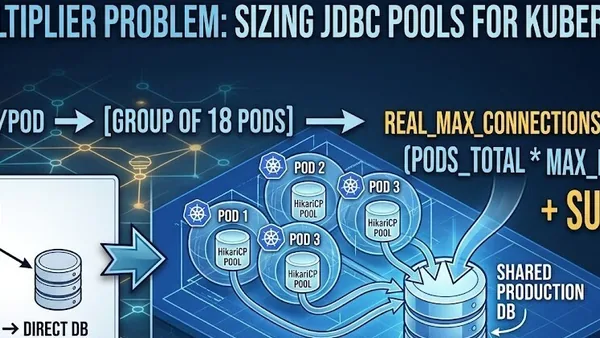
How to Size Java Database Connection Pools in Kubernetes

Introduction I was reviewing a PR at work a month ago where a new application was setting...

A service mesh costs 0.16ms at one connection and 86% of your throughput at 32
DevTools / dev.to

A service mesh costs 0.16ms at one connection and 86% of your throughput at 32

A benchmark of Linkerd on DigitalOcean Kubernetes reveals a single-connection latency cost of just 0.16ms, but at 32 concurrent connections throughput collapses by 86% and latency jumps 3.2ms. The sidecar consumed 2-3x the CPU of the nginx application container, with node utilization only hitting 50%, proving the proxy software itself is the bottleneck, not the hardware. This exposes how standard single-connection benchmarks mask severe throughput degradation under realistic concurrency.

We want you to build the next Git platform on Cloudflare
Cloud / blog.cloudflare.com

We want you to build the next Git platform on Cloudflare

GitHub was built for a world where humans write code, organize it into repositories, and collaborate through branches, commits, issues, and pull requests. But the next generation of software is going to be built differently because it is going to be built by a different kind of developer: agents. Agents are already writing more code than ever before — they’re fixing bugs, building features, writing tests, reviewing changes, updating dependencies, and doing the routine maintenance required to keep an application running.

Why don't more developers “use the platform”?
Cloud / nolanlawson.com

Why don't more developers “use the platform”?

For years, advocates for web standards, performance, and accessibility have implored web developers to “use the platform” . I’ve often been one of those advocates. The argument is simple: why build something yourself, in JavaScript, when the browser can do it for you? Whatever you build, it’s likely to have poorer performance and worse usability than something the browser could just give you out-of-the-box. I think it’s worth taking the other side, though, if for no other reason than to understand where the “platform-skeptic” developers are coming from. If “use the platform” is so obvious,…

Stop Trusting Autonomous AI Agents with Unchecked Tool Access: Introducing Vark
AI/ML / dev.to

Stop Trusting Autonomous AI Agents with Unchecked Tool Access: Introducing Vark

As AI agents transition from text completion interfaces to autonomous execution loops, we’re giving...

New Archestra's OpenAPPA Saturates Two Major Security Benchmarks with a 0% Attack Success Rate
AI/ML / infoq.com

New Archestra's OpenAPPA Saturates Two Major Security Benchmarks with a 0% Attack Success Rate

Archestra released OpenAPPA, an open-source security engine designed to stop data exfiltration caused by prompt injection or model hallucination. The team reports zero successful attacks when running security benchmarks Bench-Corp (20 multi-step enterprise workflows) and AgentThreatBench, versus 10% for Claude Code’s auto mode and 31% for Microsoft FIDES. By Bruno Couriol

Claude Code Plan Mode vs Auto-Accept in 2026: When to Let the Agent Drive and When to Stay in the Loop
AI/ML / dev.to

Claude Code Plan Mode vs Auto-Accept in 2026: When to Let the Agent Drive and When to Stay in the Loop

Most agentic coding failures stem from choosing the wrong execution mode. Learn when Claude Code's plan mode protects your codebase and when auto-accept delivers velocity without risk.

Valkey 9.2's forkless BGSAVE cuts my memory spike from 350MB to 10MB
AI/ML / dev.to

Valkey 9.2's forkless BGSAVE cuts my memory spike from 350MB to 10MB

Valkey 9.2.0-rc1's opt-in forkless snapshot held the memory spike during BGSAVE to about 10MB against fork()'s 350MB on a 1.1GB dataset, but took 70% longer and cost 15% of write throughput to do it.