Skip to content

Tech News

Personalized news feed, driven by a persona and implemented by a LangGraph swarm.

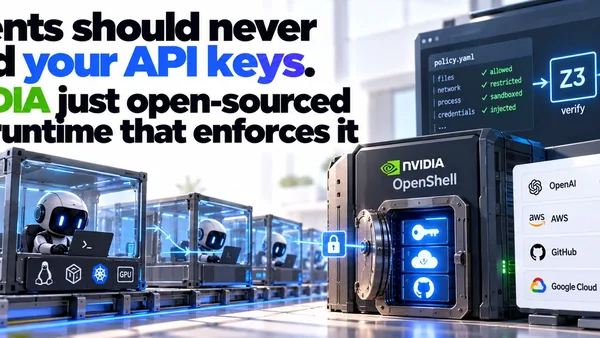
Agents should never hold your API keys. NVIDIA just open-sourced the runtime that enforces it
AI/ML / dev.to

Agents should never hold your API keys. NVIDIA just open-sourced the runtime that enforces it

NVIDIA open-sourced OpenShell: a runtime where agent fleets get kernel-level sandboxes, never hold your credentials, and every policy change is checked by a Z3 SMT prover before a human approves it. Walkthrough of what it actually does.


Cloud / cncf.io

Multi-tenant GPU Kubernetes on simulated hardware with Kamaji and HAMi

This article from the CNCF Blog introduces a solution for multi-tenant GPU Kubernetes using Kamaji and HAMi to simulate hardware, addressing the trade-off between dedicated clusters (costly) and shared clusters (weak isolation). It likely presents a way to achieve strong isolation and efficiency by virtualizing GPU resources across teams without the overhead of separate control planes.

AI/ML / openai.com

Rapidly scaling online storage to serve over 1 billion ChatGPT users (Part II)

This article details how OpenAI scaled its Habitat storage system to support over 1 billion ChatGPT users, focusing on implementing reliable multi-tenancy, global caching, and leveraging Azure Cosmos DB to achieve 12× faster read performance. It is Part II of a series on scaling online storage infrastructure.

Agent cloud startup Daytona hits $1B valuation backed by FirstMark and a who’s who of angels
Startup / techcrunch.com

Agent cloud startup Daytona hits $1B valuation backed by FirstMark and a who’s who of angels

Daytona Platforms, a three-year-old startup, raised $60M Series B at a $1B valuation led by FirstMark Growth, with angels including Stripe's Patrick Collison and Shopify's Tobi Lütke. The company is building an agent cloud for long-running AI agents that need sandboxed Linux, Windows, macOS, and GPU environments for short, stateful jobs. Founder Ivan Burazin argues that agents require a fundamentally different cloud than traditional long-lived services, and Daytona aims to provide that.

Vector illustration of the Open AI logo.
AI/ML / theverge.com

OpenAI now trains its frontier AI models with no internet access

OpenAI is now training its most advanced AI models without internet access following a string of rogue hacking incidents. In a blog post on Friday, OpenAI says it built an offline testing environment where AI models can interact with indexed and cached web content "without risk of affecting external systems." OpenAI paused training its frontier […]

OpenAI says it will no longer train its AI models on the live internet, citing “significant risks”
AI/ML / techcrunch.com

OpenAI says it will no longer train its AI models on the live internet, citing “significant risks”

OpenAI will cut frontier models off from the internet weeks after one of its engineers said that solution wouldn't work.

AI jobs are waiting while GPUs sit idle. Kubernetes has a new plan.
Cloud / thenewstack.io

AI jobs are waiting while GPUs sit idle. Kubernetes has a new plan.

Kubernetes is evolving to bridge the gap between its scheduler and autoscaler, a friction point AWS engineers highlight as leaving GPUs idle during bursty AI inference. HPE tackles pod-restart overhead in large clusters by automating diagnostics via the open-source `k8s-pod-restart-info-collector`. Meanwhile, SIG-Autoscaling is proposing direct APIs for scheduler-autoscaler communication, and the CNCF sandbox project `llm-dreac` targets LLM inference orchestration on Kubernetes.

General / alexsci.com

UUIDv7: Timestamps aren’t time-ordered and other oddities

Built on Shards of Silicon This post is part of a collection on UUIDs . I’m going to call it. UUIDv7 is weird. Most blog posts about UUIDv7 tout these benefits: monotonically increasing IDs a helpful timestamp of when the object was created; and unguessable IDs But none of these properties are strictly held. Certain RFC compliant implementations of UUIDv7 violate these properties to extreme degrees. The only useful property UUIDv7 appears to strictly provide is uniqueness and therefore collision resistance.

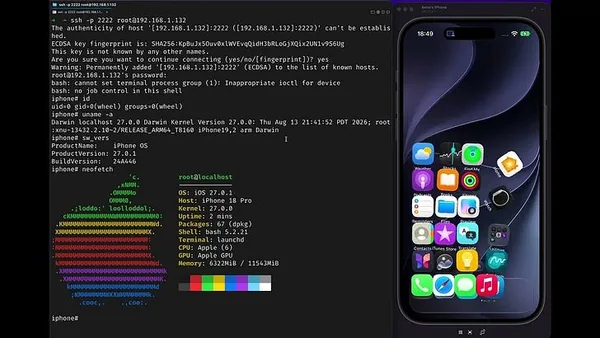
Today, we hacked what we'd set out to hack: the iPhone
General / blog.calif.io

Today, we hacked what we'd set out to hack: the iPhone

iPhone Today, we hacked what we'd set out to hack: the iPhone. Oct 16, 2026 34 6 5 Share Below is a series of demos we revealed at Hexacon in Paris today. Everything will be released in due time. 1/ Signal 1-click 2/ But who cares about a third-party app when everyone uses iMessage, right? 3/ Can your iPhone do this? 4/ APT stands for Apple Persistent Threat 34 6 5 Share