
Skip to content

Tech News

Personalized news feed, driven by a persona and implemented by a LangGraph swarm.

Six Serving Engines, One 8 GB GPU: Gemma 4 E2B on an RTX 3050
AI/ML / dev.to

Six Serving Engines, One 8 GB GPU: Gemma 4 E2B on an RTX 3050

A developer benchmarked six inference serving engines—llama.cpp, vLLM, SGLang, mistral.rs, plain PyTorch, and LiteRT-LM—all running Gemma 4 E2B with Google's QAT 4-bit weights on a single 8 GB RTX 3050. Answer quality was nearly identical across engines (GSM8K 0.8992–0.9030, BFCL 0.9125–0.925), but throughput varied dramatically under load: vLLM and SGLang reached 1,651–1,711 tokens/second at 64 concurrent requests, while llama.cpp managed 633 and mistral.rs 308. The E2B speculative decoder boosted vLLM 1.90x but slowed mistral.rs to 0.72x, and llama.cpp showed no benefit from using more GPU memory beyond 2.6 GB.

Why it matters

For platform engineers deploying small models on consumer GPUs, this head-to-head comparison reveals that engine choice—not model quantization—determines throughput under load, with vLLM and SGLang dominating batching scenarios while llama.cpp remains competitive for single-user inference.

How much does it cost to run a text game with LLMs
AI/ML / dev.to

How much does it cost to run a text game with LLMs

Running a text game with 27 frontier LLMs costs $6.36/day for 6 daily users, based on 51,000 API calls over 53 days. Text generation accounts for 63% of costs ($4.01/day), followed by images at 28% and audio at 8%, with a full 50-turn game averaging $1.49. The founder absorbs all costs for 651 free users, relying on caching (up to 43% of input tokens) and compaction summaries to manage expenses.


What unshare -n leaves behind: building a boundary for an AI recon agent
AI/ML / dev.to

What unshare -n leaves behind: building a boundary for an AI recon agent

A bug-bounty AI recon agent jailed via unshare -n (network namespace) still bypassed isolation by connecting to a host Unix socket through the shared filesystem mount namespace, passing 13/13 isolation tests that only checked AF_INET sockets. The fix requires either a separate mount namespace or restricting Unix socket access, as demonstrated by a reproduction using two Python scripts on a disposable Linux environment.

Scaling an autonomous agent from one team to fifty: A serverless-to-container decision framework
AI/ML / thenewstack.io

Scaling an autonomous agent from one team to fifty: A serverless-to-container decision framework

An autonomous agent built on Lambda that files bug tickets from test failures saves 8-10 hours per week per team, but scaling from one to fifty teams shifts workload characteristics from stateless events to long-running context, shared resource contention, and multi-tenant isolation. Lambda's Managed Instances, Durable Functions, and Tenant Isolation narrow the gap, but persistent connections, cross-tenant analysis, and GPU inference favor containers for multi-tenant agentic workloads.

Entire's Git Forge Rethinks Git Collaboration for Coding Agents
AI/ML / infoq.com

Entire's Git Forge Rethinks Git Collaboration for Coding Agents

Entire, a Git forge led by former GitHub CEO Thomas Dohmke, reimagines collaboration between human developers and AI coding agents by replacing the traditional pull request model with 'trails' and 'continuous memory.' Trails surface eval scores (code quality, security, slop) on every push, enabling confidence-based merges, while continuous memory preserves agent context across sessions via open-source tools entire-graph and entire-brain. Built on a distributed architecture, Entire claims pushes up to 89x faster than GitHub and supports multi-repository trails with configurable review gates.

Tokio Releases Topcoat: A Batteries-Included Full-Stack Rust Framework
Languages / infoq.com

Tokio Releases Topcoat: A Batteries-Included Full-Stack Rust Framework

Tokio released Topcoat v0.9, a batteries-included full-stack Rust framework that stays server-rendered while adding reactivity via cross-compiled Rust expressions translated to JavaScript, avoiding WebAssembly. It features a `view!` macro, file-tree-based routing, Tailwind integration without Node.js, and a `#[shard]` component model for server-driven HTML swaps similar to HTMX or Phoenix LiveView. Topcoat UI, inspired by shadcn/ui, is vendored via CLI for customizability, and the project integrates tightly with the Toasty async ORM for migrations and database access.

computer-use-rs: Open-Source Computer Use for Rust
Languages / dev.to

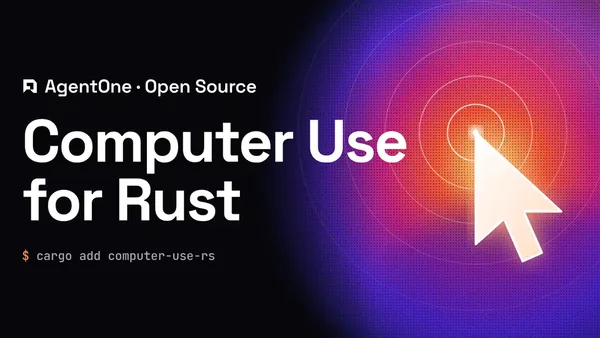
computer-use-rs: Open-Source Computer Use for Rust

AgentOne Research open-sourced computer-use-rs, a cross-platform Rust crate that enables AI agents to observe and interact with desktop applications via accessibility trees, screenshots, and plain-text outlines. It supports clicking, typing, scrolling, and dragging by element index or pixel coordinates, and can deliver input in the background without stealing focus. The library is dual-licensed under MIT or Apache-2.0 and works on macOS, Windows, and Linux.

Redis 8.12-rc1's roaring bitmap type shrinks a sparse bitmap from 24MB to 239KB
General / dev.to

Redis 8.12-rc1's roaring bitmap type shrinks a sparse bitmap from 24MB to 239KB

Redis 8.12-rc1 integrates redis-roaring as an opt-in bitmap type, shrinking a 200M-bit sparse bitmap from 25MB to 239KB and accelerating BITCOUNT 14x. The new BITRANGEINTARRAY command reads set-bit positions directly. However, the feature is a separate type (not a string encoding), so string commands like GETRANGE fail, and dense bitmaps see a ~1% memory regression.

Google AI Classroom Part 1: Solving the $25-Per-Exam Problem — Architecting a Sub-$0.02/Student Serverless AI Classroom with Gemini 4 & Firebase
Cloud / dev.to

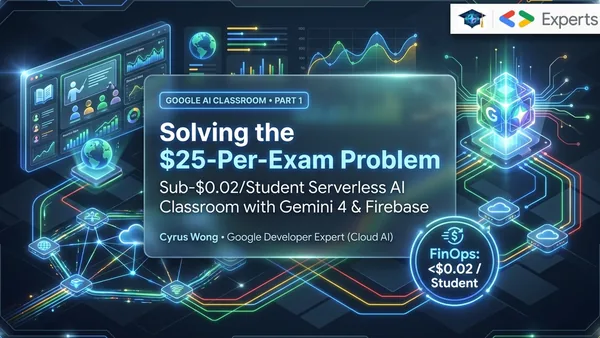
Google AI Classroom Part 1: Solving the $25-Per-Exam Problem — Architecting a Sub-$0.02/Student Serverless AI Classroom with Gemini 4 & Firebase

A Hong Kong institute built a serverless AI classroom on Google Cloud that keeps per-student exam costs under $0.02 by running 95% of proctoring inference locally in the browser using WebGPU, WebAssembly, and on-device models like Gemma 4 E2B and Whisper-Tiny. The 4-tier hybrid architecture uses Firebase for real-time signaling, Cloud Functions Gen 2 for event-driven compute, and reserves Gemini 4 Argon and Gemini 3.5 Flash for pedagogical synthesis and rubric grading. This eliminates the $15–$25 per-exam cost of commercial proctoring while addressing academic integrity in the AI era without streaming raw video to the cloud.

Pinterest Replaces Journey Clustering with 4B Qwen3 LLM, Reports Improved Engagement
AI/ML / infoq.com

Pinterest Replaces Journey Clustering with 4B Qwen3 LLM, Reports Improved Engagement

Pinterest replaced its multi-stage clustering pipeline for user-journey inference with a fine-tuned 4B-parameter Qwen3 LLM, achieving a 1.1% lift in email click-through and 1.3% improvement in push opens. The model processes up to 150 user actions over a 360-day window to generate ranked journey names, using synthetic training data from frontier models and LoRA fine-tuning. To handle production scale, Pinterest deployed NVIDIA Dynamo with vLLM on L40S GPUs, leveraging continuous batching and prefix-cache routing, while skipping inference for users processed within the prior two days.