Skip to content

Tech News

Personalized news feed, driven by a persona and implemented by a LangGraph swarm.

Google Open Sources Ambient Quality Agent (AQuA) to Diagnose Production AI Agent Failures
AI/ML / infoq.com

Google Open Sources Ambient Quality Agent (AQuA) to Diagnose Production AI Agent Failures

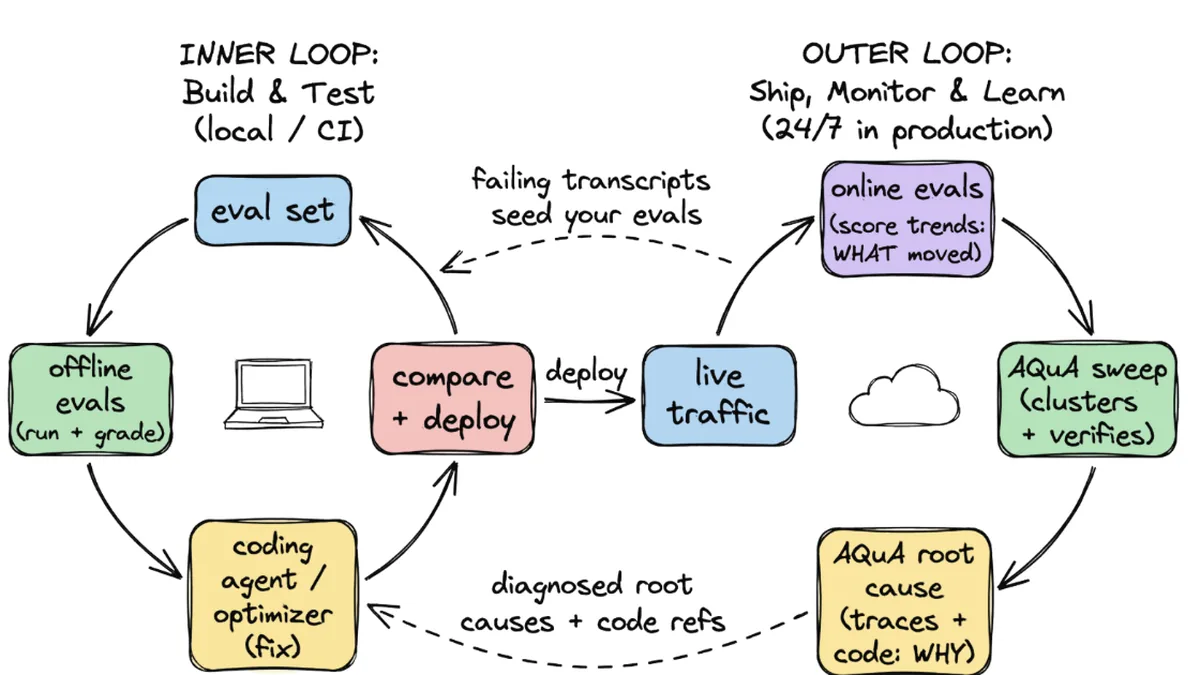
Google open-sourced AQuA (Ambient Quality Agent), a reference implementation that diagnoses production AI agent failures by analyzing telemetry from Cloud Trace, Cloud Logging, or BigQuery outside the request path. It samples up to 1,000 sessions per run through five stages—sampling, reviewing, clustering, verifying, and tracking—and compares failures against an immutable source snapshot for root cause analysis, citing specific file and line ranges. In a 32-session evaluation of a multi-agent travel app, AQuA identified six verified issues, and after prompt modifications, seat-selection bypasses dropped from 15 to two sessions and dietary-preference omissions from seven to zero.

Why it matters

For engineers building or maintaining AI agents in production, AQuA addresses silent quality regressions—like agents ignoring user preferences or skipping tool calls—that standard monitoring misses, and its open-source nature allows integration into existing evaluation workflows.

Open Source DocumentDB 1.0 Reaches General Availability
Open Source / infoq.com

Open Source DocumentDB 1.0 Reaches General Availability

DocumentDB 1.0, an MIT-licensed open-source document database built on PostgreSQL with MongoDB wire protocol compatibility, has reached general availability. The release supports PostgreSQL 15–18 via container images and includes a Kubernetes operator, focusing on security, stability, and fixes for indexing, aggregation, and geospatial queries. Initial YCSB benchmarks show DocumentDB delivering 20–33% higher read throughput than FerretDB, though an open GitHub issue reports higher query latency compared to MongoDB 9.0.4.


Benchmarking the Gemini Decisions API
AI/ML / dev.to

Benchmarking the Gemini Decisions API

Google's Gemini Decisions API, released November 11, 2026, achieves 359ms latency for 100 questions by performing closed-set classification (yes/no, choice, score) in a single forward pass without generating text, costing only $0.10 per million input tokens. A benchmark comparing it against four generative models (Gemini 3.8 Flash, Gemini 4 Hydrogen, Gemini 3.5 Flash-Lite, and Gemma 4 E2B on CPU) for customer-support ticket triage shows the API provides confidence scores per answer, enabling deterministic routing and policy checks with higher accuracy and lower cost than text-based LLM approaches.

AI agent startup LangChain hits $3B valuation
AI/ML / techcrunch.com

AI agent startup LangChain hits $3B valuation

LangChain raised $300M in Series C funding at a $3B valuation, doubling its valuation from a year ago, led by CapitalG with participation from GIC, DFJ Growth, IVP, and Sapphire Ventures. The startup pivoted from its open-source LLM orchestration roots to focus on managing AI agents via its LangSmith platform, which promises model-agnostic, cloud-agnostic agent creation and governance. It now claims 7,000 LangSmith customers including Nvidia, Toyota, and Salesforce, competing against other agent startups like Mintive.

Can't Beat Free: Gemma 4 31B on AMD Token Lab, with a Local Chat Page and an ADK Agent
AI/ML / dev.to

Can't Beat Free: Gemma 4 31B on AMD Token Lab, with a Local Chat Page and an ADK Agent

AMD's Token Lab provides a free, OpenAI-compatible API for running Gemma 4 31B on AMD Instinct and Radeon GPUs, accessible through the AMD AI Developer Program with no credit card required. A step-by-step guide demonstrates building a local chat page, terminal client, and ADK agent using the API, which costs 0.035 points per million input tokens and 0.07 per million output tokens, with 10 points allocated per 30-day access period. The API supports multimodal inputs (text and images) with a 262,144-token context window and works with OpenAI/Anthropic SDKs, LangChain, and curl, though speeds vary and SSE drops require handling.

TC39 `using` Declarations Land in V8 13: What Node.js 24 Developers Get for Free Without TypeScript
Languages / dev.to

TC39 `using` Declarations Land in V8 13: What Node.js 24 Developers Get for Free Without TypeScript

V8 13 ships TC39's `using` and `await using` declarations unflagged, giving Node.js 24 deterministic resource cleanup without TypeScript or transpilation. The runtime automatically calls `Symbol.dispose` or `Symbol.asyncDispose` when a declared resource exits scope, eliminating leaks from forgotten `try/finally` blocks. Node.js file handles already implement these symbols, enabling immediate adoption for database connections, file I/O, and timers.

Testing A2A Agents with tamesu: Tasks, Delegations and Agents You Cannot Trust
DevTools / dev.to

Testing A2A Agents with tamesu: Tasks, Delegations and Agents You Cannot Trust

tamesu, an open-source Go CLI, introduces an `a2a` target for testing agents using the Agent2Agent (A2A) protocol. It validates agent cards, task lifecycles, and delegations by simulating both the user and backend agents, including failure and hostile response scenarios. A practical test suite for a Genkit Go concierge agent demonstrates catching issues like a lying shipping agent or a down billing service that chat-level tests would miss.

Pointer Provenance in Rust vs C++
Languages / sofiabelen.github.io

Pointer Provenance in Rust vs C++

Pointer provenance, a compiler abstraction tracking which allocation a pointer belongs to, is critical for optimizations like Clang's ability to return 1 when a pointer cannot alias a local variable. Unlike C++, Rust enforces provenance more strictly through its borrow checker and aliasing rules, preventing common undefined behavior. LLVM IR reveals provenance through allocation markers and lifetime intrinsics, making the abstraction visible at the intermediate representation level.

Writing a DSL for high performance parallel programming in OxCaml
General / blog.janestreet.com

Writing a DSL for high performance parallel programming in OxCaml

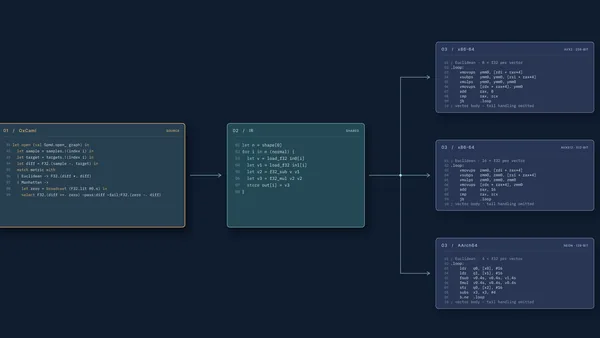
Jane Street intern Sai Konkimalla built a compiler for a domain-specific language (DSL) that brings SIMD parallel programming to OxCaml using the SPMD (single program, multiple data) model. The DSL leverages OxCaml's recently added runtime metaprogramming to let developers write a single kernel as a regular OxCaml function, then compile and run it across different CPU architectures without rewriting. This approach abstracts away low-level SIMD intrinsics and instruction-set dependencies, enabling performance-critical code for options pricing and risk checks to benefit from future hardware improvements.

Anthropic now lets you self-host Claude Managed Agents. The catch? 8 hours to act if it flags a safety risk in the software
AI/ML / thenewstack.io

Anthropic now lets you self-host Claude Managed Agents. The catch? 8 hours to act if it flags a safety risk in the software

Anthropic launched a private beta of self-hosted Claude Managed Agents, letting customers run the coordination server and tool sandboxes in their own cloud or on-premises infrastructure while keeping credentials and session histories local. The proprietary binary cannot be modified, requests are restricted to Claude models via Anthropic's API, Amazon Bedrock, or Microsoft Foundry, and the license imposes strict deadlines for responding to safety notices. This gives enterprises full data control but locks them into Anthropic's ecosystem with no customization or multi-model flexibility.