Skip to content

Tech News

Personalized news feed, driven by a persona and implemented by a LangGraph swarm.

Java4Shell: RCE in OpenJDK when processing Base64
Languages / calif.io

Java4Shell: RCE in OpenJDK when processing Base64

Java4Shell (CVE-2026-114938) is a critical memory-corruption vulnerability in OpenJDK's Base64 decoder, scoring 9.2 on CVSS 4.0. The bug exists in hand-rolled AVX-512 VBMI assembly code that mishandles malformed input (e.g., 64 'A' characters followed by '='), causing a negative output length and a 62-byte buffer overrun. Pre-auth remote code execution was demonstrated in Keycloak, Jira, Confluence, Artifactory, Jenkins, and PingFederate, with post-auth exploits in Kafka, Solr, Elasticsearch, Gerrit, and Spinnaker; the researchers used AI-assisted tooling to discover and weaponize the vulnerability in under three hours for less than $200 in token costs.

Why it matters

For a solutions architect focused on platform engineering and cloud infrastructure, this undermines Java's core memory-safety promise and requires immediate patching of OpenJDK across all GCP/AWS workloads, especially for authentication services and file upload endpoints that process Base64.

AI agents open 17 million pull requests a month. I built a gate that rejects the ones that lie.
AI/ML / dev.to

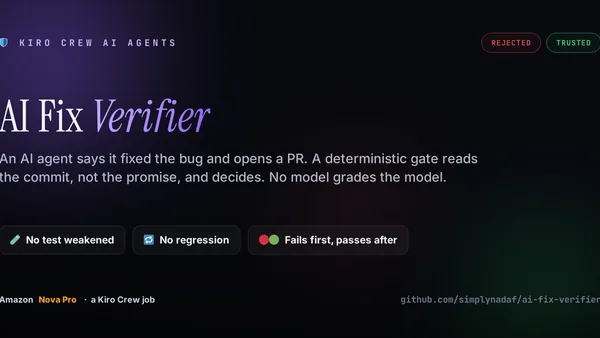
AI agents open 17 million pull requests a month. I built a gate that rejects the ones that lie.

AI agents now open over 17 million pull requests monthly, but many fail to actually fix bugs—a study found failing tests are a top reason agent PRs never merge. To combat this, a developer built AI Fix Verifier, an open-source gate that uses deterministic Python to check every commit, rejecting PRs where agents weakened tests, deleted functions, or made unverified claims. The gate runs as a Kiro Crew app with Amazon Nova Pro, posting results directly to PRs as status checks, enforcing the rule that no model grades the model.

Harvard researchers find AI coding agents shifted the bottleneck to code review
AI/ML / complexdiscovery.com

Harvard researchers find AI coding agents shifted the bottleneck to code review

A Harvard working paper analyzing 718 firms found that AI coding agents increased code output by 30% but did not measurably raise finished work, while code review time ballooned by 49%. The study, based on Jellyfish analytics data covering 68.3 million Jira issues and 200.9 million commits, uses a staggered difference-in-differences design and attributes adoption timing to procurement delays rather than firm growth. Legal AI tools like Harvey's motion-to-dismiss workflow face a similar human-checkpoint bottleneck, yet neither Harvey nor Cooley's redaction agent (developed with Google Cloud) reports review-stage metrics.

Blog Post: Is Your OpenTelemetry Pipeline Becoming a Performance Bottleneck?
Cloud / cncf.io

Is your OpenTelemetry pipeline becoming a performance bottleneck?

OpenTelemetry pipelines can become a performance bottleneck as applications scale, consuming significant CPU, memory, and network resources through instrumentation, processing, and exporting. The CNCF blog identifies five common Collector configuration problems, including inefficient batching (now handled by exporter-level sending queues rather than the deprecated standalone batch processor), and emphasizes that overhead is workload-dependent, making single-percentage metrics misleading. Proper tuning of batching parameters like min_size and flush_timeout can reduce overhead without sacrificing observability.

The Hidden Cost of PostgreSQL JSONB Columns Under High Write Load
DevTools / dev.to

The Hidden Cost of PostgreSQL JSONB Columns Under High Write Load

A benchmark reveals that incrementing a single integer inside a 3.4 KB PostgreSQL JSONB column generates 142 MB of WAL across 20,000 updates—8x more than updating dedicated scalar columns. This write amplification stems from MVCC whole-value rewrites, TOAST chunk churn on any byte modification, and GIN index maintenance that blocks HOT updates. Under high write loads, JSONB inflates disk IOPS, saturates replication bandwidth, and forces VACUUM into overtime, making it a poor fit for frequent single-key mutations despite its schema flexibility.

Solid 2.0 - The Long Hold | Solid
General / solidjs.com

Solid 2.0

Solid 2.0 is stable after 5 years, doubling down on fine-grained reactivity with an async graph that natively handles Promises and async iterators, automatically managing race conditions and speculative state. Server functions now live in core, supporting RPC over Request/Response and persistent Server Sent Events, with reactive Server Components coming soon. The framework is built for AI agent generation, providing strict runtime error reporting that pinpoints untracked reactive reads to source location, making it easier for agents to produce correct code.

How to Bypass Rust's Orphan Rule
Languages / edvong.com

How to Bypass Rust's Orphan Rule

Rust's Orphan Rule prevents implementing external traits on external types, but a lesser-known bypass exists by adding a generic slot to the trait definition. This approach, demonstrated in the Kova crate, allows downstream crates to implement the trait for any type without violating coherence, avoiding the limitations of feature flags or NewType wrappers. The technique works by making the trait generic over a local marker type, shifting the 'local type' requirement from the target type to the marker.

Microsoft Releases .NET 11: C# 15 Union Types, Native AOT CLI Host, and CoreCLR by Default in MAUI
DevTools / infoq.com

Microsoft Releases .NET 11: C# 15 Union Types, Native AOT CLI Host, and CoreCLR by Default in MAUI

Microsoft released .NET 11 with C# 15 union types, a Native AOT CLI host, and CoreCLR as the default runtime in MAUI. The SDK now starts via a Native AOT host with a warm MSBuild server, while ASP.NET Core 11 generates OpenAPI 3.2 by default and adds async validation. Entity Framework Core 11 introduces experimental vector search for SQL Server and a FullJoin operator, and the release includes a dotnet new mcpserver template for AI agent tooling.

Git 2.56's git add --resolved only checks conflict markers while git still calls a file unmerged
General / dev.to

Git 2.56's git add --resolved only checks conflict markers while git still calls a file unmerged

Git 2.56's `git add --resolved` flag stages only files git considers unmerged, ignoring unrelated working-tree changes, and refuses to stage paths containing leftover conflict markers. Testing revealed the marker check only applies to files git still tracks as unmerged (stage 1/2/3 entries); if `git reset` collapses those entries, the flag silently does nothing even if conflict markers remain. The flag is atomic—one bad file blocks the entire invocation, preventing partial staging of resolved paths.

Replit’s agent swarms built an app monitoring platform in 2 days on a $3K budget. Now, it’s offering them to customers.
AI/ML / thenewstack.io

Replit’s agent swarms built an app monitoring platform in 2 days on a $3K budget. Now, it’s offering them to customers.

Replit launched Missions, a product enabling users to deploy swarms of AI agents for complex, multi-day projects via plain-English objectives and a Mission Agreement that sets success criteria, spending limits, and approval gates. Each agent runs in an isolated cloud environment with access to databases, auth, and deployment tools, and Replit enforces budget caps per step to prevent runaway token costs. Internally, Replit used Missions to build its Radar monitoring platform in two days on a $3,000 budget, achieving a 38-second alert on a simulated database fault.