
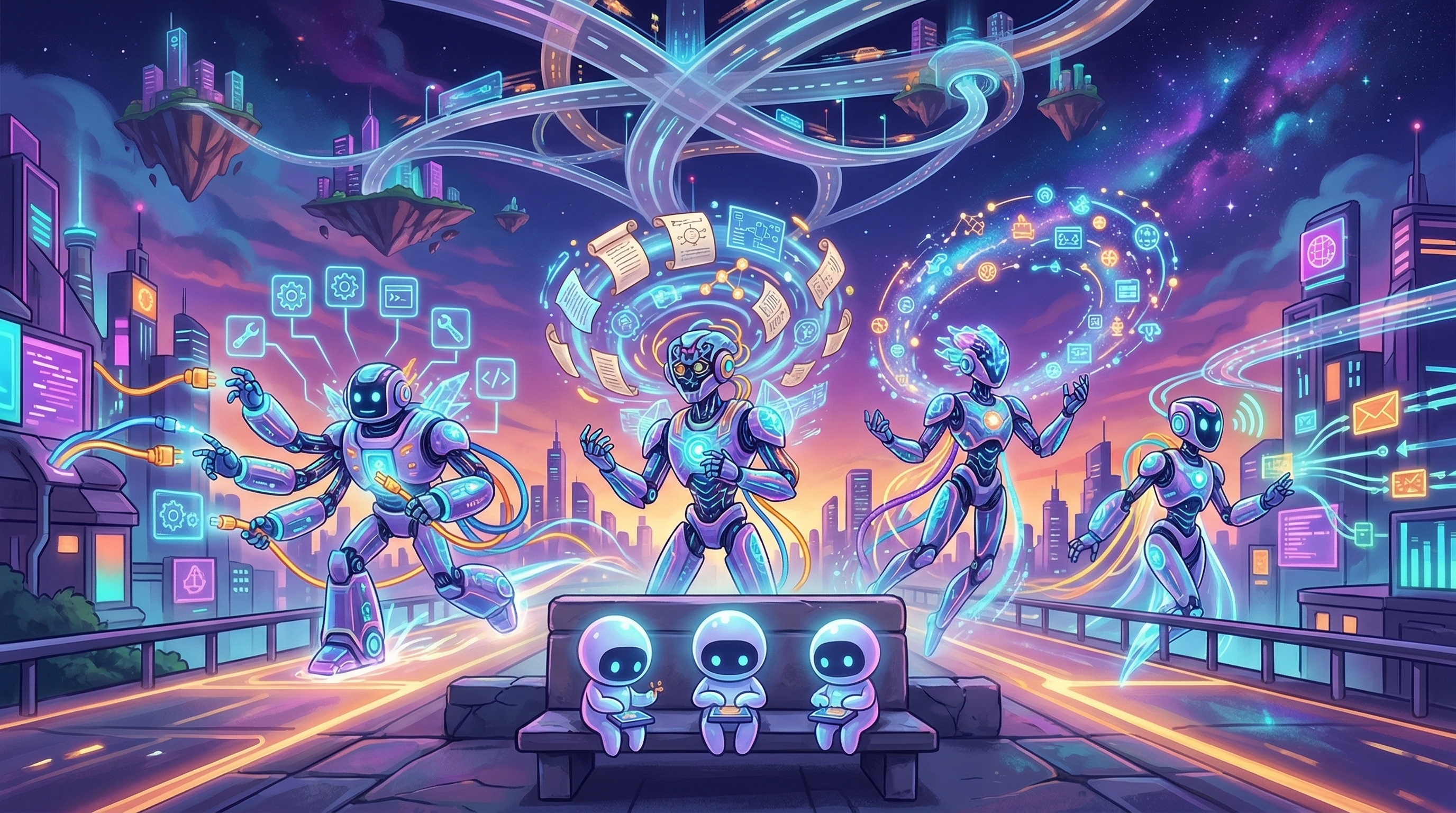
The first wave of generative AI gave machines the ability to talk. The current wave gives them the ability to do. We have moved from chatbots that respond to prompts into systems that plan, reason, use tools, and complete multi-step goals without someone hovering over every decision. These are AI agents, and the market around them is projected to exceed $10 billion this year, growing at over 45% annually. Gartner forecasts that 40% of enterprise applications will embed task-specific agents by the end of 2026, up from less than 5% in 2025.
This is not a future prediction. It is happening now. Late 2025 I hit a coding tipping point. I found myself prompting more than coding, reading and steering agents rather than writing logic. As we build more of these autonomous teams, the terminology is a mess, and it varies by vendor. My hope for 2026 is more standardisation on naming and implementation.
This article takes a high-level look at the terminology, what frameworks exist, and where they deliver real business value.
What is an AI Agent?
AI Agent. A system that can perceive its environment, reason about what to do, and take action to achieve a goal. Unlike a chatbot that predicts the next word, an agent predicts the next action. It follows a sense-think-act cycle: gather context, decide on a plan, execute using tools.
The Anatomy of an Agent
Tools. The mechanisms an agent uses to interact with the outside world. Think of them as the agent's hands. A tool might be an API wrapper, a database query, a web search, or a file reader. The agent decides which tool to call and with what parameters.
Skills. If tools are the hands, skills are the playbooks. A skill packages procedural knowledge -- the instructions for how to use tools to accomplish a specific task. A tool gives access to your CRM; a skill tells the agent how to conduct a competitive analysis using that CRM data.
Memory. How an agent retains context. Short-term memory is the current conversation window. Long-term memory stores information across sessions, often in a vector database, enabling personalisation and continuity over time.
Reasoning Engine. The logic layer that makes an agent more than a script. It evaluates context, constraints, and available options to determine a sequence of actions. This is what separates a reflex-based automation from a genuinely autonomous system.
How Agents Work Together
A single agent handling a straightforward task works fine. But real business problems are rarely straightforward. When complexity increases, you need multiple specialised agents coordinating their work. That requires two things: protocols that connect them, and patterns that organise their work.
The Protocols
Two standards are emerging, and they are complementary layers, not competitors. Both are now governed by the Linux Foundation's Agentic AI Foundation.
MCP (Model Context Protocol) gives agents hands. Introduced by Anthropic in late 2024, MCP is a standardised way for agents to connect to tools and data sources. Any MCP-compatible agent can use any MCP-compatible tool without custom integration. Adopted by OpenAI, Google, and Microsoft. Start here. Every agent needs tool access first.
A2A (Agent-to-Agent Protocol) gives agents colleagues. Introduced by Google in 2025, A2A enables agents built on different frameworks to discover each other, delegate tasks, and collaborate. Add A2A when your agents need to coordinate at scale.
The Concepts
Orchestration is the coordination layer that determines which agents run, in what order, and how they share information. This is where the architectural patterns below come in.
Swarm refers to a multi-agent system where agents operate with distributed coordination rather than centralised control. The term has become overloaded, but in practice it means agents self-organise around tasks rather than following rigid hierarchies.
The Patterns
Sequential (The Assembly Line). Agents work in a pipeline. One agent's output becomes the next agent's input. A research agent gathers data, a writer agent drafts content, a review agent checks quality. Predictable and easy to debug, but a failure anywhere in the chain stops everything.
Parallel (The Brainstorming Session). Multiple agents work on independent sub-tasks simultaneously. Their results get merged by an aggregator agent at the end. Useful when you need diverse perspectives on the same problem, like running risk analysis across multiple dimensions at once.
Hierarchical (The Org Chart). A supervisor agent coordinates specialised sub-agents. The supervisor analyses what needs doing and routes tasks to the right specialist. One agent handles internal data retrieval, another manages web searches, a third processes personal accounts. Clear division of responsibility and good for controlling access to sensitive data.
Human-in-the-Loop (The Checkpoint). Critical decisions get routed to a human for approval before execution. The workflow pauses, a human validates or modifies the proposed action, then the agent continues. Essential for regulated industries and high-stakes decisions.
Router (The Traffic Controller). A central agent determines which specialist agent to invoke based on the task or input. Similar to hierarchical, but lighter weight: it directs traffic rather than managing people.
Most production systems use hybrid approaches. You might have a hierarchical coordinator routing to sequential pipelines, with human-in-the-loop gates at critical decision points, all working against a shared database.
The Framework Landscape
Choosing the right framework depends on who is building, what they are building, and how much control they need. The landscape breaks into three categories.
Visual Workflow Platforms (Low-Code / No-Code)
These are for business users and rapid prototyping. You build agent workflows visually, dragging and connecting nodes rather than writing code.
n8n is the most established. It mixes deterministic automation steps with AI agent nodes, which means you can anchor AI reasoning in predictable logic. Strong human-in-the-loop controls and log streaming to tools like Datadog make it viable for regulated industries. Fair Code licensed, not fully open source.
Activepieces focuses on democratising agent building through a visual designer. Fully MIT licensed (truly open source). Pre-configured agent libraries for Sales, Marketing, and Support teams. Native AI integrations with minimal setup friction. Impact analytics show teams how many hours their agents save.
Make (formerly Integromat) has a large library of pre-built integrations and a visual builder that non-technical teams can use immediately.
Developer Frameworks (Code-First)
These are for engineering teams building custom agent behaviour and production systems.
CrewAI is the fastest-growing framework (44K+ GitHub stars). It uses a role-based metaphor where you define agents with roles, goals, and backstories, then assemble them into a "crew" with assigned tasks. Lowest barrier to entry for developers. Best for structured business workflows like content pipelines, customer support, and marketing automation. Some limitations when workflows need heavy conditional branching.
LangGraph is the most battle-tested for production. It models agent interactions as nodes in a directed graph, giving you precise control over execution flow. Supports durable, long-running workflows with checkpointing and human-in-the-loop oversight. Steeper learning curve, but the control is worth it for complex, stateful systems.
Microsoft AutoGen focuses on conversational multi-agent collaboration. Strong human-in-the-loop patterns and async execution. Note that Microsoft has shifted strategic focus to a broader Agent Framework, so active feature development has slowed. Still solid for conversational coordination patterns.
OpenAI Agents SDK is the simplest entry point. Optimised for OpenAI's model stack with native tool calling and structured outputs. Cleanest developer experience if you are staying within the OpenAI ecosystem. Limited if you need model flexibility.
Google ADK (Agent Development Kit) offers native A2A protocol support and multimodal agent capabilities. Worth watching if you are building on Google Cloud or need cross-vendor agent interoperability.
Autonomous Agent Systems (Experimental)
These are pushing the boundary of what agents can do, but they are not enterprise-ready.
OpenClaw lets you run a local agent with full system access: read/write files, run shell commands, execute scripts. Its "self-evolution" capability means the agent can build its own tools on the fly. Impressive for personal productivity and proof-of-concepts. But it has security vulnerabilities, no governance framework, and no enterprise controls. It represents what is possible, not what is production-ready.
OpenHands (38K+ GitHub stars) is an autonomous coding agent. Useful as a software development use case reference, but similarly early-stage for enterprise deployment.
Use Cases That Actually Deliver
The hype-to-value ratio in agentic AI is still high. Here is where agents are delivering measurable results today.
Intelligent Document Processing
A multi-agent system where one agent extracts data from documents (insurance claims, loan applications, legal contracts), another validates against business rules, and a third handles exceptions. Financial services firms report significant reductions in processing time and error rates. This is one of the clearest ROI stories in agentic AI because the workflow is structured, the rules are well-defined, and the volume justifies automation.
Autonomous Customer Support
An agent triages incoming tickets, retrieves relevant knowledge base articles, drafts a response, and escalates to a human when confidence is low. The hierarchical pattern with human-in-the-loop gates at critical decision points. Customer service leads agentic adoption because the workflow is repeatable and the ROI is directly measurable.
Research and Content Pipelines
A sequential multi-agent system where a research agent mines sources for relevant information, an analysis agent synthesises findings, a writing agent drafts content, and a review agent checks quality. Marketing teams and analyst firms are using this pattern to compress research cycles from days to hours.
Internal Knowledge and Operations
Agents connected to internal tools via MCP that can query databases, retrieve documents, update records, and trigger workflows across CRM, ticketing, and communication platforms. The value here is not in any single task but in reducing the friction of moving between systems. Instead of a person switching between six tabs, an agent coordinates the work across all of them.
Summary
This is a snapshot of a fast-moving space. I'd love to hear what technologies and use cases you are adopting.
A word of caution: not everything needs an agent. If a simple function call solves the problem, use that. If there are no clear success metrics, you cannot justify the investment. And high-stakes decisions without human oversight are where agents fail loudest. The hype is real, but so is the waste when agents get deployed where a script would do.
The organisations that master agentic architecture now will have a meaningful head start over those still experimenting in two years. But the goal is augmentation, not replacement. The best agent systems keep humans in the loop for decisions that matter and let agents handle the repetitive coordination that burns time and attention.
The experimental phase is over. The deployment phase has begun. Follow along at foursignals.dev or connect with me on LinkedIn.