Skip to content

Four Signals

Presentation: Directing a Swarm of Agents for Fun and Profit
ai/ml / InfoQ

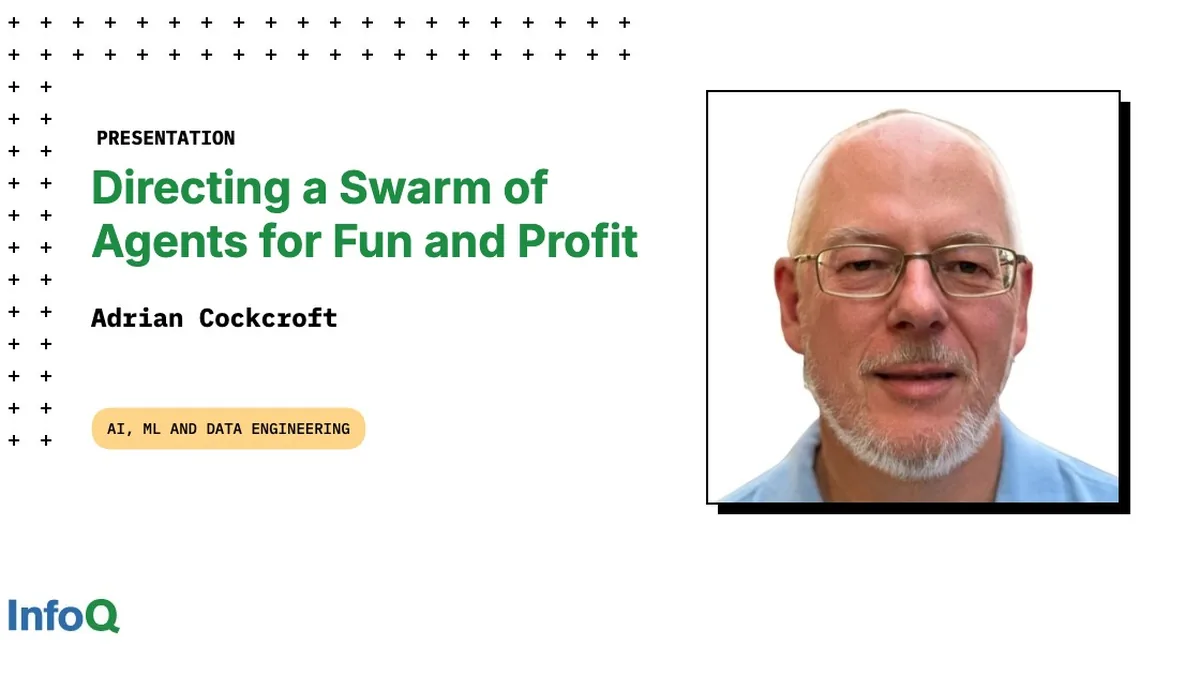
Presentation: Directing a Swarm of Agents for Fun and Profit

Adrian Cockcroft, former Netflix cloud architect, details the shift to AI-native development via director-level management of agent swarms using Cursor and Claude Flow. His experiments in BDD, MCP servers, and language porting demonstrate that engineering's future lies in building platforms for AI-driven development or…

Why it matters

This matters because it provides a strategic framework for senior engineers to adopt AI-native practices using existing tools like Cursor, directly impacting orchestration and platform design in their work.

ai/ml / Lobsters

Reading leaked Claude Code source code

Leaked Claude Code source (132k LOC TypeScript) uses hex-encoded species names to bypass a build check grepping for internal model codenames in excluded-strings.txt. Feature flags like COORDINATOR_MODE implement multi-agent orchestration with explicit agent instructions, while a TypeScript type I_VERIFIED_THIS_IS_NOT_CODE_OR_FILEPATHS forces developers to certify non-sensitive analytics data. Directly reveals internal multi-agent orchestration patterns (COORDINATOR_MODE) and build-time security tactics (excluded-strings.txt) from a leading AI product, relevant to your focus on agent systems and secure devtool design. Implement compile-time forcing functions like I_VERIFIED_THIS_IS_NOT_CODE_OR_FILEPATHS to prevent accidental PII/code leaks in analytics pipelines.
Pinterest Deploys Production-Scale Model Context Protocol Ecosystem for AI Agent Workflows
ai/ml / InfoQ

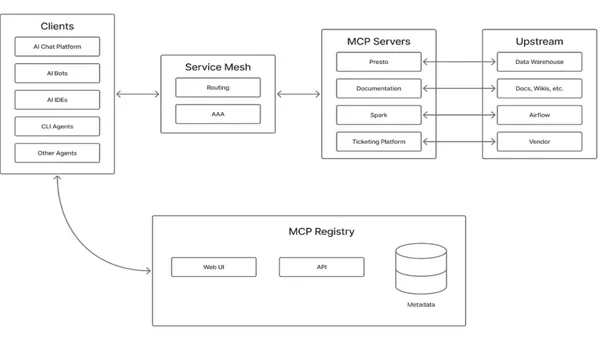
Pinterest Deploys Production-Scale Model Context Protocol Ecosystem for AI Agent Workflows

Pinterest deployed a production-scale Model Context Protocol (MCP) ecosystem using cloud-hosted, domain-specific MCP servers (Presto, Spark, Airflow) connected via a central registry, enabling AI agents to automate engineering tasks with 66,000 monthly invocations saving 7,000 hours, while enforcing security via human-in-the-loop approvals and a two-layer authorization model. This demonstrates a scalable, secure pattern for integrating AI agents with internal tools and data sources, directly relevant to your focus on agent orchestration, cloud infrastructure, and developer productivity. Adopt a domain-specific MCP server architecture with a central registry to standardize AI tool access while enforcing governance through human-in-the-loop approvals and fine-grained authorization.

The reputation of troubled YC startup Delve has gotten even worse
open/source / TechCrunch

The reputation of troubled YC startup Delve has gotten even worse

Delve faces allegations of violating the Apache 2.0 license by forking Sim.ai's open-source SimStudio agent-building tool, modifying it, and selling it as their proprietary Pathways product without attribution. This is particularly egregious as Sim.ai, a fellow YCombinator alum and Delve customer, received no compensation. Delve has since scrubbed Pathways from their site as Insight Partners' $32M Series A due diligence comes under scrutiny. As a senior engineer focused on open-source adoption and startup tech stacks, this underscores the critical legal and reputational risks of non-compliant open-source usage, directly impacting vendor trust and integration decisions in your own architectures. Implement automated license scanning and attribution verification in your CI/CD pipeline for all forked or modified open-source dependencies to prevent inadvertent violations.

When Chrome Ate My RAM: Designing a Pressure-Aware Tab Orchestrator with Rust
languages / Dev.to

When Chrome Ate My RAM: Designing a Pressure-Aware Tab Orchestrator with Rust

The article details a Chrome MV3 extension paired with a Rust native host via Native Messaging to manage tab lifecycles. The Rust pressure engine scores system state (RAM, CPU, battery) while focus clustering adjusts TTLs based on active workflow context. Strict guardrails—including never discarding active/pinned/audible tabs and enforcing cooldowns—ensure deterministic, non-disruptive behavior. As a senior engineer focused on developer tooling and infrastructure, this demonstrates a pragmatic hybrid architecture (browser extension + native host) for building deterministic, context-aware system tools without cloud dependencies. Implement a split-architecture pattern for browser tooling, delegating system metrics to a native host and browser lifecycle to an extension, with explicit guardrails to preserve user intent.

pGenie social preview showing SQL-first PostgreSQL tooling
languages / Lobsters

pGenie – SQL-first code generator for PostgreSQL (Haskell, Rust, Java)

pGenie is a PostgreSQL-specific code generator (Haskell/Rust/Java) that produces type-safe client SDKs directly from plain SQL migrations and queries, without ORM abstractions. It analyzes queries against evolving schema versions in CI, catching type mismatches, nullability errors, and performance issues like sequential scans before deployment, and serves as a verification gate for LLM-generated SQL proposals. This directly enhances your focus on AI-assisted development and robust tooling by providing a proof system to validate LLM-drafted SQL against real schema evolution, preventing runtime failures in cloud-native applications where SQL correctness is critical. Integrate pGenie into your CI pipeline to automatically validate PostgreSQL schema changes and queries, using it as a mandatory quality gate for any LLM-assisted SQL work.

Holo3: Breaking the Computer Use Frontier
general / Hugging Face Blog

Holo3: Breaking the Computer Use Frontier

Holo3 by Hcompany achieves 78.85% on OSWorld-Verified, setting a new state of the art for computer use agents. It employs an agentic flywheel with synthetic navigation data and reinforcement learning for robust perception and decision-making in enterprise workflows. With 10B active parameters, it offers a cost-efficient alternative to proprietary models like GPT 5.4, available via Inference API and open-sourced under Apache2. This matters because it delivers a high-performance, open-source agent model for orchestrating complex desktop workflows, directly supporting your focus on AI/ML agent orchestration and cost-effective cloud infrastructure. Evaluate Holo3's open-source weights and Inference API for production deployment in multi-agent systems requiring precise computer use capabilities.

Subscription bombing and how to mitigate it
general / Hacker News (100+)

Subscription bombing and how to mitigate it

Suga detected subscription bombing via inactive accounts with gibberish names, using Resend and PostHog to trace bots that sign up then request password resets within 60 seconds. Bots mimic human typing with uniformly random one-character-per-second delays and originate from diverse countries like India and Brazil. The low-volume, global pattern evades typical bot detection. As a senior engineer building authentication systems, you need to design defenses against low-and-slow attacks that exploit email-based workflows and evade simple rate limiting. Implement adaptive bot detection and mandatory email verification before triggering any sign-up emails.

EmDash – A spiritual successor to WordPress that solves plugin security
cloud / Hacker News (100+)

EmDash – A spiritual successor to WordPress that solves plugin security

Cloudflare's EmDash is a serverless CMS built with TypeScript and Astro that isolates plugins in Dynamic Workers to address the 96% of WordPress security issues from plugins. The MIT-licensed open-source project, in v0.1.0 preview, deploys on Cloudflare or any Node.js server and aims for WordPress compatibility without code reuse. This showcases a practical serverless architecture with plugin isolation, directly relevant to your work in cloud infrastructure and secure developer tooling for scalable systems. Assess EmDash's Dynamic Workers isolation model to enhance security in your own plugin-based or microservices architectures.

general / Lobsters

Packaging 128 languages with Nix

Packaging 128 languages with Nix

IBM Announces Strategic Collaboration with Arm
general / Hacker News (100+)

IBM Announces Strategic Collaboration with Arm

IBM and Arm are collaborating on dual-architecture hardware, integrating IBM's Telum II processor and Spyre Accelerator with Arm's ecosystem to run AI workloads on enterprise systems. The partnership advances virtualization for Arm software on IBM platforms, enhances high-availability security for data sovereignty, and prioritizes workload portability over disruptive trade-offs. This signals a strategic shift toward flexible, scalable infrastructure for AI-intensive operations. As a senior engineer focused on orchestration and cloud infrastructure, this collaboration directly influences your architecture decisions for deploying scalable AI workloads across hybrid environments, balancing ecosystem reach with mission-critical reliability. Evaluate how dual-architecture systems like IBM's Telum II with Arm integration can optimize your AI workload orchestration for hybrid cloud deployments.

languages / Lobsters

Python Yet Reforged Entirely

pyre ports PyPy's meta-tracing JIT architecture to Rust, preserving the design and keeping MaJIT reusable as a general tracing JIT framework. It establishes a no-GIL runtime foundation and leverages Rust for memory safety, tooling, and maintainability. A high-performance, memory-safe Python runtime directly improves the efficiency and reliability of AI/ML agent orchestration systems in cloud-native environments, aligning with your focus on infrastructure and developer productivity. Assess pyre's potential for optimizing Python-based services in your tech stack, especially where performance and safety are critical.

ESLint v10: Flat Config Completion and JSX Tracking
security / InfoQ

ESLint v10: Flat Config Completion and JSX Tracking

ESLint version 10 has removed the legacy eslintrc configuration system, finalizing a long transition to flat config. The update enhances developer experience, especially for plugin authors and monorepo teams, by changing configuration file location and improving JSX reference tracking. Node.js support has been tightened, and new assertion options have been added to the RuleTester API. By Daniel Curtis