Skip to content

Four Signals

Qwen3.6-Plus: Towards real world agents
ai/ml / Hacker News (100+)

Qwen3.6-Plus: Towards real world agents

The article likely announces Qwen3.6-Plus, a new AI model from Alibaba Cloud, emphasizing enhancements for deploying AI agents in practical, dynamic environments. It probably covers improvements in agent reasoning, tool integration, or multi-agent coordination relevant to orchestration frameworks like LangGraph or Crew…

Why it matters

As a senior software engineer focused on AI/ML agent orchestration, this matters because Qwen3.6-Plus could offer new model capabilities or open-source tools that influence the design and efficiency of real-world agent systems in cloud-native applications.

Why coding agents will break your CI/CD pipeline (and how to fix it)
ai/ml / The New Stack

Why coding agents will break your CI/CD pipeline (and how to fix it)

Autonomous AI agents generating 10x more code overwhelm CI/CD by shifting the bottleneck to validation; shared staging environments fail under asynchronous parallel commits, causing cascading microservice outages. Teams must implement isolated, production-like validation environments per agent to prevent deploy gaps and post-merge failures. This directly impacts your focus on AI/ML agent orchestration and cloud-native architectures, as validation bottlenecks will determine whether increased code velocity translates to safe, scalable deployment. Replace shared staging with ephemeral, agent-isolated validation environments to prevent cascading failures in microservices.

Open Source Security Tool Trivy Hit by Supply Chain Attack, Prompting Urgent Industry Response
security / InfoQ

Open Source Security Tool Trivy Hit by Supply Chain Attack, Prompting Urgent Industry Response

Attackers compromised Aqua Security's Trivy by publishing malicious v0.69.4 release on March 19, 2026, using stolen repository credentials to exfiltrate data via compromised GitHub Actions and package distribution. Maintainers removed the release and urged users to downgrade and rotate secrets, exposing how CI/CD pipelines and trusted developer tooling are critical attack surfaces. As a senior engineer building AI/ML agent systems and cloud infrastructure with heavy reliance on open-source tooling and automated CI/CD, this incident directly compromises the integrity of your build pipelines and requires immediate audit of your toolchain's trust boundaries. Verify artifact signatures and enforce strict credential isolation for all third-party developer tools in your CI/CD workflows.

Decisions that eroded trust in Azure – by a former Azure Core engineer
cloud / Hacker News (100+)

Decisions that eroded trust in Azure – by a former Azure Core engineer

A former Azure Core engineer details specific strategic and operational decisions made by Microsoft that damaged customer and developer trust in the Azure platform, likely covering issues like pricing changes, service deprecations, or opaque communication. As a cloud infrastructure specialist, understanding the trust erosion factors at a major provider like Azure is critical for evaluating vendor lock-in risks, designing resilient multi-cloud strategies, and anticipating potential pitfalls in platform-dependent architectures. Audit your cloud provider's historical decisions on pricing, service lifecycle, and communication to model potential risks for your own infrastructure and data gravity.

Google releases Gemma 4 open models
ai/ml / Hacker News (100+)

Google releases Gemma 4 open models

Google launched Gemma 4, introducing E2B and E4B open models optimized for maximum compute and memory efficiency on mobile and IoT devices. These models enable advanced AI deployment in edge environments with minimal resource overhead. As a senior engineer focused on agent orchestration and cloud-edge systems, Gemma 4 offers open, efficient models that can be integrated into distributed architectures for low-latency, cost-effective AI at the edge. Evaluate Gemma 4's E2B and E4B variants for embedding in your multi-agent frameworks to enhance edge intelligence without compromising performance.

Harness engineering for coding agent users
ai/ml / Martin Fowler

Harness engineering for coding agent users

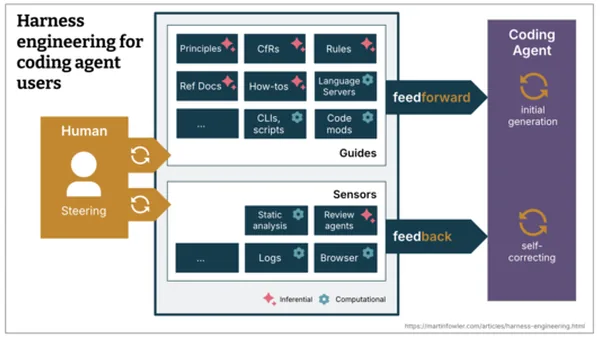
Harness engineering for coding agents, defined as Agent = Model + Harness, uses outer harnesses with feedforward guides and feedback sensors to build trust. Computational controls like tests and linters provide deterministic steering, while inferential controls like AI reviews add semantic judgment. This reduces review toil and improves system quality by enabling self-correction. As a senior engineer focused on AI agent orchestration and developer tooling, this framework directly addresses trust and efficiency in AI-assisted coding, reducing manual oversight and enhancing system reliability. Implement an outer harness for your coding agents that combines computational controls (e.g., linters) and inferential controls (e.g., AI reviews) to minimize review burden and maximize output quality.

Cursor 3
general / Hacker News (100+)

Cursor 3

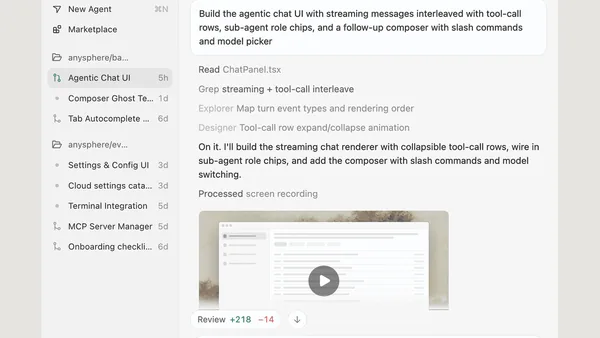
Cursor 3 debuts a scratch-built, agent-first interface unifying local/cloud workflows with Composer 2 for rapid iteration. It supports parallel multi-repo agents, MCP-extensible plugins, and seamless session handoffs via Cmd+Shift+P. Enhanced diffs and PR management streamline code review within this new paradigm. This directly advances your focus on agent orchestration by providing a unified workspace that abstracts environment management, letting you concentrate on higher-level system design and multi-agent coordination. Evaluate Cursor 3's agent handoff workflow and plugin marketplace to assess integration into your team's AI development pipeline.

Axios npm Package Compromised in Supply Chain Attack
security / InfoQ

Axios npm Package Compromised in Supply Chain Attack

The Axios npm package (100M+ weekly downloads) was compromised in versions 1.14.1 and 0.30.4 via a hijacked maintainer account, injecting malware through the typosquatted plain-crypto-js@4.2.1 dependency. Socket's scanner detected the attack within six minutes, impacting projects with unpinned caret ranges like ^1.14.0. Mitigation requires immediate rollback, dependency pinning, and settings like ignore-scripts=true, with alternatives such as native fetch offering smaller attack surfaces. As a senior engineer focused on developer tooling and infrastructure, supply chain attacks directly threaten the security of your build pipelines and runtime environments, impacting system reliability and compliance. Pin all dependencies and configure npm to ignore install scripts to prevent similar supply chain compromises.

Why Broadcom gave Velero to the CNCF Sandbox — and what it means for Kubernetes data protection
open/source / The New Stack

Why Broadcom gave Velero to the CNCF Sandbox — and what it means for Kubernetes data protection

Broadcom transferred Velero, Kubernetes' backup and restore tool, to the CNCF Sandbox, shifting governance to foster community trust and collaborative growth. This move bolsters Broadcom's full-stack Kubernetes strategy by integrating with vSphere for lifecycle management and reducing operational overhead. Broadcom aims to evolve Velero into an industry-standard data protector, expanding its use beyond current definitions. This governance shift impacts your Kubernetes data protection tooling choices, influencing cloud infrastructure reliability and reducing vendor lock-in risks in production deployments. Evaluate Velero's CNCF sandbox progress to inform your Kubernetes backup architecture and adopt emerging open-source standards.

The laptop return that broke a RAG pipeline
general / The New Stack

The laptop return that broke a RAG pipeline

The retrieval accuracy gap in RAG systems occurs when vector similarity retrieves stale policy documents or mis-scoped content, as semantic closeness doesn't ensure factual correctness. Hybrid search—a single query merging vector similarity with SQL predicates—addresses this by letting the database optimizer apply structured filters before vector scans, avoiding inefficient two-phase filtering. You're building RAG for AI agents where silent failures from outdated or mis-scoped documents directly impact user trust and operational correctness in production. Implement hybrid search queries that combine vector similarity with time, scope, or permission predicates in your RAG database schema.

Article: Replacing Database Sequences at Scale Without Breaking 100+ Services
general / InfoQ

Article: Replacing Database Sequences at Scale Without Breaking 100+ Services

Coupang replaced database sequences during a migration to DynamoDB by implementing a client-side library with two-tier caching, supporting 10,000+ counters across 100+ services. By dropping gap-free IDs and strict ordering, they eliminated network calls and ensured backward compatibility through full parameter matching, enabling the Orders team to migrate 12 services in three weeks. This demonstrates a pragmatic approach to large-scale database migrations that prioritizes operational simplicity and backward compatibility—critical for senior engineers managing cloud infrastructure and developer tooling at scale. Implement a client-side sequence generation library with multi-tier caching to maintain backward compatibility and eliminate network dependencies during database migrations.

Module Federation 2.0 Reaches Stable Release with Wider Support Outside of Webpack
devtools / InfoQ

Module Federation 2.0 Reaches Stable Release with Wider Support Outside of Webpack

Module Federation 2.0 stable release, built from ByteDance's infrastructure, introduces dynamic TypeScript type hints, a decoupled runtime, and Node.js support. It now supports bundlers like Rspack, Rollup, and Vite alongside frameworks such as Next.js and Storybook, with migration via the @module-federation/enhanced plugin. New tools include an mf-manifest.json protocol and a Side Effect Scanner for safer remote module integration. This directly impacts your work in developer tooling and open-source adoption by reducing Webpack lock-in, improving type safety in micro-frontends, and extending module sharing to backend services—key for modern full-stack and multi-agent system architectures. Evaluate Module Federation 2.0's type hints and multi-bundler support to reduce micro-frontend friction in your stack, and test the Side Effect Scanner before integrating remote modules.

Why I built a self-hosted centralized backup manager
open/source / Dev.to

Why I built a self-hosted centralized backup manager

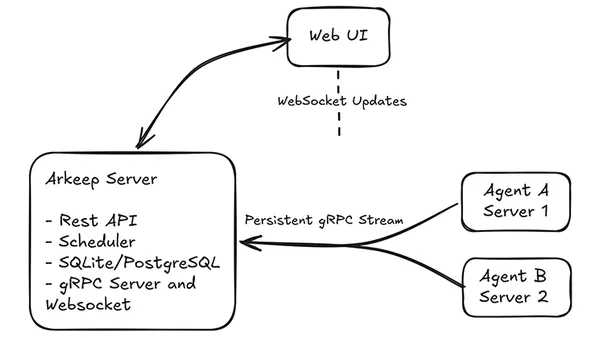
Arkeep centralizes multi-machine backups via a server/agent model where agents use persistent outbound gRPC streams, eliminating inbound ports and SSH. The server orchestrates Restic-based jobs with pre/post hooks, streaming real-time logs and metrics to a SQLite/PostgreSQL database, while supporting OIDC SSO (e.g., Zitadel) for ISO 27001 compliance. This demonstrates a production-grade agent orchestration pattern using outbound-only gRPC streams, directly applicable to building secure, auditable distributed systems in cloud-native environments. Implement centralized job dispatch via persistent outbound gRPC streams instead of SSH polling to simplify NAT traversal, enhance security, and enable real-time monitoring for multi-node systems.