
Skip to content

Four Signals

Claude Platform on AWS
ai/ml / Hacker News (100+)

Claude Platform on AWS

Anthropic's Claude Platform is now GA on AWS, bringing the full Claude API with IAM authentication, CloudTrail audit logging, and AWS billing that retires commitments. It includes Claude Managed Agents for scalable agent deployment, code execution, web search, MCP connector, and the Claude Console, with models Opus 4.7…

Why it matters

For a senior engineer building AI agents on cloud infrastructure, this eliminates the need to manage separate API keys and billing, letting you deploy Claude agents directly within your existing AWS IAM and cost governance model.

Sam Altman with OpenAI logo on green background.
ai/ml / The Verge

OpenAI just released its answer to Claude Mythos

OpenAI launched Daybreak, a security initiative combining GPT-5.5-Cyber and the Codex Security agent to automate threat modeling and vulnerability patching. It arrives just over a month after Anthropic's Claude Mythos and integrates GPT-5.5 with Trusted Access for Cyber, alongside industry and government partnerships to deploy increasingly capable cyber models. For a senior engineer building AI agents and cloud infrastructure, Daybreak signals a shift toward agent-driven security automation that could reshape DevSecOps pipelines and threat response strategies. Evaluate Daybreak's agent-based vulnerability detection for integrating into your CI/CD and security workflows.
Postmortem: TanStack NPM supply-chain compromise
ai/ml / Hacker News (100+)

Postmortem: TanStack NPM supply-chain compromise

An attacker chained three GitHub Actions vulnerabilities—pull_request_target (Pwn Request), cache poisoning across fork/base trust boundary, and OIDC token memory extraction—to publish 84 malicious versions across 42 @tanstack/* npm packages. No npm tokens were stolen; the payload executed via optionalDependencies and prepare lifecycle scripts during install. Detected externally by StepSecurity's ashishkurmi within 20 minutes, all affected versions deprecated; install hosts from 2026-05-11 require rotating AWS, GCP, Kubernetes, Vault, GitHub, npm, and SSH credentials. For senior engineers managing open-source or CI/CD pipelines, this demonstrates how known GitHub Actions design flaws can be combined to compromise the entire supply chain, emphasizing the need for explicit trust-boundary mitigations. Audit your GitHub Actions workflows for pull_request_target usage, implement cache isolation between forks and base, and restrict OIDC token permissions to prevent similar chained attacks.

Linux bitten by second severe vulnerability in as many weeks
security / Ars Technica

Linux bitten by second severe vulnerability in as many weeks

Dirty Frag, a deterministic Linux privilege escalation exploit chaining CVE-2026-43284 and CVE-2026-43500, grants root access from containers or low-privilege users by using splice() to plant a read-only page-cache reference into an sk_buff frag, then modifying it via in-place crypto operations in esp4/esp6 and rxrpc handlers. Microsoft has observed in-the-wild experimentation. Patches are now available from Debian, AlmaLinux, and Fedora, but other distributions lag. As a senior engineer managing cloud infrastructure and containerized workloads, this vulnerability directly threatens multi-tenant environments and requires immediate patching to prevent root compromise. Patch Dirty Frag immediately on all Linux systems, especially shared hosting and container hosts, and review kernel page cache hardening.

Mythos finds a curl vulnerability
security / Lobsters

Mythos finds a curl vulnerability

Anthropic's Mythos AI model, accessed via the Linux Foundation's Alpha Omega program, found a single vulnerability in curl's 178K-line codebase during its first scan. This adds to the 200-300 bugfixes already triggered by other AI tools like AISLE, Zeropath, and OpenAI's Codex Security over the past year, highlighting the growing role of AI in open-source security auditing. For a senior engineer building AI-driven developer tooling and securing critical infrastructure, this demonstrates how frontier models are being applied to real-world codebases and the practical impact on vulnerability discovery in widely-used open-source projects. Integrate AI-powered static analysis into your CI pipeline to catch vulnerabilities early, but treat it as a complement to—not a replacement for—human review and traditional fuzzing.

open/source / Hacker News (100+)

Learning Software Architecture

Software architecture is best learned by doing, as matklad's experience with IntelliJ Rust and rust-analyzer shows. Conway's law and incentive structures dominate technical decisions: rust-analyzer's design (stable Rust, no C dependencies, fast tests, catch_unwind isolation) explicitly targets both deep compiler contributors and weekend warriors. The key insight is that social and incentive issues outweigh code quality in shaping software. This reinforces that as a senior engineer, you must consider team dynamics and incentives when designing systems, not just technical purity. Design your project's architecture to match the incentive structure of your contributors, not just the ideal technical solution.

AWS Lambda Is Dead. The $0.20 Was Never the Price
cloud / Dev.to

AWS Lambda Is Dead. The $0.20 Was Never the Price

After migrating 47 Lambda functions, a team's monthly bill dropped from $8,362 to $1,790, revealing that Lambda's $0.20/request is a loss leader for a bundle where API Gateway, CloudWatch, and NAT dominate. The August 2025 INIT billing change now charges for cold start initialization, hitting JVM and ML functions hardest, with 23% of customer-facing invocations experiencing cold starts. The crossover point where Fargate or Workers wins has moved from 20M to 2M invocations per month, making Lambda uneconomical for most API, webhook, and auth workloads. For a senior engineer building serverless architectures, this exposes the hidden cost multipliers and recent pricing changes that make Lambda a poor default for latency-sensitive or high-volume endpoints. Audit your serverless bill for hidden orchestration costs and evaluate alternatives like Cloudflare Workers or Fargate once monthly invocations exceed 2M.

devtools / Lobsters

A Technical Guide to Compiling Emacs for Performance on Linux and Unix systems

Compiling Emacs from source with -march=native and enabling the native Lisp compiler via libgccjit transforms Lisp packages into machine code, outperforming generic distribution binaries. Dropping legacy X11 for Wayland (using PGTK with gtk3, cairo, harfbuzz) improves rendering and system integration. The guide details dependency installation for Arch, Debian, and generic Linux, and fine-tuning native-comp via native-comp-compiler-options in early-init.el. For a senior engineer using Emacs as a primary editor, this optimization directly reduces latency in everyday editing and package loading, improving workflow efficiency. Compile Emacs with --with-native-compilation and -march=native, then configure native-comp-compiler-options in early-init.el for maximum Lisp performance.

languages / Lobsters

Zig vs Rust in 2026

Zig's human-ergonomic features (allocator interface, arbitrary bit-width integers, packed structs) are overshadowed by AI coding agents that provide 100x productivity boosts, making Rust's ecosystem and nightly Allocator trait more attractive for unsafe systems programming. The author now prefers Rust because agents work better with its tooling, and AI can generate code to compensate for Rust's ergonomic gaps. For engineers building agent-driven development pipelines, this highlights that language choice should prioritize agent compatibility over human ergonomics, impacting tooling and infrastructure decisions. Prioritize AI agent compatibility when selecting systems programming languages for new projects.

Ratty: A terminal emulator with inline 3D graphics
general / Lobsters

Ratty: A terminal emulator with inline 3D graphics

Ratty appears to be a new terminal emulator that supports inline 3D graphics, likely leveraging GPU acceleration or a novel rendering approach to display 3D content directly within the terminal. This could enable developers to visualize data, simulations, or interactive 3D models without leaving the command line. For a developer focused on tooling and productivity, Ratty could redefine terminal-based workflows by merging traditional CLI interaction with rich 3D visualizations, potentially useful for debugging, data exploration, or immersive development environments. Evaluate Ratty's API and performance to see if it can replace or augment your current terminal setup for 3D data visualization or interactive tooling.

Netflix Serves 84% of Query Results from Cache with Interval-Aware Caching in Apache Druid
general / InfoQ

Netflix Serves 84% of Query Results from Cache with Interval-Aware Caching in Apache Druid

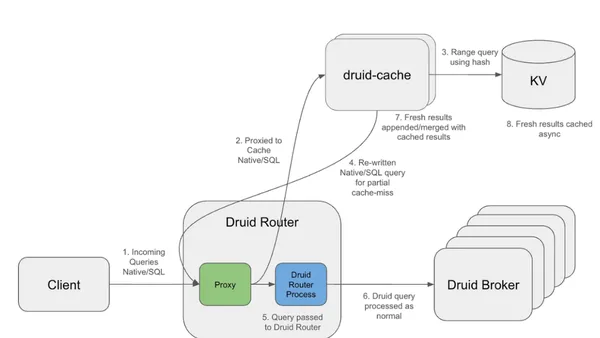
Netflix's interval-aware caching for Apache Druid serves 84% of query results from cache by decomposing rolling window queries into granularity-aligned buckets with exponential TTL, reusing historical segments via an external proxy layer while recomputing only the most recent interval. This reduced query load by 33%, improved P90 latency by 66%, and cut result bytes up to 14x for real-time analytics dashboards processing trillions of rows. For engineers building data-intensive monitoring or experimentation dashboards, this technique directly reduces compute costs and latency by eliminating redundant scans on sliding window queries—a pattern common in real-time analytics at scale. Adopt interval-aware caching with time-aligned segments and exponential TTL to avoid recomputing overlapping historical data in rolling window queries.

Copy Fail and Dirty Frag: Linux Page-Cache Exploits Target Every Major Distribution
security / InfoQ

Copy Fail and Dirty Frag: Linux Page-Cache Exploits Target Every Major Distribution

Two Linux kernel local privilege escalation vulnerabilities—Copy Fail (CVE-2026-31431) and Dirty Frag (CVE-2026-43284, CVE-2026-43500)—exploit page-cache write primitives similar to Dirty Pipe, allowing unprivileged users to gain root on all major distributions. Copy Fail, discovered by Theori's AI tool Xint Code in under an hour, targets the crypto subsystem's algif_aead module and roots Ubuntu 24.04, Amazon Linux 2023, RHEL 10.1, and SUSE 16 with a 732-byte Python PoC. Dirty Frag chains xfrm-ESP and RxRPC page-cache writes to cover distribution-specific gaps (e.g., namespace restrictions), achieving root on every tested distro; patches landed in mainline by early April 2026, but unpatched systems remain exposed. For a senior engineer managing cloud infrastructure, these exploits directly threaten Linux servers in production, and the use of AI for vulnerability discovery signals a shift in security tooling that impacts your threat model and patch cadence. Patch your Linux kernels immediately—verify your distribution's fix for CVE-2026-31431, CVE-2026-43284, and CVE-2026-43500, and review your page-cache attack surface.