
Skip to content

Four Signals

Engineering Agent Memory
ai/ml / Dev.to

Engineering Agent Memory

The article argues that most AI agents fail in production due to stateless architecture, not model limitations, and proposes a structured memory system with working, semantic, and episodic layers. It highlights Oracle's AI Developer Hub GitHub repo, which provides Jupyter notebooks demonstrating intentional memory stor…

Why it matters

For engineers building agent orchestration systems, this provides a concrete architectural pattern to replace fragile prompt stuffing with scalable, persistent memory—critical for production multi-agent workflows.

AWS WorkSpaces Now Lets AI Agents Operate Legacy Desktop Applications Without APIs
ai/ml / InfoQ

AWS WorkSpaces Now Lets AI Agents Operate Legacy Desktop Applications Without APIs

AWS WorkSpaces now serves as managed virtual desktops for AI agents, using computer vision and input simulation to interact with legacy applications that lack modern APIs. The service integrates with the Model Context Protocol (MCP), enabling frameworks like LangChain, CrewAI, and Strands Agents to connect securely. While this approach avoids expensive modernization, benchmark data from Reflex shows vision-based agents consume 45x more tokens than API-based agents, highlighting a cost-performance tradeoff. For a senior engineer building agent orchestration on cloud infra, this offers a viable path to automate legacy systems without API rewrites, but the 45x token overhead from Reflex benchmarks must be factored into agent architecture and cost modeling. Evaluate vision-agent workflows against API-based alternatives using token cost benchmarks (Reflex: 45x difference) before committing to computer-use patterns for legacy automation.
security / Hacker News (100+)

CERT is releasing six CVEs for serious security vulnerabilities in dnsmasq

CERT is disclosing six critical CVEs for dnsmasq, a widely used DNS forwarder and DHCP server. The vulnerabilities are likely remote code execution or denial-of-service flaws affecting many Linux-based systems, routers, and IoT devices. Patches are expected to be released imminently. dnsmasq is a core component in many cloud, edge, and embedded environments you may deploy or depend on; these CVEs could expose your infrastructure to remote compromise. Immediately update dnsmasq to the latest patched version across all systems and monitor CERT's advisory for specific mitigation steps.

When “idle” isn't idle: how a Linux kernel optimization became a QUIC bug
cloud / Hacker News (100+)

When “idle” isn't idle: how a Linux kernel optimization became a QUIC bug

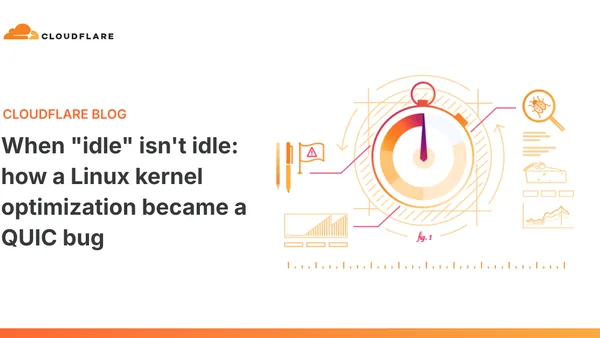
A Linux kernel optimization implementing RFC 9438's app-limited exclusion for CUBIC created a death-spiral bug in Cloudflare's quiche QUIC implementation. Under 30% packet loss, the congestion window permanently stalled at its minimum, causing 60% of integration tests to fail until a one-line fix corrected the recovery logic. For engineers building QUIC or TCP stacks, this reveals how seemingly correct kernel-level congestion control changes can introduce subtle recovery deadlocks in user-space implementations, highlighting the need for edge-case testing. Test your congestion controller under extreme loss scenarios to uncover cwnd deadlocks that throughput dashboards miss.

Quack: The DuckDB Client-Server Protocol
devtools / Hacker News (100+)

Quack: The DuckDB Client-Server Protocol

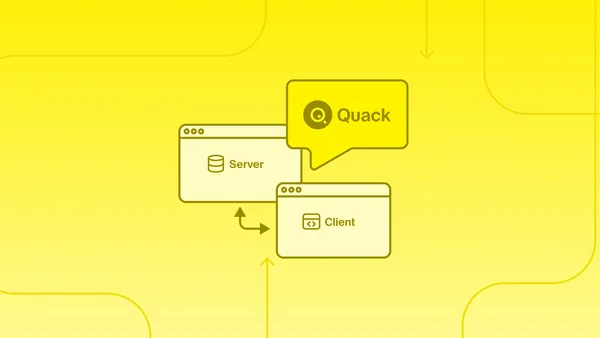
DuckDB's new Quack protocol enables client-server setups with concurrent writers, built on HTTP for simplicity and performance. It addresses the in-process architecture's multi-process limitation, a gap previously filled by workarounds like Arrow Flight SQL and MotherDuck. Quack supports workloads from bulk operations to small transactions. For a senior engineer building data pipelines or multi-service architectures, this unlocks DuckDB for concurrent access patterns without custom RPC solutions or switching to PostgreSQL. Evaluate Quack for replacing custom RPC or third-party solutions when you need concurrent writes to DuckDB.

Building a cloud native platform from the ground up with Kairos, k0rdent, and bindy
cloud / CNCF Blog

Building a cloud native platform from the ground up with Kairos, k0rdent, and bindy

RBC Capital Markets details their cloud native platform modernization journey, building on a GitOps foundation with FluxCD by integrating Kairos, k0rdent, and bindy. The article likely covers architectural decisions and lessons learned in assembling these open source tools for production Kubernetes. This real-world enterprise case study demonstrates how to combine emerging CNCF ecosystem tools (Kairos, k0rdent, bindy) to build a scalable, GitOps-driven platform — directly relevant to your work in cloud infrastructure and platform engineering. Evaluate Kairos for immutable OS, k0rdent for cluster management, and bindy for service binding when designing a cloud native platform from scratch.

Grafana's Pyroscope 2.0 Makes Continuous Profiling Practical at Scale
general / InfoQ

Grafana's Pyroscope 2.0 Makes Continuous Profiling Practical at Scale

Grafana Labs released Pyroscope 2.0, a complete rearchitecture of its continuous profiling database that eliminates write-path replication (reducing storage from 3x to 1x) and makes the read path fully stateless for elastic scaling. The new design stores profiles once in object storage, deduplicates symbolic information to cut symbol storage by 95%, and enables new capabilities like metrics derived from profiles and single-profile inspection. Deployments that took 8-12 hours in v1 now complete in minutes, and the architecture supports bursty query patterns from LLM-powered agents. For engineers building agentic systems and optimizing cloud costs, Pyroscope 2.0 makes continuous profiling practical at scale, enabling function-level optimization of LLM agent workloads and reducing idle capacity overhead. Adopt Pyroscope 2.0 to identify function-level bottlenecks in your agentic workloads and reduce observability storage costs by up to 95%.

Erlang/OTP 29.0 Release
general / Lobsters

Erlang/OTP 29.0 Release

Erlang/OTP 29.0 ships with unsafe function attributes, secure-by-default SSH (shell/exec disabled), and post-quantum x25519mlkem768 as default SSL key exchange. Experimental native records (EEP-79), multi-valued comprehensions, and JIT improvements for binary matching join new default warnings on catch, exported variables, and obsolete bool operators. The release also moves current directory to last in code path and drops 32-bit Windows builds. For engineers building reliable distributed systems or using the BEAM for agent orchestration, these changes harden security defaults, introduce safer language patterns, and improve runtime performance—directly impacting production reliability and developer productivity. Update to Erlang/OTP 29.0 to adopt secure-by-default SSH, post-quantum crypto, and new compiler warnings that catch unsafe patterns early.

arXiv logo
general / Hacker News (100+)

Deterministic Fully-Static Whole-Binary Translation Without Heuristics

Elevator is a novel binary translator that statically converts entire x86-64 executables to AArch64 without heuristics, debug info, or source code. It considers all possible byte interpretations, generating separate translations for each feasible path, pruning only those leading to abnormal termination. The result is a deterministic, self-contained binary with no runtime component, achieving performance comparable to QEMU's JIT on SPECint 2006, at the cost of code size expansion. For engineers deploying on ARM-based cloud infrastructure, Elevator provides a deterministic, auditable path to run legacy x86 binaries without runtime emulation overhead, improving security and performance predictability. Evaluate Elevator for migrating x86 workloads to ARM in security-critical or certification-required environments.

general / Lobsters

Redis and the Cost of Ambition

Redis's evolution from a focused 'memcached but better' data structure server to a sprawling database with features like ACLs, JSON, and time-series has diluted its identity, as exemplified by antirez's recent PR for an array type. The author argues this ambition, driven by enterprise DBaaS dynamics and second-system effects, risks undermining the simplicity that made Redis indispensable. For a senior engineer evaluating infrastructure choices, this highlights the tension between adding features and maintaining core simplicity, relevant when choosing or building data layers. Evaluate Redis alternatives (e.g., Dragonfly, KeyDB) that preserve its original performance and simplicity for your use cases.

My graduation cap runs Rust
languages / Hacker News (100+)

My graduation cap runs Rust

Using Rust on a Digispark ATtiny85, a developer created a graduation cap that lights WS2812B LEDs when a reed switch detects tassel movement, requiring forked avr-hal and ws2812-avr crates for ATtiny85 support. The 2-hour coding and 3-hour hardware project is open-sourced on GitHub, though the author opted not to wear it to graduation. This project demonstrates Rust's viability for embedded systems on constrained microcontrollers, a key consideration for senior engineers evaluating Rust for IoT or firmware work. Consider Rust for embedded projects even on low-end MCUs like ATtiny85, but be prepared to fork and patch HAL crates for unsupported targets.