Maintainability sensors for coding agents
Scored daily by a customisable AI persona to surface the most relevant engineering leadership news.
Novel concept for coding agent harness; deeply technical and forward-looking.
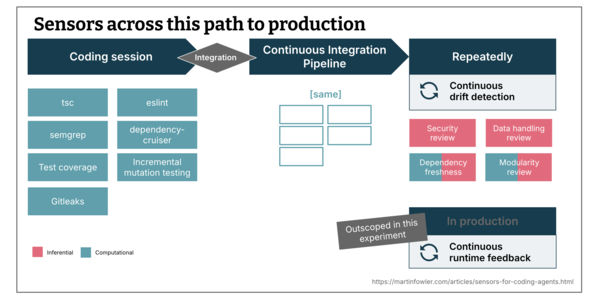
Birgitta Böckeler details a harness of maintainability sensors for AI coding agents, using a TypeScript/NextJS/React analytics dashboard as the testbed. Sensors—including type checkers, ESLint, Semgrep, dependency-cruiser, incremental mutation testing, and GitLeaks—run both during coding sessions and in CI pipelines, providing fast feedback that enables agents to self-correct before human review. The approach targets internal code quality, helping prevent entanglement and context overload that degrade maintainability over time.
Deploy a layered sensor framework (linting, type checking, dependency analysis, mutation testing) in your coding agent harness to enforce maintainability standards continuously.
For a solutions architect focused on AI-assisted SDLC, this offers a practical blueprint to embed quality gates directly into agent workflows, reducing technical debt and human oversight while scaling AI contributions.
Maintainability sensors for coding agents In a recent article about harness engineering for coding agent users , I laid out a mental model for expanding a coding agent harness: a system of guides and sensors that increase the probability of good agent outputs and enable self-correction before issues reach human eyes. This article is a more practical follow-up where I walk through my experience with using sensors that help keep the codebase maintainable. 19 May 2026 Birgitta Böckeler Birgitta is a Distinguished Engineer and AI-assisted delivery