
Skip to content

Four Signals

How to use Google’s new AI agents to go beyond your standard searches
ai/ml / TechCrunch

How to use Google’s new AI agents to go beyond your standard searches

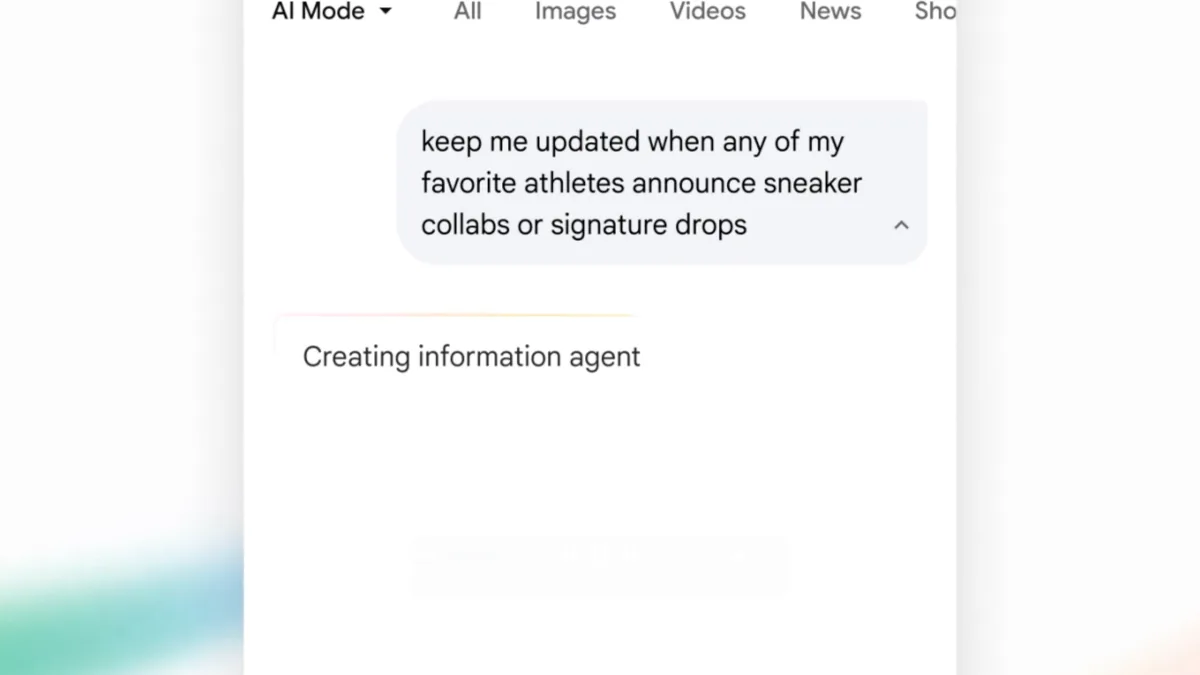
At Google I/O 2026, Google introduced agentic capabilities in Search that let users create persistent AI agents operating 24/7 to monitor topics, synthesize information from multiple sources, and push notifications—far beyond traditional Google Alerts. These agents, available this summer first to Google AI Pro and Ultr…

Why it matters

For a Solutions Architect focused on AI/ML agent orchestration, this signals a shift from reactive tools to persistent, autonomous agents directly integrated into a major platform—an architectural pattern you'll need to evaluate for custom monitoring workflows, event-driven systems, and user-facing agent loops.

A clown in bright clothes holds a laptop above his head.
ai/ml / Ars Technica

In stunning display of stupid, secret CISA credentials found in public GitHub repo

CISA contractor Nightwing leaked plaintext passwords, SSH keys, and tokens in a public GitHub repo named 'Private-CISA' since November 2025, with GitHub's default secret scanning protections deliberately disabled by the repo admin. Security researchers Krebs and GitGuardian's Valadon uncovered the exposure, and Seralys founder Caturegli confirmed he could use the credentials to access AWS GovCloud accounts at high privilege. This follows CISA's earlier ChatGPT incident this year, highlighting systemic failures in credential management and default security controls. For a solutions architect focused on cloud infrastructure and CI/CD security, this is a concrete case study of how disabling default secret scanning protections (even temporarily) can lead to full GovCloud compromise—a direct caution against overriding platform defaults without compensating controls. Never disable GitHub's default secret scanning protections without a documented, audited exception policy, and integrate automated secret detection (e.g., GitGuardian, truffleHog) into your CI/CD pipeline to catch leaks before merge.
Maintainability sensors for coding agents
ai/ml / Martin Fowler

Maintainability sensors for coding agents

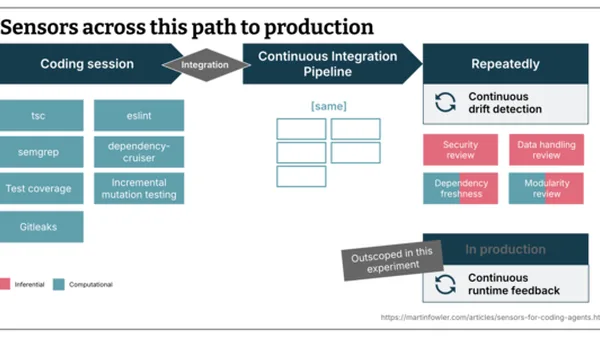
Birgitta Böckeler details a harness of maintainability sensors for AI coding agents, using a TypeScript/NextJS/React analytics dashboard as the testbed. Sensors—including type checkers, ESLint, Semgrep, dependency-cruiser, incremental mutation testing, and GitLeaks—run both during coding sessions and in CI pipelines, providing fast feedback that enables agents to self-correct before human review. The approach targets internal code quality, helping prevent entanglement and context overload that degrade maintainability over time. For a solutions architect focused on AI-assisted SDLC, this offers a practical blueprint to embed quality gates directly into agent workflows, reducing technical debt and human oversight while scaling AI contributions. Deploy a layered sensor framework (linting, type checking, dependency analysis, mutation testing) in your coding agent harness to enforce maintainability standards continuously.

Google Cloud deletes Australian trading fund’s infra
cloud / Pragmatic Engineer

Google Cloud deletes Australian trading fund’s infra

Google Cloud accidentally deleted UniSuper's entire subscription, wiping all data across two replicated regions and causing a two-week outage for the $124B Australian superannuation fund. UniSuper avoided total data loss only because they maintained an independent backup with another provider. GCP CEO Thomas Kurian issued an unusually direct admission of fault, but the incident underscores that GCP can delete customer data even with multi-region replication enabled. For engineers relying on GCP, this is a concrete example that cloud-native replication alone is not a sufficient disaster recovery strategy — you need to test external backups as a non-negotiable part of your architecture. Design every GCP workload with an external, provider-independent backup strategy that can survive a full account deletion.

ai/ml / Techmeme

GitHub confirms ~3,800 internal repositories were breached after one of its employees installed a malicious VS Code extension; TeamPCP claims responsibility (Sergiu Gatlan/BleepingComputer)

GitHub disclosed that an employee's installation of a malicious VS Code extension led to the compromise of about 3,800 internal repositories, with the threat actor TeamPCP claiming responsibility. The breach highlights risks in the developer toolchain, particularly the supply chain of IDE extensions. For a Solutions Architect, this incident underscores the critical need to vet and control third-party developer tools like VS Code extensions, as a single compromised tool can expose internal infrastructure and sensitive code repositories at even the most security-conscious organizations. Implement strict policies and tools to validate and monitor all developer IDE extensions, and consider using dedicated development environments or sandboxing to reduce the blast radius of similar compromises.

ai/ml / Hacker News (100+)

OpenAI Adopts Google's SynthID Watermark for AI Images with Verification Tool

OpenAI is integrating Google's SynthID watermarking technology into its AI image generation tools, alongside a new verification tool for content provenance. This move aims to enhance traceability and authenticity of AI-generated images, addressing growing concerns about misinformation. For platform engineers and developers working on AI systems, this signals a shift toward built-in provenance standards that may influence infrastructure choices for image generation and verification pipelines. Evaluate adding SynthID-style watermarking to your AI image generation workflows to align with emerging provenance standards and improve content authenticity.

general / Hacker News (100+)

Everything in C is undefined behavior

All nontrivial C and C++ code contains undefined behavior (UB), making correct programs impossible, argues a veteran developer. UB includes subtle cases like misaligned pointer access (C23 6.3.2.3) — safe on x86 but deadly on SPARC or Alpha — and compilers assume such UB never occurs, even without optimizations. This 'telephone game' means code that works today may break on future architectures or compiler versions. For a platform/solutions architect, this reinforces the argument for adopting memory-safe languages like Rust or Go in new systems programming to eliminate UB risks that threaten reliability and security at scale. Evaluate Rust or Go for any new systems-level code that replaces C/C++ to avoid undefined behavior and future-proof your infrastructure.