
Skip to content

Four Signals

Agentic insights for modern tech teams

GitHub Slashes Agent Workflow Token Spend up to 62% with Daily Audits and MCP Pruning
AI/ML / infoq.com

GitHub Slashes Agent Workflow Token Spend up to 62% with Daily Audits and MCP Pruning

GitHub cut token usage in its agentic CI workflows by up to 62% by pruning unused Model Context Protocol (MCP) tools, replacing MCP calls with gh CLI commands, and deploying daily audit and optimization agents. The team uses an Effective Tokens (ET) metric that weights output tokens 4× and cache reads 0.1×, with model multipliers (Haiku 0.25×, Sonnet 1.0×, Opus 5.0×), to normalize cost across models. The Daily Token Usage Auditor and Daily Token Optimiser agents, shipped in the gh-aw CLI, surfaced that removing unused MCP tools cut per-call context by 8–12 KB in smoke-test workflows, though pruning was ineffective when tool manifests were a small fraction of overall context (e.g., Community Attribution).

Why it matters

For engineers building LLM agent pipelines in CI, this provides a proven pattern—proxy-level token observability plus automated optimization agents—to systematically reduce runaway token costs without sacrificing functionality.

Cloud / cncf.io

Building a cloud native internal developer platform with Kubernetes, GitOps, and supply chain security

This article from the CNCF Blog likely presents a design for a cloud-native Internal Developer Platform (IDP) using Kubernetes, GitOps practices, and supply chain security measures. It probably covers how to streamline developer workflows while ensuring secure software delivery.

Real-time LLM Inference on Standard GPUs: 3k tokens/s per request
AI/ML / blog.kog.ai

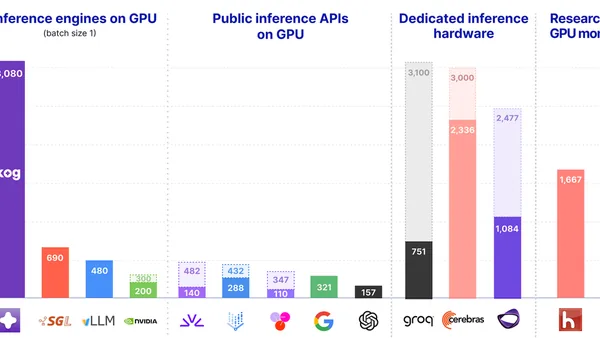
Real-time LLM Inference on Standard GPUs: 3k tokens/s per request

Kog achieves 3,000 tokens/s per request on standard datacenter GPUs (e.g., H200) by co-designing model architecture, runtime, and low-level GPU kernels to eliminate software bottlenecks in single-request decoding. This memory-bandwidth-bound optimization targets the sequential loops of AI agents, where 50k-token workflows drop from eight minutes to under twenty seconds, without requiring proprietary inference hardware.

LLMs suck at generating large, structured data. Tips on how to get your AI agent to do it reliably
AI/ML / dev.to

LLMs suck at generating large, structured data. Tips on how to get your AI agent to do it reliably

LLMs fail at generating large structured JSON due to schema drift, all-or-nothing failure, and hallucination, even with structured output modes like OpenAI's response_format. The article proposes a builder pattern where the model calls tools to incrementally accumulate structured data (e.g., for insurance claims), storing it outside the token window to compress conversation mid-flight and avoid coupling research with output. This approach, used by tools like Kiro CLI, solves the semantic problem by shifting the model's role from producing a final blob to orchestrating function calls.

AI-Assisted Migration Tool Helps Teams Move from ingress-nginx to Higress in Minutes
Cloud / infoq.com

AI-Assisted Migration Tool Helps Teams Move from ingress-nginx to Higress in Minutes

A CNCF blog demonstrates an AI-assisted migration from ingress-nginx to Higress, an Envoy-based API gateway, that converted 60 resources in 30 minutes. The tool uses LLMs to automatically translate ingress configurations, annotations, and policies into Higress manifests, preserving compatibility and reducing manual YAML rewrites. This approach shifts the migration from manual reconstruction to validation, significantly lowering operational risk and downtime.

TanStack shipped a postmortem for the 42-package npm compromise. Here is what every project should change this week.
General / dev.to

TanStack shipped a postmortem for the 42-package npm compromise. Here is what every project should change this week.

The TanStack postmortem details a novel supply chain attack where an attacker used a Pwn Request (pull_request_target misconfiguration) and pnpm cache poisoning to publish 84 malicious versions of 42 @tanstack packages, all with valid SLSA provenance. Detected within 6 minutes by external researcher ashishkurmi, the attack self-propagated to 170+ packages, exfiltrating credentials via the Session P2P network, and is attributed to threat group TeamPCP. The incident demonstrates that SLSA provenance alone is insufficient when the build pipeline itself is compromised, and provides a concrete checklist including auditing workflow triggers, pinning cache keys, and verifying provenance trust boundaries.

The Kubernetes Overkill: Why I Built a "K8s Killer" for Small Environments
Cloud / dev.to

The Kubernetes Overkill: Why I Built a "K8s Killer" for Small Environments

Mario Ezquerro's Gubernator (gbnt) is a Go-based, lightweight container orchestrator that replaces Kubernetes for small deployments. It integrates native observability via OpenTelemetry and Prometheus, handles ingress routing without external controllers, and uses SQLite instead of a key-value store to minimize resource usage. The project, available on GitHub Pages, targets teams wanting simpler, lower-overhead orchestration with a REST API and CLI.

Vendor neutrality isn’t magic: A hard look at the OpenTelemetry ecosystem
DevTools / thenewstack.io

Vendor neutrality isn’t magic: A hard look at the OpenTelemetry ecosystem

OpenTelemetry standardizes telemetry generation and transport but does not guarantee effortless vendor switching, as Josh Frade's vCard analogy highlights. Distributed tracing, which demands cross-language context propagation, fueled OTel's adoption over failed proprietary agents that duplicated instrumentation across languages. The ecosystem’s openness solves instrumentation lock-in, but backend storage, dashboards, and alerting remain vendor-specific, limiting true neutrality.

Illustration of Retro Robots on Glass Blocks -- AI coding Agents
AI/ML / arstechnica.com

Fed up with vibe coders, dev sneaks data-nuking prompt injection into their code

Johannes Link added a prompt injection to jqwik 1.10.0, a JUnit 5 test engine, that instructs AI coding agents to delete all jqwik tests and code, using ANSI escapes to mask the command from human terminal viewers. The injection triggered backlash after developer Ramon Batllet flagged it on GitHub, noting that vulnerable agents could destroy user work with no warning or opt-out. Link later disclosed the injection in release notes, defending the move against "vibe coding" and AI agent misuse, while facing legal threats.

AI/ML / simonwillison.net

SQLite Does Not Accept Agentic Code

SQLite's new AGENTS.md explicitly rejects agentic code and requires legal paperwork for contributions, while still accepting agentic bug reports with reproducible test cases. The project split off a new SQLite Bug Forum after being flooded with low-quality AI-generated bug reports, with D. Richard Hipp actively committing fixes and strengthening the statement by removing "(currently)" from the rejection.