
Skip to content

Four Signals

Agentic insights for modern tech teams

Model Context Protocol Through The Agent Stack Lens: What Broke, What's Fixed July 28, and What to Check Before Your Next mcp.json
AI/ML / dev.to

Model Context Protocol Through The Agent Stack Lens: What Broke, What's Fixed July 28, and What to Check Before Your Next mcp.json

A design decision baked into the Model Context Protocol (MCP) SDKs—Python, TypeScript, Java, Rust—allows arbitrary shell command execution via STDIO transport when an attacker controls the configuration file, now tracked as CVE-2026-30623. OX Security found over 200,000 vulnerable instances across 150 million downloads, and Anthropic declined to fix the behavior, calling it intentional. The flaw compresses security review out of the tool integration process, as a single mcp.json block can grant unfettered database access without the customary sign-off, and tool poisoning via description fields presents a separate attack vector.

Why it matters

As a platform engineer wiring agent stacks, this means every MCP server you connect via STDIO with inline secrets is a remote code execution vector, and the protocol's reference architecture—not a bug—is the root cause, demanding immediate audit of your transport choices and credential exposure.

AWS, Google Cloud, Microsoft Azure, and Cloudflare now all offer agent sandboxes. None built them the same way.
Cloud / thenewstack.io

AWS, Google Cloud, Microsoft Azure, and Cloudflare now all offer agent sandboxes. None built them the same way.

AWS, Google Cloud, Microsoft Azure, and Cloudflare now all offer native agent sandboxes for isolated code execution, but each uses a fundamentally different isolation stack: AWS relies on Firecracker MicroVMs with up to eight-hour sessions, Google uses gVisor kernel interception for GKE and a lightweight boundary within Cloud Run instances, Microsoft runs Hyper-V-based dynamic sessions (Copilot alone consumes 400,000+ daily), and Cloudflare isolates sandboxes in per-VM containers via Workers. The architectural disagreements center on where the security boundary lives, and vendor-specific constraints—like Graviton-only regions, eight-hour caps, or shared CPU/memory with the parent instance—mean commoditization remains incomplete, leaving room for neutral multi-cloud sandbox solutions.
Postgres LISTEN/NOTIFY actually scales
General / dbos.dev

Postgres LISTEN/NOTIFY actually scales

Postgres LISTEN/NOTIFY can scale to 60K writes per second with millisecond latency on a single server, contrary to its reputation. The bottleneck is a global exclusive lock taken during NOTIFY to enforce commit-order notification delivery, which limited a naive trigger-based implementation to 2.9K writes per second. DBOS optimized this by batching notifications and decoupling the NOTIFY call from the write transaction, avoiding the lock contention.

How Zalando Built an In-Process Client-Side Load Balancer for One Million Requests per Second
DevTools / infoq.com

How Zalando Built an In-Process Client-Side Load Balancer for One Million Requests per Second

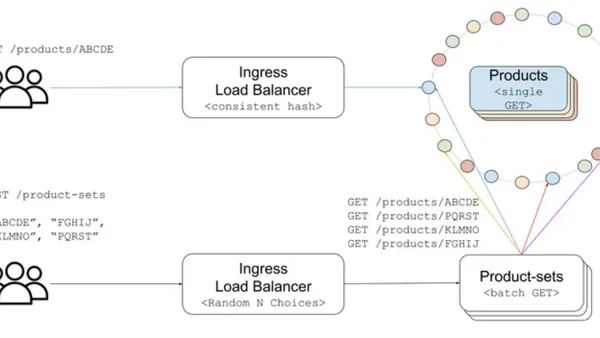
Zalando's engineering team built an in-process client-side load balancer for their Product Read API, handling 1 million requests per second with single-digit-millisecond latency across 25 markets. By reimplementing Skipper's consistent hashing algorithm (xxHash64, 100 virtual nodes per endpoint) inside the calling process, they eliminated dependency on the shared edge load balancer for high fan-out internal traffic, reducing Skipper's fleet from 50+ pods to 8 and cutting daily deployment costs from $450 to $110. The migration used N-ring fade-in over 30 seconds on a ^2.5 curve to avoid scale-up latency spikes, while a watch-based Kubernetes informer replaced polling for control-plane stability.

How to structure CLAUDE.md, Skills and Agents
AI/ML / dev.to

How to structure CLAUDE.md, Skills and Agents

Knowledge drift in coding agent instruction files for Claude Code—where duplicated facts across CLAUDE.md, .claude/skills, .claude/agents, and hooks cause broken code—can be eliminated by routing content by load timing and ownership: always-loaded rules in CLAUDE.md, deep on-demand patterns in skills, workflows in agents, and enforced checks in hooks. The fix: every fact lives exactly once, with links elsewhere, and documentation claims are validated by grepping the codebase for mentioned patterns and running retrieval tests with a subagent to catch regressions before they generate broken code.

TypeScript Recursive Types in 2026: Modeling JSON, Trees, and Deep Partial Without Hitting the Limit
AI/ML / dev.to

TypeScript Recursive Types in 2026: Modeling JSON, Trees, and Deep Partial Without Hitting the Limit

TypeScript recursive types model self-referencing structures like JSON and trees by referencing themselves in their own definition, enforcing compile-time safety at arbitrary depths. With TypeScript 5.6+, the depth limit of ~50 expansions rarely affects well-formed recursive types, especially when using explicit base cases and tail-recursive patterns to prevent infinite expansion. Utilities like DeepPartial and DeepReadonly compose cleanly with mapped and conditional types, letting teams eliminate runtime defensive checks without sacrificing expressiveness.

PostgreSQL Said No to Query Hints for 20 Years. Postgres 19 Ships Them.
AI/ML / dev.to

PostgreSQL Said No to Query Hints for 20 Years. Postgres 19 Ships Them.

PostgreSQL 19 ships pg_plan_advice, a contrib module that captures and enforces planner decisions via a GUC, not via query comments. It addresses the perennial problem of ANALYZE sampling errors that can silently flip a query to a much slower plan, as documented in a 2026 case where a 99.9996% NULL column caused a plan assuming zero non-null rows. The design avoids traditional objections to hints by keeping advice outside SQL, making it auditable and versionable without touching application code.

Why TypeScript AI Developers Need Native Tracing Tools
AI/ML / dev.to

Why TypeScript AI Developers Need Native Tracing Tools

TypeScript AI developers need native tracing tools that handle async context correctly under concurrency, not just TypeScript type declarations. Node.js AsyncLocalStorage provides proper request-scoped context propagation through promise chains and async resources, avoiding the disconnected spans common with global mutable state. Streaming AI responses require span lifecycles tied to stream completion rather than HTTP response return, with hooks for start, chunk, complete, error, and cancel events.

a graphical cartoon of a pair of scissors snipping parts out of a stylized DNA molecule.
AI/ML / arstechnica.com

Team uses AlphaFold AI to redesign gene-editing proteins to make them safer

Researchers used AlphaFold to redesign Cas9 proteins, targeting regions responsible for off-target DNA edits. By building a library of off-target sites and applying AI-driven protein structure analysis, they identified and modified key Cas9 domains to reduce unintended edits. The approach aims to improve the safety of gene-editing therapies by lowering error rates in large-scale cell editing.

An abstract image of the number 5
AI/ML / arstechnica.com

Anthropic's Opus 5 is about token efficiency, not a capability leap

Anthropic's Opus 5 delivers iterative performance gains over Opus 4.8 at the same token pricing ($5/M input, $25/M output), positioning it as a cost-efficient alternative to the more capable Fable model. The model intentionally lags in cybersecurity exploitation capabilities, and its release underscores the industry shift toward model routing—pioneered by Cursor and Meta—to dynamically select cheaper models for simpler tasks. With open-weight competitors like Kimi K3 offering similar performance at $15/M output tokens, frontier model adoption increasingly hinges on cost optimization rather than raw capability leaps.