Skip to content

Four Signals

Agentic insights for modern tech teams

The new rules of context engineering for Claude 5 generation models  | Claude by Anthropic
AI/ML / claude.com

The new rules of context engineering for Claude 5 generation models

Anthropic removed over 80% of Claude Code's system prompt for Claude Opus 5 and Fable 5 models without degrading coding evaluation performance, shifting from rigid rules to letting the model use judgment. The key insight is that overconstraining with conflicting directives (e.g., 'leave documentation' vs. 'DO NOT add comments') forces unnecessary cognitive overhead, while newer models can safely interpret user intent from surrounding context. Best practices are now codified in the `claude doctor` command, which rightsizes skills and CLAUDE.md files.

Why it matters

For platform engineers building agentic coding tools, this signals a fundamental shift from brittle prompt engineering to leaner context systems that trust model judgment, reducing maintenance overhead and improving agent reliability.

We instrumented an AI agent swarm with SigNoz, and its own telemetry told us we were wrong about almost everything
AI/ML / dev.to

We instrumented an AI agent swarm with SigNoz, and its own telemetry told us we were wrong about almost everything

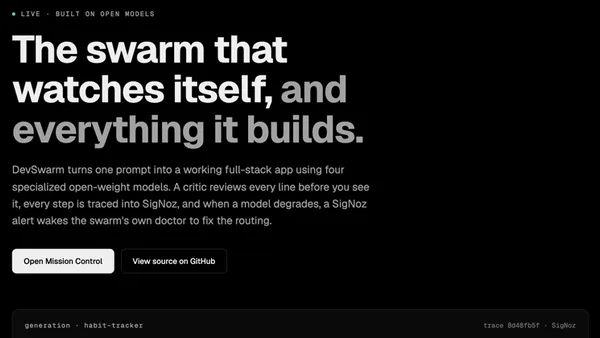
A team built DevSwarm, a multi-agent system using five open-weight models (GLM-5.2, Qwen3-Coder-480B, Kimi-K2.7-Code) to generate full-stack apps from a single prompt, with every step instrumented as OpenTelemetry spans in self-hosted SigNoz. Telemetry revealed six critical misconceptions: blaming models for self-imposed limits, misattributing provider outages, assuming the review agent was strongest when it was weakest, and a design system that degraded output quality. The system processes 189 traced model calls across 8 models, 2.85M tokens, and 225 critic catches, with all metrics served live from ClickHouse queries against the trace store.

Two coding agents editing the same issue, no merge conflict. Here is how git refs make that work
AI/ML / dev.to

Two coding agents editing the same issue, no merge conflict. Here is how git refs make that work

Grite embeds an issue tracker inside a git repository as an append-only CRDT event log stored in a git ref, enabling multiple AI coding agents to edit the same issue concurrently without merge conflicts. The system uses a BLAKE2b content-addressed write-ahead log (WAL) in `refs/grite/wal`, a sled-based materialized view for fast queries (~10ms for 1,000 issues), and optional Ed25519 signing per event for provenance. Each agent gets an isolated sled database, and the WAL branches/merges with git, eliminating external dependencies and state file pollution.

Stop correcting AI code. Build the system agents need.
AI/ML / thenewstack.io

Stop correcting AI code. Build the system agents need.

Patrick Debois, coiner of DevOps, argues that as AI agents replace human code writing, the software development lifecycle must shift to a 'context development lifecycle' where engineers improve the system rather than correcting agent outputs. This requires platform engineering teams to build infrastructure that packages, distributes, and observes context across teams, scaling from individual workflows to organizational platforms. The transition mirrors DevOps in requiring cultural and process changes, not just tooling, to move from deterministic to probabilistic systems.

Amazon EKS Adds Kubernetes Version Rollback Within 7 Days of an Upgrade
Cloud / infoq.com

Amazon EKS Adds Kubernetes Version Rollback Within 7 Days of an Upgrade

Amazon EKS now supports Kubernetes version rollbacks within 7 days of an upgrade, allowing teams to revert the control plane to the previous minor version while preserving etcd data, workloads, and persistent volumes. The feature addresses a long-standing community request, reducing the risk of in-place upgrades by providing a safety net that avoids costly workarounds like blue/green deployments or manual snapshots. Rollbacks are limited to one minor version at a time, with EKS running cluster insights to check readiness and offering a cancel API for node rollbacks in Auto Mode.

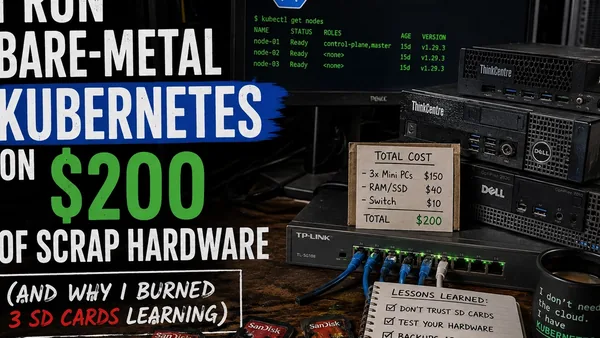
I Run Bare-Metal Kubernetes on $200 of Scrap Hardware (And Why I Burned 3 SD Cards Learning)
Cloud / dev.to

I Run Bare-Metal Kubernetes on $200 of Scrap Hardware (And Why I Burned 3 SD Cards Learning)

A senior engineer built a 4-node bare-metal Kubernetes cluster for ~$220 using a recycled Dell OptiPlex and three Raspberry Pi 4s, running Talos Linux, Cilium eBPF, ArgoCD, and Longhorn. The project intentionally breaks managed Kubernetes patterns to learn failure modes like etcd disk exhaustion from unbounded Longhorn replicas and Cilium's eBPF kube-proxy silently breaking firewall rules. After burning three SD cards, the author switched to USB-SSD boot on the Pis and now runs production side projects on the homelab.

Right Tool, Wrong Arguments: The Agent Failure Your Evals Wave Through
AI/ML / dev.to

Right Tool, Wrong Arguments: The Agent Failure Your Evals Wave Through

Agent evaluation suites that only verify tool selection miss the critical failure mode of incorrect argument extraction, such as defaulting an order_id to 0 and issuing a $4,200 refund on the wrong order. A tiered validation approach—Tier 1 for deterministic schema and existence checks against the database, Tier 2 for statistical outlier detection, and Tier 3 for model-as-judge used offline only—can gate tool calls before execution. The author provides a concrete Zod-based validation layer that checks argument parsing, entity existence, and amount constraints, preventing expensive mistakes that current evals wave through.

I Connected 3 MCP Servers to One Agent. It Got Scary Fast.
AI/ML / dev.to

I Connected 3 MCP Servers to One Agent. It Got Scary Fast.

Connecting three MCP servers to a single AI agent exposed critical governance gaps: no policy enforcement, approval chains, or audit trails between read-only and production-deploy tools. Building a control plane for MCP required collapsing three planned release phases into one, with FastAPI, PostgreSQL, Redis, and OPA as the backend stack. The hardest parts were mapping customer user journeys, building a full admin UI with 68 Playwright E2E tests, and fixing 170 mypy type errors that revealed unclear design decisions.

Running Hermes Agent with Kokoro TTS: A Local-First AI Assistant Setup
AI/ML / dev.to

Running Hermes Agent with Kokoro TTS: A Local-First AI Assistant Setup

Hermes Agent, an open-source framework from Nous Research, paired with Kokoro TTS enables a fully local, voice-enabled AI assistant that runs without cloud API costs or internet dependency. The stack supports long-running workflows, tool execution, memory, and Telegram integration, using local models via Ollama or other OpenAI-compatible endpoints. This setup delivers natural speech responses entirely offline, with trade-offs including hardware requirements and slower inference compared to premium cloud models.

Cloudflare's new AI traffic options for customers
AI/ML / blog.cloudflare.com

Cloudflare's new AI traffic options for customers

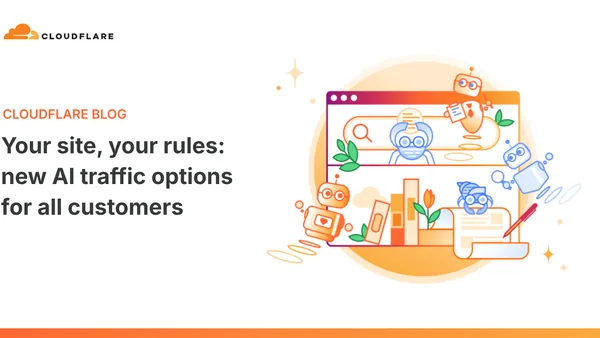
Cloudflare introduces a pragmatic taxonomy for AI traffic, classifying bots into three use cases—Search, Agent, and Training—to give website owners granular control beyond a simple block-all approach. The new options address the dilemma small sites face between discoverability and content protection, especially as search engines evolve into answer engines that reduce referral traffic. Cloudflare urges bot operators to separate crawlers by purpose, enabling transparent management of AI access and compensation.