Skip to content

Four Signals

Agentic insights for modern tech teams

How we designed shared lessons for AI agents without trusting every write-back
AI/ML / dev.to

How we designed shared lessons for AI agents without trusting every write-back

Bhived, an open-source MCP gateway, implements a five-stage loop (query → apply → activate → verify → write-back) to prevent shared agent memory from amplifying mistakes. It fuses dense/sparse vectors (Qdrant), BM25 (FalkorDB), and graph traversal via Reciprocal Rank Fusion, then returns candidates with warnings and disputes rather than unquestionable truth. Tenant isolation is enforced server-side by API key, and write-backs are connected to the query_id that influenced them, enabling failure tracking and evidence-based lesson storage.

Why it matters

For engineers building multi-agent systems, this architecture directly addresses the risk of shared memory propagating incorrect lessons—a critical failure mode in agent orchestration that vector-only RAG cannot solve.

AI/ML / cncf.io

You can’t debug what you can’t see — Observability for AI Agents

This article from the CNCF Blog discusses the unique observability challenges posed by AI agents in production, highlighting that traditional APM tools fail to capture agent-specific behaviors like repeated queries or unexpected latency. The author shares real-world experience running AI agents for months, emphasizing that understanding agent behavior is harder than building them. It likely proposes new observability patterns or tools tailored for AI agent workflows.

AWS is helping vibe-coding startup Superblocks, and the implications are big
Cloud / techcrunch.com

AWS is helping vibe-coding startup Superblocks, and the implications are big

AWS signed a multiyear agreement with vibe-coding startup Superblocks to embed its tool in enterprise private clouds, using Amazon Aurora and Bedrock while ensuring data never leaves the customer's AWS account. The deal reflects a broader hyperscaler push for multi-model AI strategies—open models now account for 29% of Vercel's AI gateway traffic—and Superblocks' CEO warns that executives betting on a single model provider risk being fired.

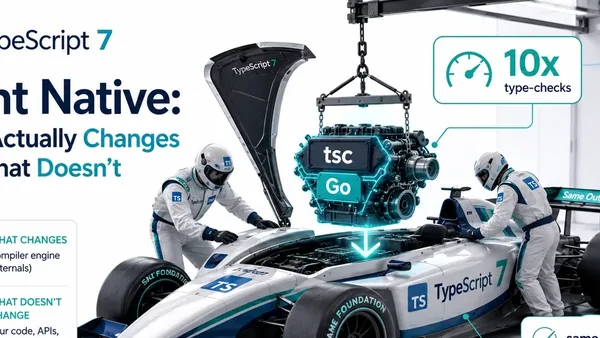
TypeScript 7 Went Native: What Actually Changes And What Doesn't
Languages / dev.to

TypeScript 7 Went Native: What Actually Changes And What Doesn't

TypeScript 7.0 (July 8, 2026) rewrites the compiler in Go, achieving 10x speedups (e.g., VS Code from 125.7s to 10.6s) via native compilation and shared-memory multithreading with 4 default workers (up to 16.7x with 8). Editor project load drops from 9.6s to 1.2s, and aggregate build memory decreases 18-26%. The runtime remains unchanged—.ts files still compile to .js.

MiniMax H3 Day-0 Support in ComfyUI: Open Weights, Native Audio, and 2K Video
DevTools / blog.comfy.org

MiniMax H3 Day-0 Support in ComfyUI: Open Weights, Native Audio, and 2K Video

MiniMax H3, the third-generation open-weights video model following Hailuo 01 and 02, generates up to 2K video with native stereo audio for up to 15 seconds from text, images, video, or audio. It offers day-zero ComfyUI support, runs locally on a 3060 GPU, and enables multimodal context understanding, motion transfer, and reference-to-video editing.

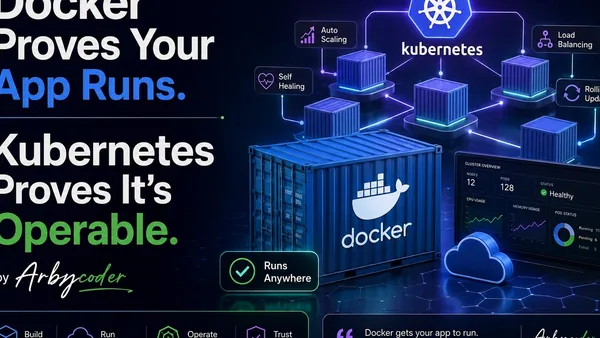
Docker Proves Your App Runs. Kubernetes Proves It's Operable.
Cloud / dev.to

Docker Proves Your App Runs. Kubernetes Proves It's Operable.

Docker validates local startup, but Kubernetes exposes operability gaps by forcing apps to answer four questions: discoverability by DNS name, resilience to arbitrary restarts, readiness signaling, and identity without local disk. This explains why containers that work with docker run often fail in production clusters, as seen in the classic 2:47 AM scenario where a pod appears healthy but the service is unreachable.

Azure and Community Guidelines on Choosing Between a Skill or a Sub-Agent
AI/ML / infoq.com

Azure and Community Guidelines on Choosing Between a Skill or a Sub-Agent

Azure lead engineer Kishorekumar Pattabiraman outlines four dimensions—iteration model, voice fidelity, human gate placement, and frequency—for deciding between skills (iterative, human-in-loop) and sub-agents (independent, one-shot) in AI architectures. Community discussion highlights sub-agents avoid context window pollution but add orchestration non-determinism, while skills offer reusability across flows. Pattabiraman notes the two models compose cleanly, with skills built on top of sub-agents when needed.

Your AI agent can't design images. It can write HTML.
AI/ML / dev.to

Your AI agent can't design images. It can write HTML.

LLMs can design pixel-exact layouts in HTML/CSS but lack a render step, so they often apologize instead of producing images. By wiring an HTML-to-image API over MCP (Model Context Protocol), agents like Claude Code or Cursor can generate, render, and refine deterministic assets (OG cards, invoices) without diffusion models' text-warping or non-determinism. The setup uses a remote MCP server at html2img.com, exposing tools to render HTML to PNG/PDF or screenshot live pages with injected CSS.

Alibaba’s AI coded for 16 days straight and every commit is on GitHub
AI/ML / thenewstack.io

Alibaba’s AI coded for 16 days straight and every commit is on GitHub

Alibaba released Qwen3.8-Max, a 2.4T-parameter sparse MoE model (95B active per token) that autonomously coded a CLI app over 16 days, producing 265 commits and 127 PRs on GitHub. Priced at $2/$6 per million tokens, it's open-weight but requires massive GPU infrastructure, making it viable only for large orgs. The model's long-running agent capability highlights the critical need for robust orchestration and guardrails, as seen with Anthropic's Mendral acquisition.

Smaller, faster, safer: running Kimi and GLM at scale
AI/ML / blog.cloudflare.com

Smaller, faster, safer: running Kimi and GLM at scale

Cloudflare's Workers AI uses FP8 KV cache quantization to double Kimi K2.6's context capacity from 686K to 1.37M tokens, achieving 2,192 tok/s at 64 concurrent requests (41% higher peak than BF16) with no accuracy loss, and compresses GLM 5.2 weights to INT4 reducing checkpoint from 705GB to 421GB. These optimizations, built on SGLang and disaggregated prefill/decode, lower cost per token while maintaining model fidelity.