Skip to content

Four Signals

Agentic insights for modern tech teams

IntelliJ IDEA Goes LSP: Java and Kotlin Intelligence Comes to VS Code, Cursor, and Agentic Flows
Languages / blog.jetbrains.com

IntelliJ IDEA Goes LSP: Java and Kotlin Intelligence Comes to VS Code, Cursor, and Agentic Flows

JetBrains released a preview VS Code extension that exposes IntelliJ IDEA's Java and Kotlin language intelligence via the Language Server Protocol (LSP), enabling smart completion, navigation, refactoring, and build tool support (Maven, Gradle, Bazel) in editors like VS Code and Cursor. The same LSP backend also improves terminal-based agentic workflows (e.g., Claude Code) by reducing token consumption and providing deterministic results. The extension is free during preview but will require an IntelliJ IDEA Ultimate subscription post-preview.

Why it matters

For a solutions architect focused on developer experience and AI agent orchestration, this bridges the gap between JetBrains' powerful static analysis and the lightweight, agent-friendly LSP protocol — enabling consistent Java/Kotlin intelligence across IDEs, CI pipelines, and AI coding agents without forcing a full IDE switch.

OpenCode: The Open Source Coding Agent That Doesn't Lock You In 🔓
AI/ML / dev.to

OpenCode: The Open Source Coding Agent That Doesn't Lock You In 🔓

OpenCode is an open-source coding agent built in Go by the SST team that separates the agent harness from the model, supporting 75+ LLM providers including local models via Ollama. It surpassed Claude Code on GitHub stars (160K+ vs 122K+) and offers a client/server architecture driving terminal, desktop, and IDE extensions. Anthropic's January 2026 OAuth policy change blocked OpenCode from authenticating through Claude.ai accounts, shifting the value proposition from cost savings to philosophical choice between managed and open tools.
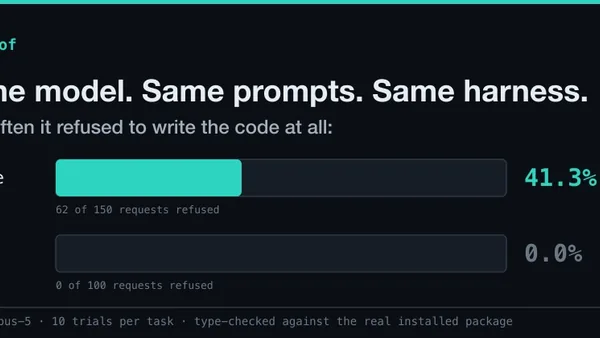

I type-check AI-generated SDK code against the real package. Claude refused a third of my Stripe tasks.
AI/ML / dev.to

I type-check AI-generated SDK code against the real package. Claude refused a third of my Stripe tasks.

A developer building SDKProof, a tool that type-checks AI-generated SDK code against real packages, discovered Claude refused 41.3% of Stripe API tasks (62/150) versus 0% on Zod controls. The bug was that empty refusal responses compiled cleanly, masking failures until a harness check was added. Refusal rates varied dramatically by task: payment-intent creation was refused 10/10 times, while refunds were refused only 1/10, suggesting the model applies inconsistent safety heuristics to similar financial operations.

Astro’s GitHub issue backlog is heading to zero for the first time in 5 years. Now Cloudflare is open-sourcing the tool that did it.
Open Source / thenewstack.io

Astro’s GitHub issue backlog is heading to zero for the first time in 5 years. Now Cloudflare is open-sourcing the tool that did it.

Astro is on track to clear its GitHub issue backlog for the first time in five years, dropping from over 200 open issues to roughly 20, by using a multi-agent AI triage system built in-house and now open-sourced by Cloudflare as triagebot-action. The GitHub Action runs a four-stage pipeline—reproduce, diagnose, verify, fix—with each stage handled by a separate AI agent, orchestrated via a state machine encoded in GitHub labels. Cloudflare, which acquired Astro's team in January, is releasing the tool so other open-source maintainers can automate issue triage without manual triggers.

Apache Polaris 1.7.0 and the Quiet Work of Making a Catalog Trustworthy
Languages / dev.to

Apache Polaris 1.7.0 and the Quiet Work of Making a Catalog Trustworthy

Apache Polaris 1.7.0, released August 2, 2026, focuses on correctness over features, addressing data corruption from network blips during retries. Key changes include idempotent writes for retry-safe table operations, a beta API for semantic models, stricter credential vending and location validation, and improved orphan file cleanup. These fixes matter because catalog bugs corrupt entire tables, not single queries, making this release critical for any team using Iceberg REST catalogs.

IP and DNS Leaks in WebKit Affecting Proxy Browsers and iCloud Private Relay
Cloud / mysk.blog

IP and DNS Leaks in WebKit Affecting Proxy Browsers and iCloud Private Relay

Researchers discovered three WebKit features—DNS prefetching (iOS 26.0+), WebAuthn Related Origin Requests (iOS 18.0+), and WebTransport (iOS 26.4+)—that bypass proxy configurations set via WKWebsiteDataStore.proxyConfigurations, leaking real IPs and DNS servers from iOS and macOS devices. This affects all WebKit-based proxy browsers (including Tor Browser for iOS and Psylo) and Apple's iCloud Private Relay, but not system-level VPNs. Psylo 1.3.1 mitigates all three by blocking dns-prefetch hints and disabling WebTransport and WebAuthn by default, with per-silo opt-in toggles.

Ponytail Agent Skill Corrects Its Own Benchmark After Contributor Challenge
Open Source / infoq.com

Ponytail Agent Skill Corrects Its Own Benchmark After Contributor Challenge

Ponytail, an open-source skill with 82,000+ GitHub stars, instructs AI coding agents to follow a strict decision ladder—checking necessity, existing code, standard library, platform features, and installed dependencies before writing minimal solutions—addressing the common problem of agents over-engineering. After Colin Eberhardt of Scott Logic demonstrated that a simple "Follow YAGNI principles" prompt outperformed Ponytail's original benchmark (which claimed 80-94% code reduction), the author rebuilt the benchmark against a fair agentic baseline on a real FastAPI/React repo, now reporting ~54% average code reduction with explicit caveats. The skill installs across a dozen agent platforms including Claude Code, Codex, Cursor, and GitHub Copilot, and practitioners like Red Hat's Max Rydahl Andersen use it for code review workflows.

Pi, Minimal and Performant — Earendil
General / earendil.com

Pi's Minimalism Is Its Advantage

Pi's minimalist coding harness, with only 4 tools and under 1,000 tokens in its system prompt, outperforms complex alternatives in cost and quality. Databricks' internal benchmark showed Pi with Opus 4.8 achieved the highest pass rate at significantly lower cost than Claude Code and Codex, while sending 3x less context per turn. Shopify validated Pi's extensibility by building pi-autoresearch as a self-created extension, demonstrating that minimalism enables cheaper, more performant agent workflows without sacrificing flexibility.

AI/ML / cncf.io

OpenCost 1.121.0: First-of-a-kind Kubernetes inference cost tracking

OpenCost 1.121.0 introduces a first-of-its-kind feature for tracking inference costs on Kubernetes, addressing the challenge of attributing GPU costs to individual tokens served by AI models. This likely provides granular cost allocation for model serving workloads, helping platform teams understand the true cost per token.

Nvidia’s NOOA makes an agent one Python class
AI/ML / thenewstack.io

Nvidia’s NOOA makes an agent one Python class

Nvidia's NOOA framework, contributed to the Open Secure AI Alliance, defines an agent as a single Python class where methods are capabilities, fields are state, docstrings are prompts, and type annotations are enforced contracts. Methods with an ellipsis body are completed at runtime by an LLM, while normal methods run deterministically. This approach aims to reduce fragmentation in agent development by consolidating prompts, tool definitions, callbacks, and workflow graphs that are currently scattered across Jinja templates, JSON schemas, and separate abstractions in frameworks like LangGraph and AutoGen.