
Skip to content

Four Signals

Agentic insights for modern tech teams

Grafana's gcx and MCP Server Reach GA for Telemetry-Driven Agent Development
AI/ML / infoq.com

Grafana's gcx and MCP Server Reach GA for Telemetry-Driven Agent Development

Grafana Labs has GA'd gcx CLI and the Grafana MCP Server, two tools that let AI coding agents query live observability data (metrics, logs, traces, SLOs, Synthetic Monitoring) during development. The MCP Server provides opinionated, pre-built tools for common Grafana interactions, while gcx offers a flexible CLI for building custom agent workflows against Grafana Cloud or self-hosted stacks. Both tools address the gap where agents generate code faster than engineers can build a mental model of changes, using telemetry as an evidence-based check instead of relying solely on code review.

Why it matters

For platform and AI/ML engineers building agentic coding pipelines, this provides a concrete pattern to ground agent-generated code in real system behavior — reducing the risk of merging changes that look correct but don't match production telemetry.

Build an MCP server in Rust with rmcp: a walk-through 🦀
AI/ML / dev.to

Build an MCP server in Rust with rmcp: a walk-through 🦀

A Rust MCP server using rmcp 3.1.2 manages a fleet of 16 AWS EC2 G5g (Graviton2 + T4G) instances running Gemma 4 under vLLM, communicating solely via AWS APIs and SSM with no inbound SSH. The justification is fleet-scale resource efficiency: 192 MB resident memory vs 1.33 GB for Python, 40 ms vs 7.4 s session startup across 16 rigs, plus elimination of shared-interpreter dependency conflicts. The schemars crate enforces schema correctness by generating tool definitions from the same structs the handler destructures.
System Prompts
AI/ML / platform.claude.com

Claude: System Prompts

This article appears to announce updates to the core system prompts used by Claude, the AI assistant, across its web and mobile platforms. It likely details changes in how Claude is instructed to behave, respond, or handle specific tasks, which could affect developer integrations and user interactions.

Presentation: From Thousands to One: Building LLM-Powered Selection Systems
AI/ML / infoq.com

Presentation: From Thousands to One: Building LLM-Powered Selection Systems

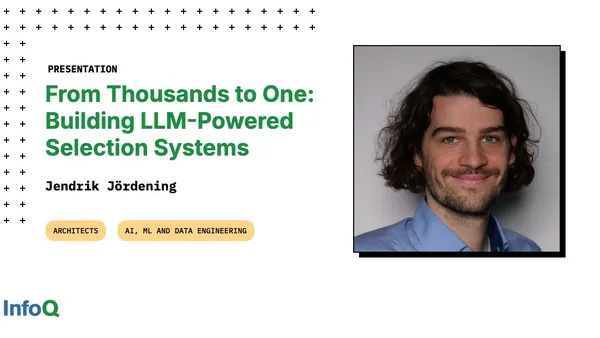
Jendrik Jördening presents engineering patterns for integrating LLMs into production selection systems, addressing core challenges like non-determinism, schema enforcement, and the difficulty of mapping free-text outputs to integer database IDs. He advocates separating semantic text extraction from deterministic code and using discriminator models for validation, while warning against monolithic architectures where the LLM conflates model, view, and controller. The talk emphasizes maintaining database integrity, observability, and guardrails against prompt injections and context window limits when scaling from thousands of options.

Qwen 3.8 27B is excellent, but it defaults to overthinking things
General / simonwillison.net

Qwen 3.8 27B is excellent, but it defaults to overthinking things

Alibaba's Qwen 3.8 27B, an Apache 2.0 licensed vision-capable LLM, defaults to an 'extra high' reasoning effort that consumes excessive tokens even for trivial prompts, generating elaborate but unintended outputs like an animated circle SVG instead of a simple static one. Running the 17GB Q4_K_M quantized build on a 128GB M5 Max MacBook Pro or NVIDIA DGX Spark, a pelican SVG took 21 minutes and 22,276 reasoning tokens to produce 3,223 output tokens, versus 137 seconds with reasoning disabled. The model supports adjustable reasoning_effort to control cost, but the default setting makes it impractical for consumer hardware without increasing context limits beyond LM Studio's default 8,192 tokens.

Protobuf has LSP support
General / buf.build

Protobuf has LSP support

Buf released the first production-grade LSP server for Protobuf, bringing modern IDE features like go-to-definition, code completion, and semantics-aware syntax highlighting to .proto files. The server is bundled with the Buf CLI and leverages their custom protocompile frontend, which uses a query-driven incremental compilation engine for faster, more accurate diagnostics than protoc. It supports VSCode and Neovim out of the box, with plans to add auto-imports, code completion for custom options, and tighter integration with buf.yaml.

AI/ML / techmeme.com

Qwen 3.8 27B shows a 17GB open-weight general purpose model can have long context, effective tool calling, strong vision ability, and competent code generation (Simon Willison/Simon Willison's Weblog)

This article covers the release of Qwen 3.8 27B, a 17GB open-weight general-purpose LLM from Alibaba's Qwen lab, licensed under Apache 2.0. It highlights the model's capabilities in long context handling, tool calling, vision, and code generation, suggesting a significant advancement in compact, open-weight models.

Shipping a vision-model verdict on Bedrock and Lightsail
AI/ML / dev.to

Shipping a vision-model verdict on Bedrock and Lightsail

A 285-line FastAPI app on Python 3.13 deployed to Amazon Lightsail (nano, scale 1) uses Bedrock's Converse API with toolConfig and toolChoice to force Nova Lite into returning a boolean verdict for dog detection, eliminating free-text parsing ambiguity. The author highlights three AWS-specific pitfalls: Lightsail containers lack IAM task roles (requiring env-var access keys), cross-region inference profiles must match the policy's pinned region, and arm64 images crash-loop silently with an exec format error unless --platform linux/amd64 is set. The fixture set scores 20/20 with a median 880 ms per scan, and a mock mode enables frontend development without credentials or model access.

Agents in Orbs
AI/ML / ampcode.com

Agents in Orbs

Ampcode launched 'orbs' — remote machines where agents run independently, billed per minute, with full file and terminal access. Developers spawn agents via `amp -ox`, sync changes locally, and manage them alongside local agents in the same TUI. The shift enables running multiple long-lived agents without resource contention, turning bug reports into investigations and freeing experimentation from local CPU limits.

AI Software Development – What Does The Data Say?
AI/ML / codemanship.wordpress.com

AI Software Development – What Does The Data Say?

Recent studies and experiments indicate that fully autonomous, reliable long-horizon agentic software development using LLMs is effectively science fiction. Effective context limits are orders of magnitude smaller than advertised, with vendor “compression” introducing lossy summarization. LLMs cannot distinguish recency from training priors, struggle with negation, and perform better with demonstrations than descriptions. Industry data shows increased output (more code, commits) but worse outcomes (longer shipping times, lower quality), with AI amplifying existing team strengths rather than fixing weaknesses. Psychological research links high confidence in LLM output to belief in the paranormal and finds negative impacts on learning and critical thinking.