
Skip to content

Four Signals

Agentic insights for modern tech teams

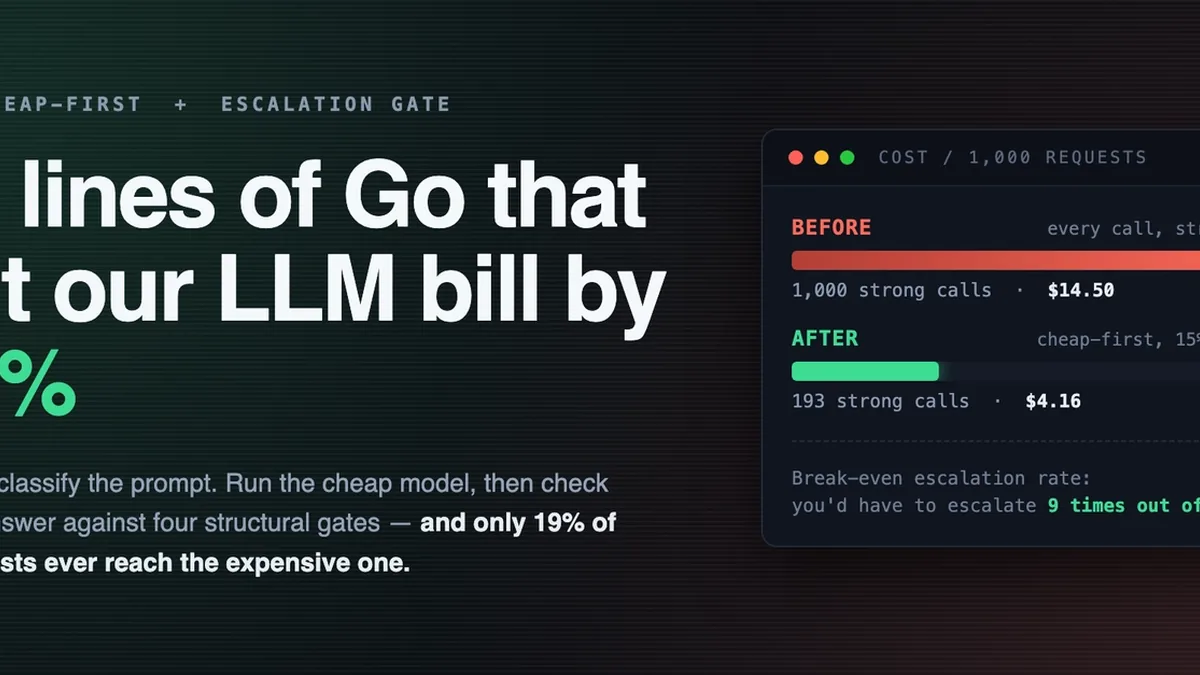
40 Lines of Go That Cut Our LLM Bill by 71%
AI/ML / dev.to

40 Lines of Go That Cut Our LLM Bill by 71%

A team built a 40-line Go router that cut their LLM bill by 71% by sending requests to a cheap model first (GPT-5.6 Luna at $0.20/M input tokens) and only escalating to a strong model if output fails a gate. The break-even escalation rate is 90%, but they escalate only 15% of the time, making the cheap-first approach cost-effective despite double billing on escalations. The key insight is to judge output quality rather than classify prompt difficulty, which avoids the overhead and inaccuracy of pre-routing classifiers.

Why it matters

For a solutions architect optimizing AI costs and latency, this pattern offers a practical, low-code way to slash LLM spend without sacrificing quality, using a simple escalation gate that's easy to implement in any stack.

AWS Open Sources Kiro Crew for Asynchronous Coding Agents
AI/ML / infoq.com

AWS Open Sources Kiro Crew for Asynchronous Coding Agents

AWS open-sourced Kiro Crew, a system for running multiple Kiro coding agents asynchronously across sessions, tools, and tasks, enabling developers to assign work like incident investigation, ticket triage, and PR monitoring without active supervision. Built internally as MeshClaw and adopted by over 39,000 Amazon developers, Kiro Crew supports persistent shared memory, reusable skills, scheduled jobs, concurrent agents, and integrates via MCP and webhooks, orchestrating agents through the Agent Client Protocol (ACP) with live visibility. It ships with defense-in-depth including OS-level sandboxing, denied-by-default commands, credential redaction, and signed audit logs, and is available under Apache 2.0 for macOS.
Prompt Injection in Claude Code Opus 5 Auto Mode
AI/ML / embracethered.com

Prompt Injection in Claude Code Opus 5 Auto Mode

A targeted attack chain achieves 60-80% prompt injection success against Claude Code Opus 5 in Auto Mode, contradicting Anthropic's commissioned third-party evaluation that reported 0.00% success. The attack works by nudging Claude from the WebFetch tool to curl, redirecting to a ZIP archive containing a malicious struct.py that shadows Python's standard library, triggering code execution when the model imports base64. Auto Mode, now default since mid-August, replaces human approval with a safety classifier but does not substitute for running agents in isolated environments.

Arbitrary code execution in QubesOS via copy-to-VM error reporting backchannel
General / qubes-os.org

Arbitrary code execution in QubesOS via copy-to-VM error reporting backchannel

QubesOS disclosed QSB-118, a critical vulnerability in qvm-copy-to-vm where a malicious qube can inject arbitrary commands into dom0 via the error reporting backchannel. The flaw lies in the wait_for_result() function: sanitize_remote_filename() only strips characters outside ASCII 32-126 and double quotes, but fails to block shell metacharacters like backticks or $(). The unsanitized filename is then passed through call_error_handler() → display_error(), which uses system() to launch kdialog or zenity, enabling command injection. An attacker who compromises a qube can exploit this when the user copies a file from dom0 to that qube, achieving full dom0 compromise.

I Built a P2P Messenger Without a Central Message Database — What I Learned About WebRTC, E2EE and Serverless Architecture
Cloud / dev.to

I Built a P2P Messenger Without a Central Message Database — What I Learned About WebRTC, E2EE and Serverless Architecture

OpenChat is an open-source P2P messenger that uses WebRTC DataChannels for direct browser-to-browser communication, MQTT only for signaling and peer discovery, and serverless functions for configuration—eliminating any central message database or traditional application server. The architecture ensures that once a WebRTC connection is established, losing the MQTT signaling link does not interrupt active message traffic, and the system relies on browser-native cryptography for end-to-end encryption. The author emphasizes that 'serverless' here means no central message storage or routing, not the absence of infrastructure, and that TURN relays may still be needed for NAT traversal.

Nuxt useState vs ref(): Why Server State Leaks Across Users
Open Source / dev.to

Nuxt useState vs ref(): Why Server State Leaks Across Users

Nuxt's `ref()` declared at module scope in composables creates a singleton that gets shared across all server-side requests, causing user-specific data like cart contents to leak between users under concurrent traffic. The fix is `useState()`, which isolates state per request via a unique key and ensures it's only hydrated on the client. The same danger exists in Nitro server routes, where `event.context` should be used instead of module-scoped variables.

Hy4 preview
General / tencent.com

Hy4 preview

Tencent open-sourced Hy4 preview, a 770B-parameter MoE LLM with 49B active parameters and a 1M+ token context window, outperforming GLM-5.3 and Kimi K3 on internal productivity benchmarks. It integrates with CodeBuddy and WorkBuddy for coding and office tasks, and autonomously optimized its own inference system, boosting throughput by 31.8%. The model also contributed to its own training pipeline via a recursive self-improvement loop, proposing and iterating on data strategies and low-level operators.

Bugs Are Innocent Until Reproduced: Building Verdict, an Evidence-First Agent Harness
AI/ML / dev.to

Bugs Are Innocent Until Reproduced: Building Verdict, an Evidence-First Agent Harness

Verdict is an evidence-first agent harness that treats bug reproduction as a bounded experiment rather than a conversation. It uses three subagents—Hunter, Surgeon, and Insurance—to find the trigger, localize the change, and produce a regression plan, with all observations stored in a deterministic evidence ledger. The system successfully reproduced TrueForge issue #417 by running a stalled-endpoint condition (10/10 failures) against a responsive control (0/10 failures), binding results to runtime, commit, and provenance hashes for verifiability.

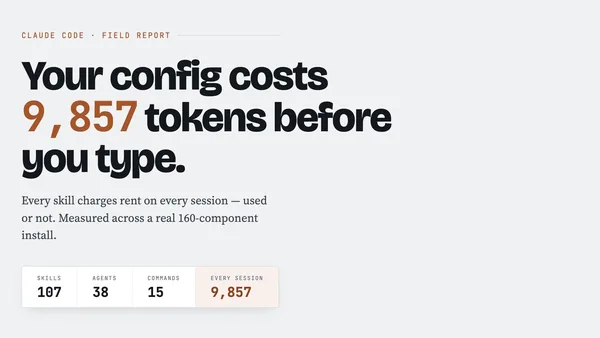
My Claude Code config costs 9,857 tokens before I type anything
AI/ML / dev.to

My Claude Code config costs 9,857 tokens before I type anything

A developer measured that their Claude Code configuration of 107 skills, 38 agents, and 15 commands consumes 9,857 tokens (5% of a 200k context window) before any input, because every skill's description loads into context permanently as 'rent' rather than on-demand. The heaviest descriptions, like loop-design-check (244 tokens) and token-budget-advisor (209 tokens), contribute disproportionately to this fixed overhead. The author provides a Python script using character-count token estimation (chars/4) to audit any Claude Code config's description token cost.

I Built an Agent That Marked Its Own Finding as Already Known
AI/ML / dev.to

I Built an Agent That Marked Its Own Finding as Already Known

An agent built with honesty controls returned a finding that correctly identified a code defect in an empty-array edge case, but labeled it as CONFIRMS_KNOWN (matching a pre-existing condition class) even though the actual behavior inverted the known class's semantics. The agent's own prose described the inversion, yet it still filed under K1, and the structural validator only checked that the novelty label and condition ID were formally consistent — not that the semantic match was correct. This exposes a fundamental gap: structural validity of agent outputs does not guarantee interpretive truth.