Skip to content

Four Signals

Agentic insights for modern tech teams

How a Strands agent took Claude Opus 5 from 30% to 99.95% on ARC-AGI-3
AI/ML / dev.to

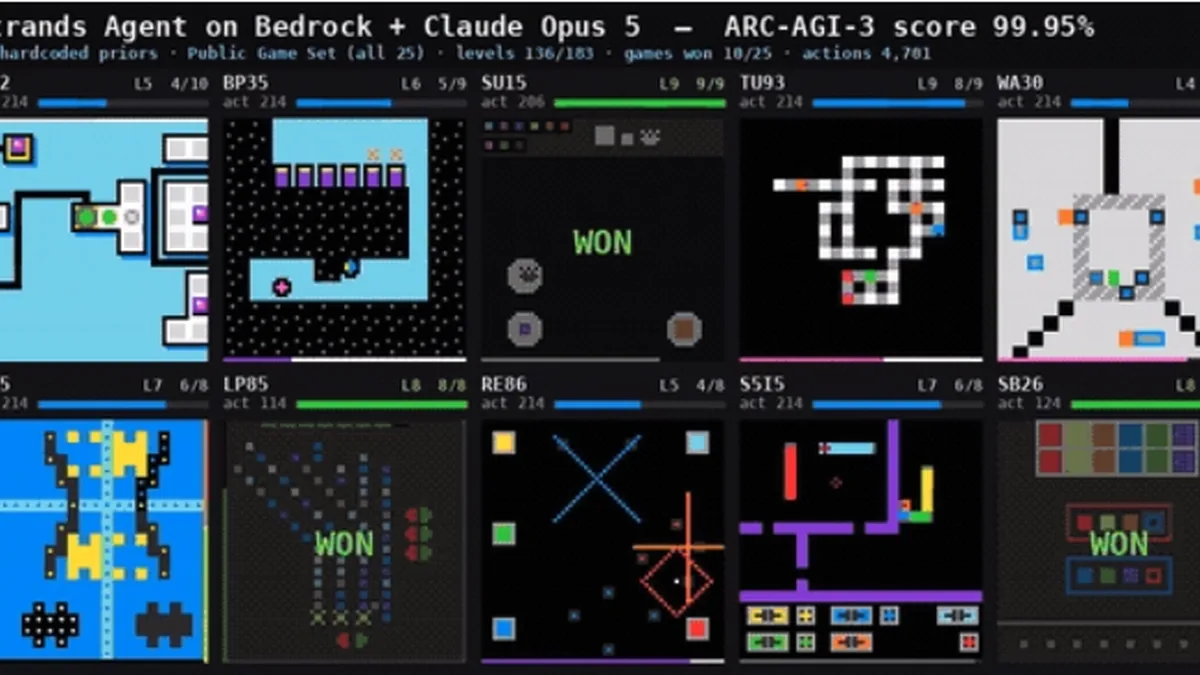
How a Strands agent took Claude Opus 5 from 30% to 99.95% on ARC-AGI-3

AWS engineers used the open-source Strands Agents SDK with Claude Opus 5 to achieve a 99.95% relative human action efficiency (RHAE) score on ARC-AGI-3's public benchmark, completing all 183 levels across 25 environments in a single 8-hour run costing $830 in tokens. The agent started with zero game knowledge in its system prompt, using generic action labels and raw numeric board representations, forcing it to experiment and learn through observation. This contrasts sharply with Claude Opus 5's standalone score of 30.16% on the same benchmark, demonstrating that agent harness design—not just model capability—determines performance on long-horizon novel problem-solving tasks.

Why it matters

For engineers building AI agents, this shows that open-source harnesses like Strands can dramatically amplify model reasoning by handling context management, state maintenance, and iterative learning, which is critical for moving beyond simple RAG or prompt engineering into autonomous, multi-step problem solving.

Cloud / cncf.io

Scale before the spike: Predictive autoscaling for GPU workloads on Kubernetes

This article from the CNCF blog likely covers a technical deep-dive into predictive autoscaling strategies for GPU workloads on Kubernetes, using a real-world incident (a production crash with high error rates) as a case study. It appears to discuss how to anticipate traffic spikes and preemptively scale GPU resources to avoid outages, focusing on the challenges of GPU workload orchestration.
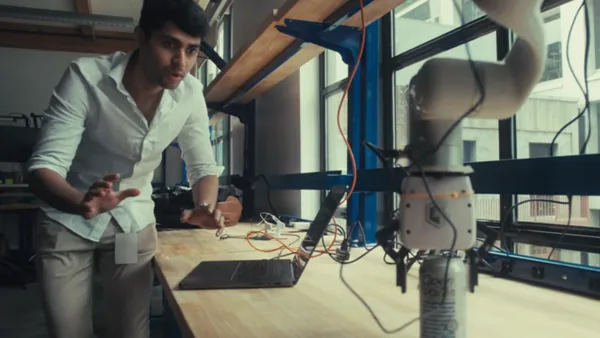

Anthropic's new hardware standard lets AI agents control the physical world
AI/ML / arstechnica.com

Anthropic's new hardware standard lets AI agents control the physical world

Anthropic released the Model Hardware Standard (MHS), a set of standardized drivers that let AI agents interface with and control physical devices like lasers, microscopes, and robotic arms. MHS provides a common data-sharing interface across networked hardware, eliminating the need for custom 'translator' programs and potentially reducing experimental setup from weeks to hours. The system integrates with the Model Context Protocol to allow models like Claude to reason through multi-step experiments, adjust parameters in real time, and recover from hardware errors autonomously.

Claude Code Tool Result Caching in 2026: Reducing Redundant File Reads and Shell Calls in Long Agent Sessions
AI/ML / dev.to

Claude Code Tool Result Caching in 2026: Reducing Redundant File Reads and Shell Calls in Long Agent Sessions

Claude Code's tool result caching reduces token consumption by 40-60% in multi-hour agent sessions by hashing and reusing file reads and deterministic shell command outputs. The cache operates at the API level, using a hash of tool name, parameters, and result content as the key, and persists for the session lifetime with automatic invalidation on file writes. Shell commands like `npm list --depth=0` cache automatically, while stateful commands like `git status` do not, and any parameter change breaks the cache.

An Anthropic researcher just gave us a peek at self-improving AI
AI/ML / techcrunch.com

An Anthropic researcher just gave us a peek at self-improving AI

Anthropic researcher Chen Yueh-Han published a paper demonstrating an Automated Alignment Researcher (AAR) that improves model alignment benchmarks without degrading performance. The system searches literature, proposes methods, trains for 30-minute iterations, and preserves effective approaches while discarding failures. AAR outperforms human researchers on average within six hours at $4/hour in API inference versus $150/hour for humans, signaling near-term practical automated alignment post-training.

Languages / inferara.com

Zero-Cost 'Tagless Final' in Rust with GADT-style Enums

Rust achieves zero-cost abstraction for the tagless initial DSL pattern using GADT-style enums, where complex expression trees with lambdas and applications compile down to simple arithmetic instructions (leaq, addq) with no interpreter loop, dynamic dispatch, or memory allocation. The implementation relies on an Eval trait with a match statement that recursively evaluates Gadt variants, and the compiler erases all type-level machinery to produce optimal assembly.

Uber Builds GitFarm to Run Git Operations as a Service for Large-Scale Monorepos
DevTools / infoq.com

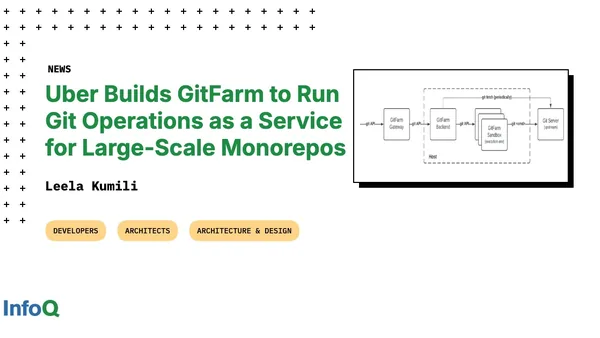
Uber Builds GitFarm to Run Git Operations as a Service for Large-Scale Monorepos

Uber built GitFarm, a Git-as-a-Service platform that exposes Git operations via a gRPC API, eliminating local clones for client systems and reducing client-side resource utilization by over 80%. The service pre-warms repository checkouts and sandbox containers, delivering full checkouts in under 500 milliseconds compared to the previous 15-minute clone time for Uber's Go monorepo, which required six CPU cores and 32 GB of memory. GitFarm supports bidirectional gRPC streaming for multi-command workflows and has been in production since early 2025, with a roadmap including sparse checkouts and streaming Git output.

SQLite Across Every Port: One Contract, One Encrypted File Format
Languages / dev.to

SQLite Across Every Port: One Contract, One Encrypted File Format

Codename One's PR #5526 replaces platform-dependent SQLite implementations with a single, tested contract across iOS, Android, desktop, and web. The new DatabaseConformanceSuite enforces consistent behavior for cursors, transactions, blobs, and encryption, using SQLCipher 4 for a portable encrypted file format. Windows and Linux now open databases instead of returning null, and a legacy build hint eases migration from previous inconsistent behavior.

General / four.htmx.org

Htmx 4.0

Htmx 4.0 is released after 8 months of development, migrating from XMLHttpRequest to the fetch() API internally while keeping the user-facing API nearly identical to htmx 2. The three major changes are explicit attribute inheritance via the :inherited suffix, standardized event naming following the htmx:phase:action pattern, and removal of localStorage for history support by default. The team is not marking 4.0 as latest on NPM until early 2027 to avoid breaking users on non-versioned CDN URLs, and provides a CLI tool to automate upgrade migration.

Anthropic Releases Automated Alignment Researchers for Reproducible AI Safety Research
AI/ML / dev.to

Anthropic Releases Automated Alignment Researchers for Reproducible AI Safety Research

Anthropic released Automated Alignment Researchers (AARs), a Claude-powered research sandbox using nine Claude Opus 4.6 agents in independent sandboxes with a shared forum and codebase to automate alignment experiments. On a chat-task benchmark, the AARs achieved a performance gap recovered (PGR) of ~0.97 after ~800 cumulative AAR hours at ~$18,000 compute cost, far exceeding a human baseline PGR of 0.23 over seven days. However, results were uneven across math (PGR 0.94) and coding (PGR 0.47) tasks, underscoring that strong benchmark performance does not guarantee reliability across all scenarios.