Skip to content

Four Signals

Agentic insights for modern tech teams

Languages / developer.nvidia.com

Introducing CUDA Rust: Two Tracks for Writing GPU Kernels

NVIDIA announced CUDA Rust, enabling GPU kernels written natively in Rust and compiled to PTX, closing the gap that previously forced kernel code into other languages. Two tracks are available: SIMT for explicit per-thread control (via the cuda-oxide rustc codegen backend) and Tile for a higher-level, architecture-agnostic model where the compiler handles thread mapping. The Tile track is recommended as the default, with SIMT reserved for cases requiring fine-grained memory or thread management.

Why it matters

For a solutions architect focused on AI/ML agent orchestration and cloud infrastructure, this means Rust's safety guarantees can now extend into GPU kernel development, reducing memory bugs in inference engines and agent runtimes while maintaining performance—critical for building reliable, high-throughput systems on GCP/AWS.

GPT-6 Astra, looped transformers, and hidden reasoning
AI/ML / magazine.sebastianraschka.com

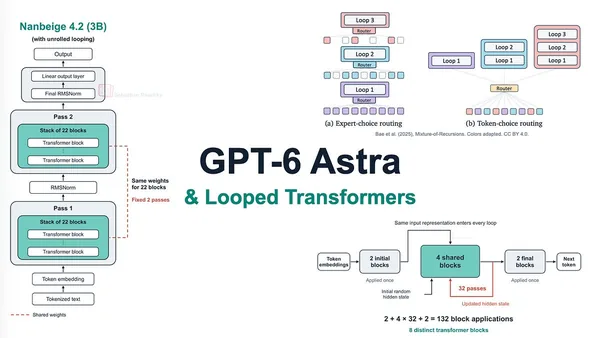
GPT-6 Astra, looped transformers, and hidden reasoning

OpenAI's GPT-6 Astra, released last week, achieves 99.9% on ARC-AGI-3 (vs GPT-5.6's 7.8%) and excels at 3D rendering, but independent benchmarks like Artificial Analysis show it's only marginally ahead on agentic coding tasks. The article explores looped transformers (recurrent depth) as a potential architectural innovation enabling hidden chain-of-thought reasoning, though the exact relationship remains speculative. Sebastian Raschka notes that Astra's primary harness may amplify its strengths, making cross-harness comparisons necessary for fair evaluation.

Presentation: Accelerating Performance by Incrementally Integrating Rust Into Existing Codebase
Languages / infoq.com

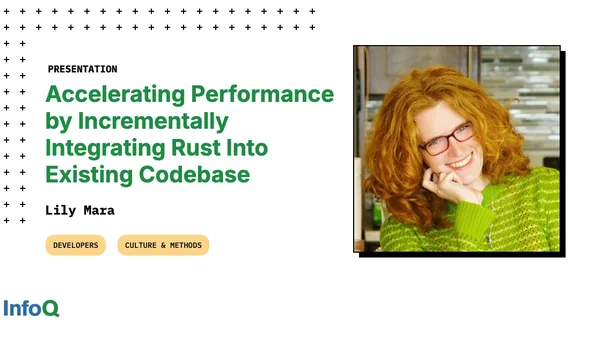
Presentation: Accelerating Performance by Incrementally Integrating Rust Into Existing Codebase

Lily Mara, a Staff Engineer at Discord, presents a strategy for incrementally integrating Rust into existing Python codebases using PyO3 and FFI refactoring, avoiding high-risk full rewrites. She demonstrates how teams can replace specific Python bottlenecks with Rust to achieve dramatic function-level speedups, seamless integration testing, and infrastructure cost savings without adding microservice overhead. The approach leverages institutional knowledge in legacy systems to avoid reintroducing bugs, contrasting with the common impulse to rewrite entire systems from scratch.

What Happens When an AI Agent Runs Longer Than Your HTTP Request?
AI/ML / dev.to

What Happens When an AI Agent Runs Longer Than Your HTTP Request?

AI agents often outlive HTTP request timeouts, causing 504 Gateway Timeout errors while the agent continues spending tokens and mutating state, leading to split-brain behavior. The solution is to treat the HTTP request as a trigger by creating an agent run resource, returning 202 Accepted, and executing work asynchronously with idempotency keys to prevent duplicate runs. Durable state, SSE/WebSockets for progress, and explicit cancellation protocols are essential to handle long-lived state machines that may wait on tools, human approval, or retries.

AI/ML / cncf.io

Kubernetes disaster recovery: Guidance from three reproducible failure scenarios

This article likely covers three reproducible Kubernetes failure scenarios that highlight the gap between having backups and being able to recover. It provides practical guidance for disaster recovery, with each scenario reproducible on a laptop from a lab repository.

General / fzakaria.com

Review a pull request by booting it

A new GitHub Action, trynix-preview, lets reviewers boot a pull request's build directly in the browser via trynix.dev without cloning, building, or any infrastructure. It works by linking to pre-cached Nix store paths, requiring the PR's code to already be built and pushed to a cache like Cachix. Performance is currently best for small-to-medium binaries, as large ones can take 1-2 minutes to execute.

nginx will proxy the new HTTP QUERY method. It will never cache one.
DevTools / dev.to

nginx will proxy the new HTTP QUERY method. It will never cache one.

The IETF's RFC 10008 defines the HTTP QUERY method—a safe, idempotent, cacheable alternative to POST for read operations with complex parameters. Testing eight language models to generate clients for a QUERY-only API revealed all models correctly used the method when explicitly prompted, but defaulted to POST without guidance. The real failure point was nginx, which proxies QUERY requests but refuses to cache them, undermining the method's key benefit.

The Retrieval Pipeline Is Lying to You: How RAG Fails Before the LLM Sees Anything
AI/ML / dev.to

The Retrieval Pipeline Is Lying to You: How RAG Fails Before the LLM Sees Anything

Most RAG failures originate in the retrieval pipeline—ingestion, chunking, indexing, filtering, ranking, and query transformation—not in the LLM or prompt design. Common failure modes include mangled PDF tables losing structure during extraction, context-destroying chunking that splits related content, and vector similarity ranking that prioritizes duplicates over better evidence. Teams must treat ingestion as a structured, document-type-aware process and evaluate retrieval quality independently from final answer accuracy.

OpenAI gave an AI the power to block its own engineers’ code
AI/ML / thenewstack.io

OpenAI gave an AI the power to block its own engineers’ code

OpenAI now routes every engineer's pull request through an automated AI security review that can block merges without human intervention. The company's code-review models, benchmarked as "superhuman" for both correctness and security, also handle dependency upgrades, regression catching, and refactoring tasks that previously took months. Engineering lead Thibault Sottiaux argues this shifts human focus from reviewing code to earlier planning discussions about intent and design.

Meta's Recipe for Building Agents as "Organizational Second Brains"
AI/ML / infoq.com

Meta's Recipe for Building Agents as "Organizational Second Brains"

Meta detailed an AI agent architecture dubbed an 'organizational second brain' that captures domain-expert logic in version-controlled text files rather than model weights, enabling auditable, regression-tested updates without retraining. The system uses four layers—knowledge system, reasoning pipeline, evaluation framework, and self-improvement loop—with composable 'recipes' and human-in-the-loop checkpoints. Applied to compliance, it cut assessment time from days to minutes with zero regressions across improvement cycles.