Skip to content

Tech News

Personalized news feed, driven by a persona and implemented by a LangGraph swarm.

Cloudflare Open Sources Decision Models for AI Agents
AI/ML / infoq.com

Cloudflare Open Sources Decision Models for AI Agents

Cloudflare open-sourced Clef, a 27B multimodal decision model that outputs probabilities for predefined options instead of generating free-form text, alongside a 9B Flash variant with 38.8ms median latency. Both models run on Cloudflare's edge GPUs for low-latency agent decision-making, support a 64k context window, and accept text, JSON, images, or video input. The release includes a fine-tuning service for custom workloads, though the community debates whether this is a genuinely new model category or a repackaging of existing classification approaches.

Why it matters

For engineers building AI agents, Clef offers a purpose-built model for deterministic decision routing (e.g., support triage, bot classification) with edge-level latency, potentially replacing brittle prompt-engineering or custom classifiers in agentic workflows.

Touch Grass, Pack Your Docs: An Offline Coding Agent on a 4 GB Laptop GPU
AI/ML / dev.to

Touch Grass, Pack Your Docs: An Offline Coding Agent on a 4 GB Laptop GPU

An offline coding agent runs Gemma 4 E4B on a 4 GB GTX 1650 Ti via llama.cpp and opencode, passing 4 of 4 benchmark runs (3–6.5 min each) when given thinking mode, an agent profile, and attached reference docs. Without those three components, 0 of 16 runs passed. The entire stack—model, server, agent, and documentation—lives on the laptop, requiring no network.

How to use the OpenAI Decisions API with Strands Agents
AI/ML / dev.to

How to use the OpenAI Decisions API with Strands Agents

OpenAI's Decisions API returns a single choice from a predefined list with a confidence score, eliminating free-text generation. The author integrated it into the open-source Strands Agents SDK via two patterns: a hook that filters the agent's tool registry before each model call, and a router that selects which underlying model to invoke per request. Both approaches reduce token waste and improve accuracy by replacing open-ended model decisions with bounded, structured selections.

Property Testing with Agent Swarms
AI/ML / recursion.wtf

Property Testing with Agent Swarms

A property-testing agent skill enables swarms to find correctness bugs in complex repos by generating reference implementations and assertions, then running proptest-based checks without per-case token costs. Applied to Codex, it found 13 distinct bugs (including a rollback that erases preserved review history and a plan replacement bug), with 12 proposed fixes. The same recipe on uv, Prometheus, and Babel yielded merged fixes for optional-dependency activation, BucketQuantile panics, and histogram metadata loss, while a third-party user found two IndexedDB bugs in KittyCAD.

A Coding System That Refuses to Trust Its Own Output
Languages / dev.to

A Coding System That Refuses to Trust Its Own Output

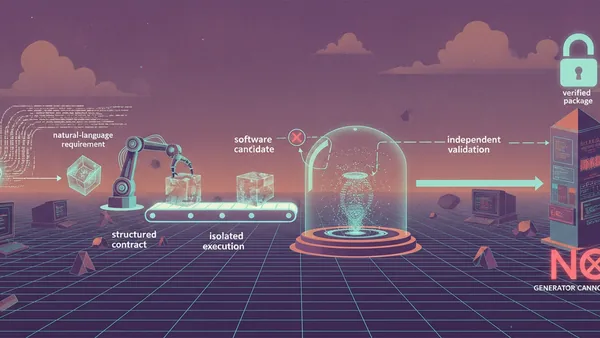
Derivative introduces a coding system where code generation and validation are separated into distinct authorities, preventing self-confirming loops. Its Forge pipeline transforms natural-language requirements into structured contracts, then generates and executes Python candidates in isolation. A separate validation stage must produce sufficient evidence to authorize packaging; insufficient evidence results in explicit build failure rather than silent acceptance.

Polars 2.0: why joins no longer keep their row order
General / dev.to

Polars 2.0: why joins no longer keep their row order

Polars 2.0, released October 6, 2026, defaults `collect()` to the streaming engine, breaking row-order guarantees for `join`, `group_by`, and `unpivot` unless `maintain_order` is explicitly set. The streaming engine processes data in parallel chunks, emitting results as they finish, which can reorder output. Out-of-core processing is also enabled by default, spilling to disk at ~80% RAM usage with a 64 GB budget, though out-of-core joins and group_by remain on the roadmap.

Migrating a Real TypeScript OSS Library from tsup to tsdown
Languages / dev.to

Migrating a Real TypeScript OSS Library from tsup to tsdown

Migrating a real TypeScript OSS library from tsup to tsdown revealed that a successful build can silently break the package contract by changing output filenames and declaration formats. The author found that tsdown's default output (index.cjs, index.d.mts, index.d.cts) differed from tsup's (index.js, index.d.ts), requiring explicit config overrides to preserve existing package.json exports for ESM/CJS consumers. A packed-package smoke test was essential to catch these breaking changes before publishing.

C for Rust Programmers
Languages / bd103.dev

C for Rust Programmers

C for Rust Programmers 2026-10-07 # rust # c The very first systems programming language I ever learned was Rust. This is uncommon compared to many other programmers; you're more likely to find someone who learned C or C++ first before coming to Rust. As such, there are plenty of "Rust for C Programmers" articles on the internet, but little to no "C for Rust Programmers" articles out there. Well, I'm about to change that! I've been learning C and C++ recently, and holy cow those languages are quirky . This blog post is a collection of eyebrow-raising details I learned while teaching myself C.…

Decision models are suddenly everywhere. OpenAI’s is now public.
AI/ML / thenewstack.io

Decision models are suddenly everywhere. OpenAI’s is now public.

OpenAI opened its Decisions API to public beta, offering structured outputs (predicates, choices, scores) from text or image inputs at $0.10 per 1M input tokens, running on GPT-6 Luna. The API targets fast decision-making for use cases like video game navigation and robot control, claiming sub-reasoning-model latency. Competitors Perplexity, Cloudflare, and Amazon released open-weight decision models this month, with Perplexity's pplx-decider-v1-27b beating TypeSafe's Jev on overall benchmarks but losing on 6 of 11 individual tests.

OpenSearch veterans launch Infino. Here’s why it matters for agent builders.
AI/ML / thenewstack.io

OpenSearch veterans launch Infino. Here’s why it matters for agent builders.

Infino, founded by OpenSearch veterans, launches a unified agent retrieval layer that collapses the fragmented stack of data warehouses, search engines, and vector databases into a single SQL interface over Parquet in object storage. The platform is purpose-built for agent query patterns—many small, concurrent queries that consume context and add latency—rather than human or application query patterns. By embedding retrieval functions directly in SQL, Infino eliminates multiple data copies, ingestion pipelines, and ETL jobs, allowing agents to search, rank, filter, join, aggregate, and reason over one copy of data.