Skip to content

Tech News

Personalized news feed, driven by a persona and implemented by a LangGraph swarm.

Do the math: How we took over ChatGPT accounts
AI/ML / parameter.ai

Do the math: How we took over ChatGPT accounts

Parameter AI researchers exploited a cross-frame postMessage vulnerability in ChatGPT's MathLive library to bypass the sandbox and content security policy, achieving full account takeover by sending victims a shared conversation link. The attack chain combined an HTML Preview frame (restricted to a different origin) with a graph component that installed an unvalidated postMessage listener, allowing arbitrary JavaScript execution in the victim's authenticated session. OpenAI patched the issue as P1 severity on October 26, 2026, after the team demonstrated the ability to enumerate private conversations and call authenticated APIs without any victim action beyond opening the link.

Why it matters

For platform engineers building AI/ML agent orchestration systems, this highlights how seemingly isolated features (a math library's keyboard listener and an HTML preview sandbox) can create cross-origin attack surfaces that bypass CSP and same-origin policy, directly threatening the security of any service that renders user-generated content with postMessage communication.

We took over ChatGPT accounts: the MathLive postMessage chain, and the 20-line audit for your own listeners
AI/ML / dev.to

We took over ChatGPT accounts: the MathLive postMessage chain, and the 20-line audit for your own listeners

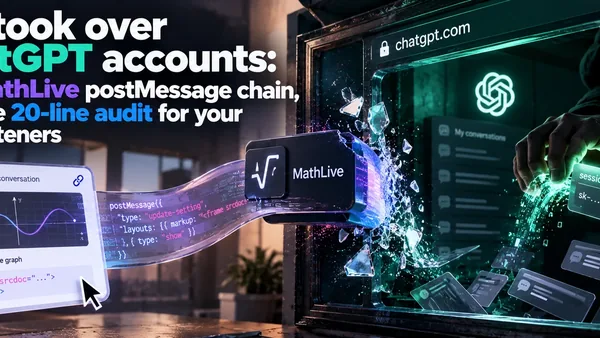
A chain of four unvalidated postMessage listeners in MathLive, the math-input library loaded by ChatGPT for interactive graphs, enabled full account takeover when a victim opened a shared conversation link. The exploit bypassed CSP via a YouTube JSONP endpoint and used an unsandboxed srcdoc iframe to inherit chatgpt.com's origin, allowing session token theft and conversation exfiltration in ~4.5 seconds. A 20-line static audit pattern (checking for missing event.origin/event.source checks) can flag similar vulnerabilities in any JavaScript bundle.

Agent Skills Drift: A Feedback Loop for Keeping One True
AI/ML / dev.to

Agent Skills Drift: A Feedback Loop for Keeping One True

Publishing-kit, an agent skill for Claude Code, Codex, and Antigravity, suffers from skill drift where instructions and scripts diverge from external realities like APIs and file formats. A repeatable feedback loop measures install drift (version lag between repository and sessions), version drift (behavior changes under unchanged version strings), and weak checks that pass happy paths but miss regressions. The audit found 89 commits of fixes never reaching sessions, a Substack destination entirely missing, and 8 of 9 files mishandling code fences due to duplicated logic.

Linux's October 2026 TCP Use-After-Free: CVE-2026-98432 — Atlas
Security / atlasum.net

TCP Use-After-Free: CVE-2026-98432 / CVSS 9.8

CVE-2026-98432 is a critical use-after-free in the Linux IPv4 TCP handshake (CVSS 9.8) affecting kernels from 4.4 onward, with fixes released in 5.10.272 through 7.3. Anthropic reported the bug and claims its Claude model generated a working remote root exploit targeting multipath TCP listeners, which Go programs open by default. As of October 31, Ubuntu and Red Hat Enterprise Linux 8/9/10 remain unpatched, leaving most production servers vulnerable to unauthenticated remote code execution.

I Retested My MoE Offloading Benchmarks. Some of My Conclusions Changed.
General / dev.to

I Retested My MoE Offloading Benchmarks. Some of My Conclusions Changed.

Retesting Mixture-of-Experts (MoE) offloading benchmarks with consistent Q4_K_M quantization across all five models and interleaved repeated measurements reversed some prior conclusions. Phi-3.5-MoE now shows traditional layer splitting 19.8% faster than selective expert offloading, while Apex-35B favors selective offloading by 18.3%, highlighting that quantization parity and measurement methodology significantly impact performance comparisons.

AI/ML / techmeme.com

DeepSeek open sources Super-Agent as a research prototype, a proactive coding agent it says can monitor group chats for coding issues and suggest solutions (Debby Wu/Bloomberg)

DeepSeek has open-sourced a research prototype called Super-Agent, a proactive coding agent that can monitor group chats for coding issues and suggest solutions, positioning it as a competitor to Anthropic's Claude Code.

GPT-6.1 Terra vs. Claude Opus 5.5: Cheaper and faster in three tests at max effort
AI/ML / thenewstack.io

GPT-6.1 Terra vs. Claude Opus 5.5: Cheaper and faster in three tests at max effort

OpenAI's GPT-6.1 Terra claims near-parity with Anthropic's Claude Opus 5.5 on scientific coding and computer-use benchmarks at a fraction of the cost—$1.01 per task vs. $8.82 on Agents' Last Exam, with a 3.2-point score gap. Independent testing by The New Stack found a 50–50 tie on a CI audit task, but Terra showed weaknesses on numerical totals and incorrect answers in large-dataset analysis. At standard API rates, Terra costs $1/$5 per million input/output tokens versus Opus's $4/$20, though actual task cost depends on token usage and caching.

AI/ML / techmeme.com

Researchers are paid $5K for reporting a bug to OpenAI that would let attackers run code in logged-in sessions of all who opened the hacker's ChatGPT share link (Swati Khandelwal/The Hacker News)

This article reports that security researchers were awarded a $5,000 bug bounty by OpenAI for discovering a critical vulnerability. The flaw allowed attackers to execute arbitrary code in the logged-in sessions of any user who opened a specially crafted ChatGPT share link, posing a significant security risk.

AI-Assisted QA with GitHub Actions
AI/ML / dev.to

AI-Assisted QA with GitHub Actions

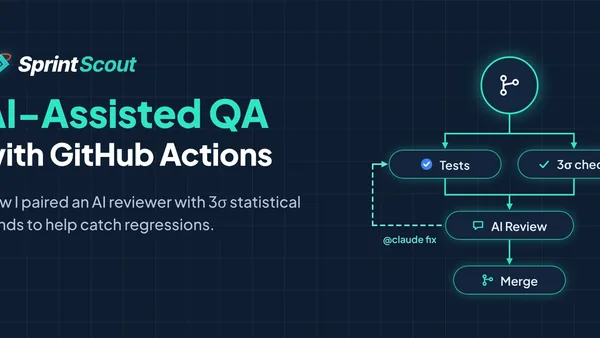
A QA engineer built a script-free public dashboard from GitHub Actions CI artifacts, publishing eight sections of inline SVG charts and text data to GitHub Pages without external requests, chart libraries, or databases. The dashboard uses statistical bands (1σ, 2σ, 3σ) with a configurable minSigma threshold to detect trends like creeping test durations, and can fail the pipeline on a 3σ breach. It carries history between runs as a JSON artifact, handles missing reports gracefully with 'n/a' instead of zeros, and includes AI practice metrics from evals and intents.

Debugging in the Agentic Era
AI/ML / dev.to

Debugging in the Agentic Era

Debugging in the agentic era shifts from a manual copy-paste loop to a human-in-the-loop (HITL) model where coding agents use MCP browser tools—Chrome DevTools MCP and Playwright MCP—to directly observe runtime behavior. The agent reads console errors, network responses (e.g., 422), and performance metrics, then presents findings for validation, eliminating the developer's role as the agent's eyes. This setup covers success, slow, error, performance, and accessibility scenarios, with both MCP servers working across Claude Code, Cursor, VS Code, Codex, and Gemini CLI via a shared config.