Skip to content

Tech News

Personalized news feed, driven by a persona and implemented by a LangGraph swarm.

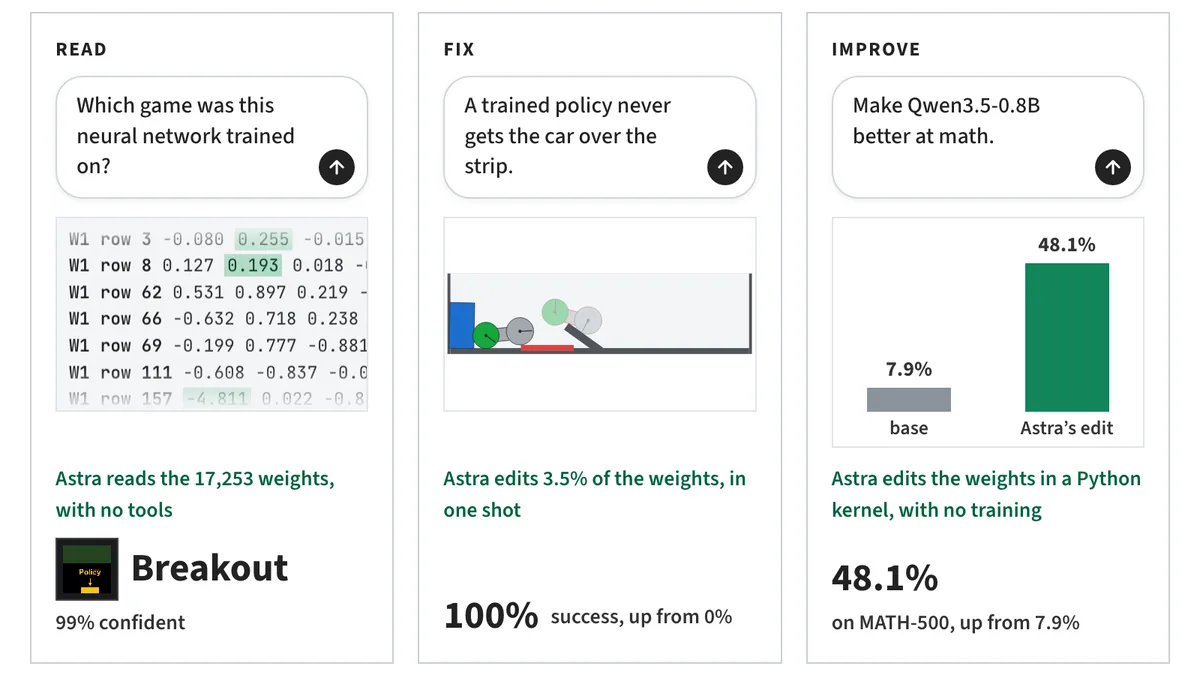
Astra can read and write weights to improve Qwen
Open Source / rikiyat.github.io

Astra can read and write weights to improve Qwen

Frontier LLMs like GPT-6 Astra can natively read and write neural network weights, identifying and fixing issues without gradient descent or environment feedback. Astra edited 0.016% of Qwen3.5-0.8B's weights to boost MATH-500 from 7.9% to 48.1% and triple IFEval, outperforming PPO-trained networks after 100 million steps. This weight-space programming paradigm shifts optimization from symbolic algorithms like Adam to reasoning-driven LLMs that directly manipulate weights.

Why it matters

For a solutions architect focused on AI/ML agent orchestration and platform engineering, this introduces a new primitive for model optimization and interpretability that could replace traditional training loops, enabling agents to directly debug and enhance deployed models without retraining infrastructure.

Gemma 4 in Rust on TorchTPU: A Native TPU Rig With PyO3 and MCP
AI/ML / dev.to

Gemma 4 in Rust on TorchTPU: A Native TPU Rig With PyO3 and MCP

A developer built a native TPU inference rig for Gemma 4 E2B using Rust on a Cloud TPU v5e-1 VM, with all 35 layers, ring cache, and decode loop written in Rust and reaching TorchTPU through a 154-line C++ shim over ATen instead of the tch crate. The setup boots in 4 minutes 29 seconds from Python 3.14 to serving an OpenAI-compatible endpoint, decodes at a median 12.20 tokens per second, and matches Hugging Face Transformers on 64 of 64 greedy tokens on CPU. A Claude Code MCP server provisions the TPU, and the VM builds the Rust crate as a PyO3 extension on boot, with Python hosting the HTTP server and process.
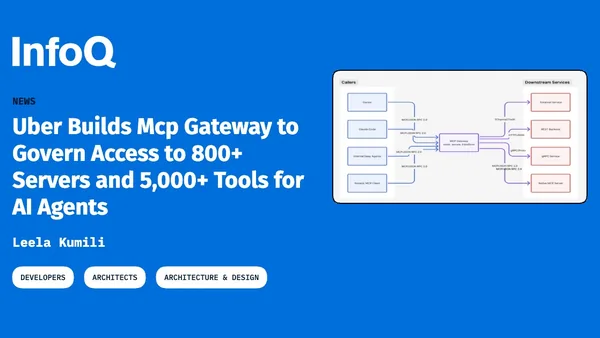
Uber Builds MCP Gateway to Govern Access to 800+ Servers and 5,000+ AI Agent Tools
AI/ML / infoq.com

Uber Builds MCP Gateway to Govern Access to 800+ Servers and 5,000+ AI Agent Tools

Uber built an MCP Gateway to standardize AI agent access to over 800 servers and 5,000 internal tools, addressing fragmented integrations and inconsistent security. The architecture separates an MCP Registry (control plane) from a Proxy Gateway (runtime), translating MCP requests into HTTP, gRPC, or TChannel calls without modifying underlying services. AutoCrawler automates tool discovery via Cadence workflows, scanning Protocol Buffers and Thrift schemas, while Omni MCP supports incremental discovery to avoid loading all tool definitions into agent context.

I Built a Visual System Design Reference — Switch Any Architecture Between AWS, Azure, GCP & Open Source
Cloud / dev.to

I Built a Visual System Design Reference — Switch Any Architecture Between AWS, Azure, GCP & Open Source

System Design Explainer is an interactive reference site that visualizes 36 real-world architectures (YouTube, Uber, etc.) and lets you switch any diagram between AWS, Azure, GCP, and open-source tooling with one click. It includes hop-by-hop request walkthroughs, component deep-dives, and concept explanations — all with auto-laid-out diagrams that stay consistent across cloud providers. Built by a developer frustrated with static, vendor-locked diagrams and scattered notes, the project is open-source and live on Vercel.

TypeScript `@throws` JSDoc and Error Typing in 2026: Why Exceptions Are Still Untyped and What to Do About It
Languages / dev.to

TypeScript `@throws` JSDoc and Error Typing in 2026: Why Exceptions Are Still Untyped and What to Do About It

TypeScript in 2026 still lacks typed exceptions because it inherits JavaScript's unchecked exception model, leaving `@throws` JSDoc annotations with zero compiler enforcement. Three technical barriers prevent implementation: dynamic function references lose throw information through indirection, npm packages lack throw annotations, and JavaScript's `throw` accepts any type. Teams must adopt Result types (`Result<T, E>`) or discriminated unions with type guards to get compiler-verified error handling today.

Article: Systemic Approach to Memory, Knowledge, and Context in Agentic AI Architectures
AI/ML / infoq.com

Article: Systemic Approach to Memory, Knowledge, and Context in Agentic AI Architectures

Agentic AI architectures must separate context, memory, and knowledge into distinct layers to move beyond chatbots toward reliable autonomous agents. Context acts as a dynamic control plane governing what the agent knows at any moment, memory provides persistence across sessions, and knowledge serves as the system's curated foundation of policies and facts. The article argues that context engineering—optimizing small, relevant context—is more critical than prompt engineering for reducing hallucinations and improving reasoning.

Google and Meta Open-source TorchTPU to Bring Native PyTorch Support to Google TPUs
DevTools / infoq.com

Google and Meta Open-source TorchTPU to Bring Native PyTorch Support to Google TPUs

Google and Meta open-sourced TorchTPU, a native PyTorch backend for Google TPUs that replaces the prior PyTorch/XLA approach. TorchTPU prioritizes eager execution, requires minimal code changes (e.g., replacing `cuda` with `tpu`), and introduces a DeferAndFuse hybrid mode that Google claims can be 50% faster than strict eager. In benchmarks, a 30B-parameter Muse Glimmer model achieved 25.7k token/s inference on a single TPUv7 chip, while Qwen3 MoE 235B scaled to 8,192 TPUv7 chips for training.

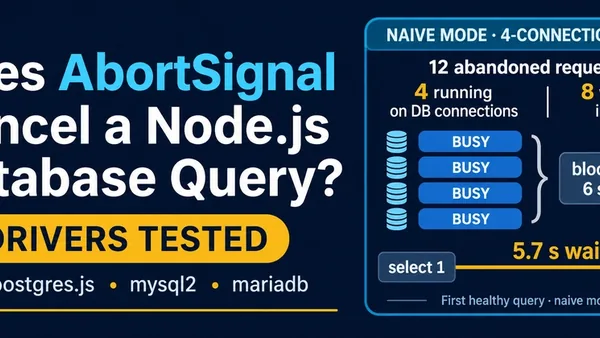
Does AbortSignal Cancel a Node.js Database Query? 4 Drivers Tested
DevTools / dev.to

Does AbortSignal Cancel a Node.js Database Query? 4 Drivers Tested

Testing five Node.js database drivers reveals that only postgres.js 4.0.0 respects AbortSignal on queries via query.signal(), while pg 8.23.1, mysql2 3.24.6, mariadb 3.5.4, and postgres.js 3.4.9 ignore it entirely. Abandoned queries from 12 clients on a 4-connection pool caused 5.7-second waits for healthy queries and 24 connection-seconds of tagged activity, exposing pool starvation risks. postgres.js 3.4.9 also exhibits a trap where 4 of 12 cancelled promises never settle on warm pools, a bug resolved in 4.0.0.

Ubuntu still has not released patch for Linux 0day RCE in almost 3 weeks
Security / freenode.net

Ubuntu still has not released patch for Linux 0day RCE in almost 3 weeks

Ubuntu has not shipped patched kernels for CVE-2026-98432, a CVSS 9.8 remote code execution vulnerability, leaving 22.04, 24.04, and 26.04 LTS releases exposed for nearly three weeks. No ETA for fixes exists, forcing operators of internet-facing or multi-tenant self-hosted systems to choose between stock kernels, out-of-tree mitigations, or migrating to already-patched releases. The delay undermines Ubuntu's LTS security guarantees for isolation and privilege boundaries.

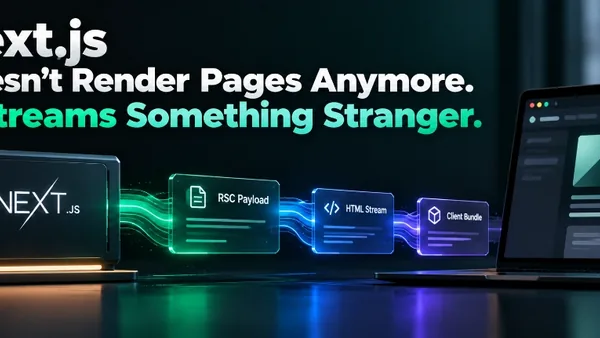
Next.js Doesn't Render Pages Anymore. It Streams Something Stranger.
DevTools / dev.to

Next.js Doesn't Render Pages Anymore. It Streams Something Stranger.

Next.js Client Components execute on the server during initial SSR, not just in the browser. The 'use client' directive defines a module boundary for bundling, not execution location—both Server and Client Components run on the server for pre-rendering, with Client Components additionally shipping JavaScript for hydration. Misunderstanding this leads to bugs like `window is not defined` during server execution.