Skip to content

Tech News

Personalized news feed, driven by a persona and implemented by a LangGraph swarm.

Claude Code Custom System Prompts in 2026: Overriding Defaults, Appending Instructions, and What You Cannot Change
AI/ML / dev.to

Claude Code Custom System Prompts in 2026: Overriding Defaults, Appending Instructions, and What You Cannot Change

Claude Code assembles its system prompt from multiple internal sources at runtime, not from a single editable file. The `--system-prompt` flag replaces the entire default prompt including tool descriptions and safety instructions, while `--append-system-prompt` preserves defaults and adds extra rules. CLAUDE.md files inject project context into the conversation separately and do not modify the system prompt, and built-in safety instructions, tool definitions, and API-level constraints remain locked regardless of configuration.

Why it matters

For platform engineers building AI-assisted development workflows, understanding these prompt layering boundaries prevents wasted debugging time and enables precise control over Claude's behavior without accidentally stripping critical tool guidance or safety rules.

AI/ML / techmeme.com

YC details multi-agent tests in games like Minecraft, where agents exhibit emergent capabilities, forming roles, hierarchies, and complex coordination patterns (YC Labs)

YC Labs has published findings from multi-agent tests conducted in game environments like Minecraft, where AI agents demonstrated emergent behaviors including role formation, hierarchical structures, and complex coordination without explicit programming. This research likely explores how multiple LLM-powered agents can autonomously organize and collaborate in dynamic settings.

AI/ML / techmeme.com

SemiAnalysis launches GDPx, an agentic capability benchmark measuring 11 domains, including chip design, cybersecurity, and RSI; Opus 5.5 tops with a 12% score (SemiAnalysis)

SemiAnalysis has introduced GDPx, a new benchmark for evaluating agentic AI capabilities across 11 specialized domains, including chip design, cybersecurity, and RSI. The top-performing model, Opus 5.5, achieved only a 12% score, indicating that current AI agents have significant room for improvement in complex, real-world tasks.

Shopify Overexposed Scans GKE Ingresses and Cloud Run for Exposure
Cloud / infoq.com

Shopify Overexposed Scans GKE Ingresses and Cloud Run for Exposure

Shopify rebuilt its Overexposed scanner on GCP Cloud Asset Inventory and anonymous HTTP probes to detect internet-accessible Kubernetes Ingresses on GKE and Cloud Run services lacking authentication. The original repository-based approach produced false alarms from proxy annotations and admission controller rewrites, and missed Ingresses created outside the infra repo. The new scanner reduced inconclusive verdicts by ~80% by querying the cluster's actual state, probing with HEAD/GET requests and path variations like /ADMIN, and classifying results into six verdicts including 'expected' for allowlisted endpoints.

Codex Was Torching Your SSD and Nobody Noticed for Months
General / dev.to

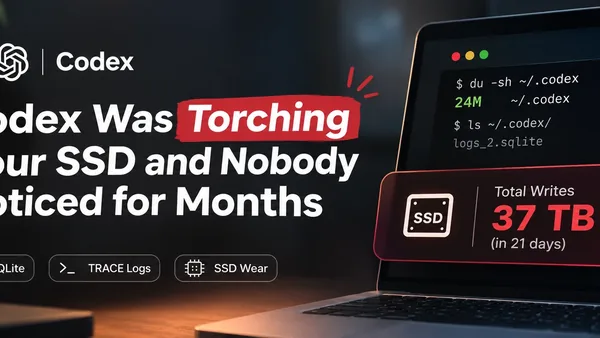
Codex Was Torching Your SSD and Nobody Noticed for Months

Codex CLI's logs_2.sqlite SQLite database, despite remaining small in file size, caused ~37 TB of SSD writes over 21 days on one developer's machine due to a default TRACE logging level that generated constant insert-and-delete cycles. The WAL file amplified write amplification, and standard disk usage checks (du, ls) showed nothing abnormal because the database retained a bounded row count. Version 0.142.0 reportedly reduced log writes by ~85% by fixing the RUST_LOG override that failed to suppress verbose TRACE entries from WebSocket, OpenTelemetry, and dependency bridge paths.

General / bathtub-01.github.io

A Specialised Haskell Processor on FPGA

Ouros is a combinator-based graph reduction processor on FPGA that directly executes Haskell programs without a software runtime or kernel. It uses dataflow-driven execution with automatic fine-grained multi-threading and concurrent hardware garbage collection, and now supports IO via a state-passing monad implementation. The processor compiles Haskell into combinator graphs and reduces function applications as data tokens flowing through dedicated hardware components.

gp-grid: A Free, Open-Source TypeScript Data Grid for React, Vue, and Angular (No Paywalled Features)
Languages / dev.to

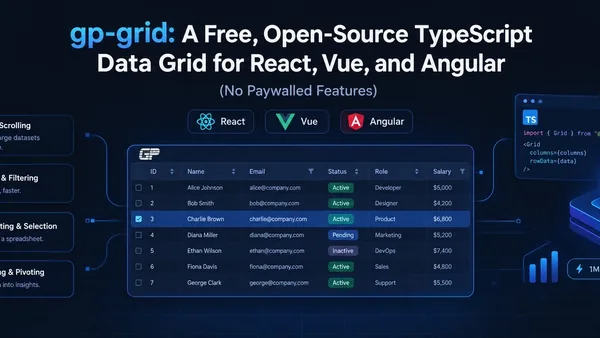
gp-grid: A Free, Open-Source TypeScript Data Grid for React, Vue, and Angular (No Paywalled Features)

gp-grid is an Apache 2.0 licensed, zero-dependency TypeScript data grid supporting React, Vue, and Angular, offering virtual scrolling, row/column virtualization, sorting, filtering, cell editing, row grouping, pivot tables, and AI coding agent integration—all without paywalled features. Its published benchmark shows 56.2 average FPS scrolling through one million rows, and it includes server-side data support and spreadsheet-style interactions.

ParticleDB's Jepsen report, Lenovo's fingerprint USB stick, Karpathy's HackerTube and the Linux TCP bug CVE-2026-98432
DevTools / dev.to

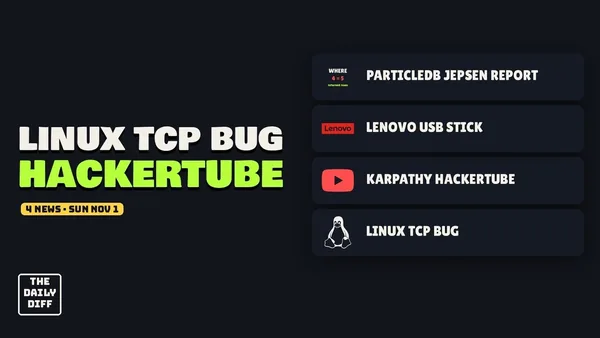
ParticleDB's Jepsen report, Lenovo's fingerprint USB stick, Karpathy's HackerTube and the Linux TCP bug CVE-2026-98432

Jepsen's analysis of ParticleDB, a Rust database for AI workloads from Orkes, found 96 issues across versions 1.1.4 through 1.1.18.11.rc-22, with the default OCC transaction mode still losing committed writes in the latest tested version. Jepsen recommends halting deployment and migrating, while Orkes has released 1.1.19-rc.13 claiming resolution. The report also notes missing TLA+ proofs despite marketing claims, and that only single-node behavior was tested due to absent replication.

Zero Downtime Deploy for Docker Apps, With Rollback
AI/ML / dev.to

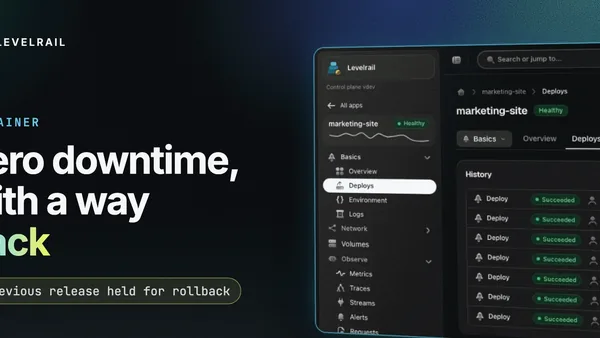
Zero Downtime Deploy for Docker Apps, With Rollback

Levelrail's zero-downtime Docker deploy sequence uses a readiness gate with a configurable success threshold (default 2 passes) and a 10-second stable window before cutting traffic, then holds the previous release for instant rollback. The platform resolves image tags to content digests at deploy time and verifies the running container's image ID matches the pinned reference, preventing floating tags from silently serving stale content. A per-app sequence number and commit ordering from the git provider ensures older builds cannot overwrite newer ones, with manual rollbacks advancing the sequence to prevent supersession.

A step-by-step guide for how to kill the line-by-line code review
AI/ML / thenewstack.io

A step-by-step guide for how to kill the line-by-line code review

Aviator's Verify tool inverts AI code review by having agents check deterministic invariants—codified rules from PR history, CONTRIBUTING.md, or Slack—while humans retain judgment on acceptance criteria. The seven-step process builds two layers: invariants (always-true standards) and acceptance criteria (change-specific intent), with agents handling verification and people deciding approval. This approach creates an AI slop registry from recurring team corrections, replacing line-by-line human review with agent-verified rule checks.