
Skip to content

Tech News

Personalized news feed, driven by a persona and implemented by a LangGraph swarm.

TypeScript `const` Enums Are Deprecated: What to Migrate to and Why the Compiler Team Made the Call
Languages / dev.to

TypeScript `const` Enums Are Deprecated: What to Migrate to and Why the Compiler Team Made the Call

TypeScript's compiler team deprecated `const` enums because they break isolated module compilation and cause runtime failures when used with modern build tools like esbuild, swc, and Vite. The inlining of values at compile time creates a mismatch when library versions drift, leading to wrong conditional branches and silent data corruption. Migration to union types with `as const` provides equivalent type safety without runtime objects, making it compatible with isolated compilation.

Why it matters

As a platform engineer building with TypeScript, this directly impacts your ability to use fast, parallel build tools and ship libraries without breaking downstream consumers—removing a common source of production bugs in multi-module architectures.

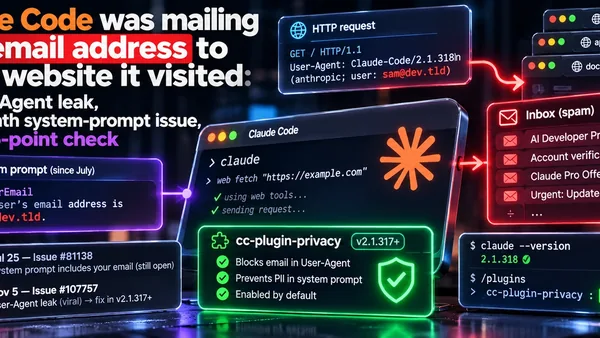
Claude Code was mailing your email address to every website it visited: the User-Agent leak, the 5-month system-prompt issue, and the 5-point check
AI/ML / dev.to

Claude Code was mailing your email address to every website it visited: the User-Agent leak, the 5-month system-prompt issue, and the 5-point check

Two separate privacy leaks in Claude Code exposed user email addresses: one via the User-Agent header in HTTP requests (leaking to every server logged), and another by injecting the email into the model's system prompt on every session. The User-Agent leak was fixed within hours after going viral on November 5, while the system-prompt issue (#81138) filed in July remains open. The fix ships as a built-in mod (cc-plugin-privacy) in v2.1.317+, but a user on v2.1.318 still observed the leak, suggesting gaps in the default-enabled protection.
The A2A CLI on AWS: One Client for Lightsail, Bedrock AgentCore and Localhost
AI/ML / dev.to

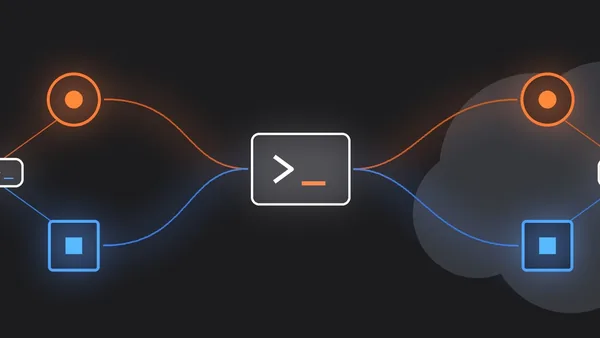
The A2A CLI on AWS: One Client for Lightsail, Bedrock AgentCore and Localhost

The A2A CLI v0.3.1 drives agents across AWS Lightsail containers, Bedrock AgentCore Runtime, and localhost using the same commands, passing 16 of 16 checks. A Rust agent (A2A 1.0) and a Strands coordinator (A2A 0.3) communicate via the CLI, which bridges protocol versions when Strands' Python client cannot read A2A 1.0. On AWS, only a Cognito token, session header, and agent card URL differ from local execution.

One Markdown File Can Hijack Your AI Coding Agent: The Hidden Cost of Blindly Trusting AGENTS.md
AI/ML / dev.to

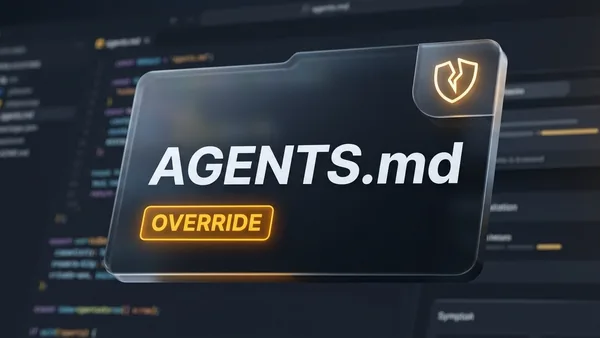
One Markdown File Can Hijack Your AI Coding Agent: The Hidden Cost of Blindly Trusting AGENTS.md

A single markdown file (AGENTS.md, CLAUDE.md, or .cursorrules) can hijack AI coding agents like Claude Code, OpenAI Codex, and Cursor CLI with up to 90% success rate, as documented by Forever Security and Aviatrix in late October 2026. The attack exploits the agent's core feature of reading project instruction files from the working directory, with no memory corruption or zero-day required—common vectors include launching agents in ~/Downloads (1,300+ recorded Claude Code sessions) or merging pull requests containing invisible Unicode payloads in seemingly legitimate rules. Developers must treat these context files as executable code, not documentation, since the LLM sees no boundary between system instructions and ingested project context.

Edera's Object Capability Bounded Authority Promises to Isolate Credentials From AI Agent Workloads
AI/ML / infoq.com

Edera's Object Capability Bounded Authority Promises to Isolate Credentials From AI Agent Workloads

Edera launched Object Capability Bounded Authority, a hypervisor-level security model that isolates AI agent workloads and Model Context Protocol (MCP) servers from sensitive credentials. Co-founded by Ariadne Conill, the architecture uses components like capcurl and capsudo to enforce granular object capabilities, decoupling operational authority from underlying credentials. This prevents credential extraction via prompt injection or supply chain attacks by restricting agents to narrowly defined actions without embedding secrets in workloads.

Groundcover automates Kubernetes sizing. Engineers set the bounds.
Cloud / thenewstack.io

Groundcover automates Kubernetes sizing. Engineers set the bounds.

Groundcover launched Autonomous Infrastructure in beta to continuously adjust Kubernetes CPU and memory requests using production data from its eBPF sensor, acquired via Wand in September. The tool balances cost efficiency and stability by both reducing over-provisioned resources and increasing allocations for under-provisioned workloads, addressing the common failure of static resource configurations against dynamic workloads. Engineers retain visibility into cost and performance impacts, with a 2025 study showing optimized allocation can improve combined performance-and-cost scores by ~50%.

GitHub Universe 2026: Announcements, Sessions, and My Technical Takeaways
Open Source / dev.to

GitHub Universe 2026: Announcements, Sessions, and My Technical Takeaways

GitHub Universe 2026 revealed a fundamental SDLC shift from AI-assisted coding to human-orchestrated agent fleets, driven by telemetry showing 40% of PRs now start with agent drafts. The platform overhaul decouples compute from storage using Azure Blob Storage and a replicated log service, achieving 7,200 writes/second with 5,000 agents targeting one repository—180x current throughput. Copilot optimization sessions detailed how stronger foundation models don't automatically improve coding experiences without careful context and protocol integration.

Your App Will Meet a Freeze. Design for It
General / dev.to

Your App Will Meet a Freeze. Design for It

Binance's $6.3B exploit demonstrates three architectural failure modes every crypto app must handle: EIP-7702 delegation attacks on hot wallets, stablecoin blacklist reversions, and tainted Bitcoin deposits. Monitor hot wallet code changes via the 0xef0100 prefix, check USDC/USDT blacklist functions before transfers (note the case-sensitive naming difference), and treat flagged deposits as a normal state requiring explicit user messaging rather than silent failures.

Vault Fork OpenBao Adds External Keys and Quantum-Ready TLS
Open Source / infoq.com

Vault Fork OpenBao Adds External Keys and Quantum-Ready TLS

OpenBao 2.7, the community fork of HashiCorp Vault under Linux Foundation governance, adds PostgreSQL read scaling, external HSM/KMS key support via plugins, and post-quantum cryptography (ML-DSA, ML-KEM) for TLS and PKI. The release also introduces control groups for human approval of sensitive operations and request-consistency headers for load-balanced deployments, extending beyond Vault Community Edition with formerly enterprise-gated features like namespaces and HSM integration.

Android 17 on a 4.9 Kernel: LineageOS 24.0 on the Pixel 3a
Open Source / dev.to

Android 17 on a 4.9 Kernel: LineageOS 24.0 on the Pixel 3a

A developer successfully booted LineageOS 24.0 (Android 17) on a Pixel 3a using its original 4.9 Linux kernel, despite Android 17 assuming at least kernel 5.10. The port required one kernel fix for a cgroup BPF reference count, five platform code forks (fscrypt keys, BPF loader, netd/Connectivity, native app zygote), and device-tree changes for ueventd, gralloc, and ION memory allocator. The phone boots in 83 seconds with SELinux enforcing, Wi-Fi, Bluetooth, sensors, Chrome, and Google Play Services working, while preserving user data across updates.