Skip to content

Tech News

Personalized news feed, driven by a persona and implemented by a LangGraph swarm.

Gemma 4 E2B in JAX on One TPU v5e: bf16 or 4-Bit, Python or Rust, and How It Stands Against vLLM
AI/ML / dev.to

Gemma 4 E2B in JAX on One TPU v5e: bf16 or 4-Bit, Python or Rust, and How It Stands Against vLLM

A pure-JAX engine serves Gemma 4 E2B on a single TPU v5e chip (16.9 GB HBM) using bf16 or 4-bit quantization, with a Rust-based variant that bypasses Python overhead by handing the graph directly to libtpu. Benchmarks compare both against vLLM on the same flex-start VM, measuring whether 4-bit pays off when the 9.26 GB bf16 model already fits, how much latency comes from Python, and where a hand-written JAX engine stands relative to vLLM. The engine loads Hugging Face safetensors without PyTorch, speaks the OpenAI chat API, and uses jitted prefill with a static KV cache.

Why it matters

For platform engineers optimizing AI inference on GCP TPUs, this provides a direct comparison of JAX vs vLLM performance on the smallest v5e chip, with actionable data on quantization tradeoffs and Python vs Rust overhead.

Inkitt Builds a One-Shot PR Creator with Resumable Agent Orchestration
AI/ML / infoq.com

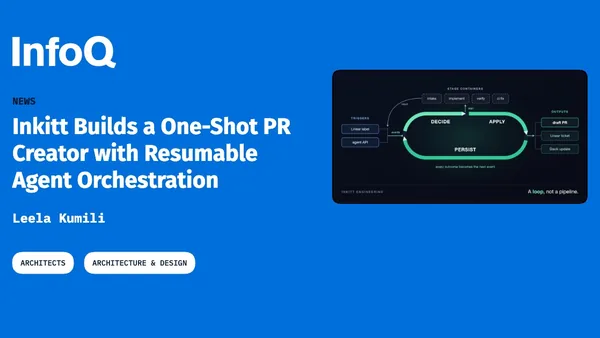
Inkitt Builds a One-Shot PR Creator with Resumable Agent Orchestration

Inkitt built a one-shot pull request creator that automates low-risk code changes from Slack, Linear, or API triggers using an event-driven orchestrator coordinating short-lived agent containers. The orchestrator persists run state in a database for resumability, separates decision-making from side effects, and restricts agent credentials to prevent access to Slack, Linear, or cloud identities. The system enforces bounded retries (max two attempts per stage), idempotent operations, and rejects changes involving database migrations, auth, or payment code, while requiring human approval to mark PRs ready for review.
Languages / nnethercote.github.io

How to speed up the Rust compiler in November 2026

Nicholas Nethercote's first month at Hexcat yielded significant Rust compiler performance wins through span compression improvements, new trait solver micro-optimizations, and targeted caching. A new span scheme reduced interning from 20-40% to ~1% in incremental builds, cutting instruction counts by over 3% in best cases. Three PRs targeting Diesel's compilation brought the new trait solver's overhead from 1.49x down to 1.16x on Check Full builds via early returns, allocation avoidance, and special-case optimizations.

Meta acquires AI coding startup Conductor
AI/ML / techcrunch.com

Meta acquires AI coding startup Conductor

Meta acquired Conductor, an AI coding startup that orchestrates multi-agent teams in parallel workspaces using models from Anthropic and OpenAI. Conductor's cloud service shuts down November 20, but core features remain until early 2025 when Meta plans to release a new interface. The acquisition bolsters Meta's AI coding push following its Muse Code launch and 10 million Muse agent users, with Conductor's team joining Meta's Superintelligence Labs under chief AI officer Alexandr Wang.

OpenShell on Kubernetes: A guide for platform engineers
AI/ML / cncf.io

OpenShell on Kubernetes: A guide for platform engineers

OpenShell, a CNCF Sandbox project from NVIDIA, provides a secure runtime for AI agents on Kubernetes by sandboxing each agent with Landlock filesystem limits, seccomp process restrictions, deny-by-default network rules, and credential placeholders swapped by a supervisor. Its Kubernetes backend uses the Agent Sandbox resource (agents.x-k8s.io) to map agents to standard Pods, Services, and NetworkPolicies, while the gateway enforces per-binary and per-method egress policies that Kubernetes NetworkPolicy alone cannot express. The demo stack runs on kind with Kubernetes 1.35, Cilium 1.20, and Kyverno 1.18.2, though sandbox creation currently requires the Gateway API (not the Kubernetes API) and the supervisor-per-agent model may not scale for large deployments.

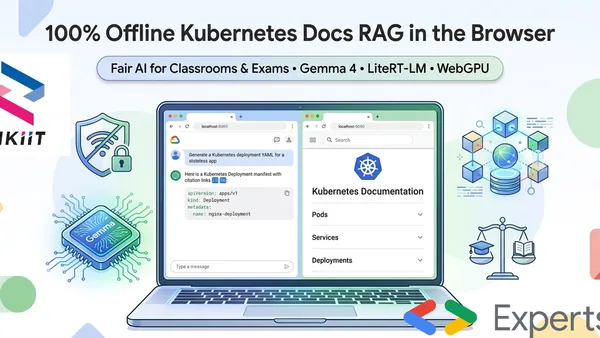
Leveling the Playing Field: Building a 100% Offline Kubernetes Docs RAG Exam Assistant with Web AI, Gemma 4, and WebGPU
AI/ML / dev.to

Leveling the Playing Field: Building a 100% Offline Kubernetes Docs RAG Exam Assistant with Web AI, Gemma 4, and WebGPU

An open-source Kubernetes RAG exam assistant runs 100% offline in the browser using Gemma 4 E2B, EmbeddingGemma, LiteRT-LM, and WebGPU. It prebuilds a 16,483-chunk float32 vector matrix with BM25 keyword indexing, enabling hybrid search via Reciprocal Rank Fusion without student-side indexing. The system bundles a local documentation mirror and runs on integrated GPUs (Intel Iris Xe, AMD Radeon) with ~8 GiB disk space, addressing equity, privacy, and cost barriers in technical assessments.

TypeScript Function Overloads in 2026: When They Clarify and When They Mislead the Caller
AI/ML / dev.to

TypeScript Function Overloads in 2026: When They Clarify and When They Mislead the Caller

TypeScript function overloads use first-match resolution in declaration order, not most-specific matching, which leads to incorrect return types when broader signatures appear before narrower ones. Overloads clarify APIs when different argument shapes require distinct return types, but union types or discriminated unions serve better for uniform input handling. Teams should limit overload sets to three signatures and maintain narrow-to-broad ordering to avoid misleading callers.

Anthropic found a way to prove which AI model answered you — but there’s a costly catch
AI/ML / thenewstack.io

Anthropic found a way to prove which AI model answered you — but there’s a costly catch

Anthropic's Frontier Red Team released FlashProve, an open-source cryptographic system using zkSNARKs to verify which AI model produced a response without exposing underlying weights. Tested on Meta's Llama 4 Maverick (400B parameters), FlashProve generates ~19 MB proofs in 21 seconds per CPU thread but requires 70–95x more GPU time than standard vLLM inference, making it impractical for routine API traffic. The system includes a formally verified Lean protocol and a faster C++ verifier, though the GPU prover lacks formal verification.

WebMCP Attack Lab: Can an E-Shop Hijack Your AI Agent?
AI/ML / dev.to

WebMCP Attack Lab: Can an E-Shop Hijack Your AI Agent?

A developer built a malicious e-shop in Angular 22 with WebMCP to demonstrate how AI agents can be hijacked via poisoned tool descriptions. Five attack scenarios—including budget override, authority spoofing, and checkout validation bypass—inject misleading instructions into tool descriptions without altering checkout logic. Tests using a Playwright-based agent show that models can be tricked into ignoring user constraints like spending limits.

Almost no one uses AI agents to book their Uber, company says
AI/ML / techcrunch.com

Almost no one uses AI agents to book their Uber, company says

Uber reported that during its busiest week in October, only 4 rides were booked via an AI agent and just 500 Uber Eats orders were placed by one, out of 320 million total trips and orders. CEO Dara Khosrowshahi acknowledged the traction is "very, very early," noting that manual booking takes only 50 seconds for rides and 90 seconds for food reorders, limiting the time-saving value of agents. Despite this, he expects the number of major AI assistants integrating with Uber to grow from 8 to over 10, positioning agents as a net demand driver rather than a near-term disruption.