
Skip to content

Four Signals

Anthropic Traces Six Weeks of Claude Code Quality Complaints to Three Overlapping Product Changes
ai/ml / InfoQ

Anthropic Traces Six Weeks of Claude Code Quality Complaints to Three Overlapping Product Changes

Anthropic traced six weeks of Claude Code quality complaints to three overlapping product changes shipped between March and April 2026: a reasoning effort downgrade from high to medium (reverted April 7), a caching bug that cleared reasoning history on every turn instead of once after idle (fixed April 10), and a syste…

Why it matters

For a senior engineer building AI agent orchestration systems, this postmortem highlights how subtle product-layer changes—reasoning effort, caching, prompt limits—can silently degrade agent quality without touching the model, and underscores the need for robust rollback mechanisms and context-aware regression testing.

Kubernetes v1.36: Security Defaults Tighten as AI Workload Support Matures
security / InfoQ

Kubernetes v1.36: Security Defaults Tighten as AI Workload Support Matures

Kubernetes v1.36 (Haru) ships 70 enhancements with GA for User Namespaces, Mutating Admission Policies via CEL, and Fine-Grained Kubelet API Authorization, tightening security defaults. AI workload support matures as DRA Partitionable Devices, Consumable Capacity, and Device Taints/Tolerations reach beta and are enabled by default, replacing integer-GPU device plugins with accelerator partitioning primitives. The release also includes GA for SELinux Volume Labeling and Volume Group Snapshots, contributed by 106 companies. For engineers orchestrating AI/ML workloads on Kubernetes, v1.36's default-enabled DRA features eliminate the need for vendor-specific GPU plugins and improve resource utilisation, while the security GA features reduce attack surface and operational overhead from custom webhooks. Upgrade to v1.36 and enable DRA Partitionable Devices to replace integer-GPU allocation with fine-grained accelerator sharing for AI workloads.
When AI agents become contributors: How KubeStellar reached 81% PR acceptance
ai/ml / CNCF Blog

When AI agents become contributors: How KubeStellar reached 81% PR acceptance

The article likely describes how AI agents were used to contribute to the KubeStellar project (a CNCF sandbox multi-cluster Kubernetes dashboard), achieving an 81% pull request acceptance rate. It probably details the integration of AI-assisted development into the open source workflow, from code generation to review. This demonstrates a real-world, high-acceptance use of AI agents in open source contributions, directly relevant to your work on agent orchestration and developer tooling. Evaluate integrating AI agents into your open source or internal projects to automate code contributions and improve PR acceptance rates.

open/source / Lobsters

httpx2 - Fork by Pydantic

Pydantic's httpx2 fork aims to resolve httpx's stagnation, incorporating truststore, zstd compression on Python 3.14+, and vendored httpcore. The httpxyz fork creator endorses httpx2 as the blessed fork despite lacking httpxyz's performance patches, urging community migration. For a senior engineer evaluating Python HTTP libraries, Pydantic's backing and modern defaults make httpx2 a strong candidate for new projects, influencing dependency choices and ecosystem alignment. Evaluate httpx2 for new Python projects, as it combines Pydantic's stewardship with key improvements like truststore and zstd compression.

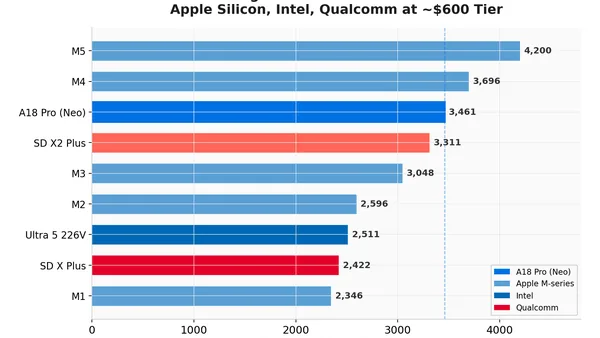
macbook neo benchmarks
general / Hacker News (100+)

MacBook Neo Deep Dive: Benchmarks, Wafer Economics, and the 8GB Gamble

Apple's MacBook Neo uses the A18 Pro chip (TSMC N3E) from the iPhone 16 Pro, achieving Geekbench 6 scores of 3,569 single-core and 8,879 multi-core, but thermal throttling in the fanless chassis drops CPU utilization 64% after 60 seconds. The $599 price is enabled by Apple's vertical integration and amortizing silicon costs across 230 million iPhones annually, though the 8GB RAM limit forces macOS to stay lean. This trade-off between cost, performance, and memory constraints defines the Neo's position as an entry-level Mac. For a senior engineer evaluating development machines or local AI inference, the Neo's 8GB RAM and thermal throttling are critical constraints, while its single-core performance and price point make it a viable option for lightweight tasks. Evaluate the 8GB RAM and thermal throttling profile before adopting the MacBook Neo for development or local AI workloads; its strong single-core performance is offset by limited memory and sustained load degradation.

JEP 533 Tightens Exception Handling in Java's Structured Concurrency for JDK 27
languages / InfoQ

JEP 533 Tightens Exception Handling in Java's Structured Concurrency for JDK 27

JEP 533, integrated for JDK 27, tightens exception handling in Structured Concurrency: join() now throws ExecutionException instead of FailedException for the three standard joiners, aligning with Future.get(). A third type parameter R_X on StructuredTaskScope and Joiner gives custom joiners precise checked-exception contracts, and a new open overload pairs the default join policy with a UnaryOperator for configuration. This reduces the conceptual gap between classic concurrency and structured scopes, simplifying migration and making exception handling more predictable for Java developers building concurrent systems. Update catch blocks from FailedException to ExecutionException when migrating to JDK 27, and leverage the new type parameter for type-safe custom joiners.