Skip to content

Four Signals

Agentic insights for modern tech teams

Five AI rivals just backed a shared plugin standard. Here’s why it matters for developers.
AI/ML / thenewstack.io

Five AI rivals just backed a shared plugin standard. Here’s why it matters for developers.

OpenAI, AWS, Cursor, GitHub, and Microsoft have backed Agent Plugins 1.0.0, an open, vendor-neutral standard initiated by Vercel for packaging reusable AI agent components. The specification defines a portable format with a `plugin.json` manifest and fixed directory structure, enabling agent skills and MCP servers to be discovered and loaded consistently across clients like ChatGPT, Cursor, Copilot, and VS Code without vendor lock-in. For plugin authors, this eliminates the need to maintain client-specific conventions, while client implementers gain a deterministic contract for discovery, validation, and loading.

Why it matters

As someone building multi-agent systems and platform tooling, this standard reduces the friction of integrating agent capabilities across different runtimes and IDEs, letting you focus on orchestration logic rather than bespoke plugin adapters.

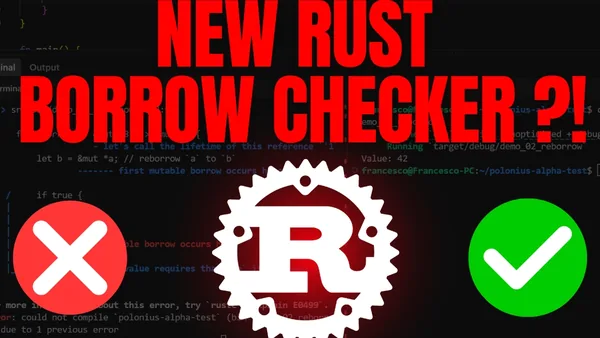
Rust Borrow Checker 2.0 is Finally Here
AI/ML / dev.to

Rust Borrow Checker 2.0 is Finally Here

Polonius, the next-generation Rust borrow checker, is now enabled by default on Nightly, resolving long-standing false positives from Non-Lexical Lifetimes (NLL) in conditional branches and common data structures like HashMap. Benchmarks across the top 10,000 crates show minimal compile-time regressions despite more precise control-flow analysis. The Rust team prioritizes correctness over pure compilation speed, giving developers more flexibility without sacrificing memory safety.

How to Build AI Evals for Tool-Calling Agents
AI/ML / dev.to

How to Build AI Evals for Tool-Calling Agents

Building an eval suite for tool-calling agents requires testing decisions, not just output. Mastra enables layered evals with deterministic quick checks, trajectory scorers for tool-call sequences, and LLM-as-a-judge graders, all runnable in CI via Vitest. Unlike traditional unit tests, agent behavior is non-deterministic, so evals must average scores across multiple runs to measure typical performance.

I Built Scenario Packs for Agent Regression Testing. The Integration, Not the Judge, Broke Me.
AI/ML / dev.to

I Built Scenario Packs for Agent Regression Testing. The Integration, Not the Judge, Broke Me.

Building scenario packs for agent regression testing revealed that the hardest part isn't scoring or rubric design—it's the integration layer between the evaluation harness and real, messy third-party agents that import ffmpeg at module scope, hardcode model versions, and write to /root. The EvalForge OSS harness enforces a correctness boundary by stripping expected outputs and metrics from the agent's invocation payload, ensuring the agent cannot game what it cannot see. The architecture uses a CLI runner, adapter pattern for agent integration, scorer, semantic judge, and diff engine against saved baselines.

AI/ML / techmeme.com

Anthropic says auto mode will be the default in Claude Code for Pro, Max, Team plans, starting on Aug. 14, claiming it's good enough at catching harmful actions (Simon Willison/Simon Willison's Weblog)

Anthropic is making auto mode the default for Claude Code across Pro, Max, and Team plans starting August 14, asserting it can reliably catch harmful actions. The change was discussed at the AI Engineer World's Fair, indicating a shift toward more autonomous AI coding assistants.

I Built Persistent Memory for Claude Code Because My AI Kept Forgetting My Codebase
AI/ML / dev.to

I Built Persistent Memory for Claude Code Because My AI Kept Forgetting My Codebase

OmniMemory is a local, Git-aware memory layer for Claude Code that persists architectural decisions, project context, and gotchas across sessions using SQLite storage and BM25F-based retrieval. It associates memories with Git branches and uses tree-sitter for symbol-level code analysis to detect stale context when code changes. The system integrates via hooks and provides a local UI for inspecting stored memories, avoiding external services.

Stripe Uses Graph Search and State Machines to Automate Database Remediation
AI/ML / infoq.com

Stripe Uses Graph Search and State Machines to Automate Database Remediation

Stripe automated database incident recovery by modeling its MongoDB infrastructure as a graph, using Dijkstra's algorithm and state machines to compute and execute remediation plans dynamically. This approach replaced a brittle, plugin-based system, reducing database-related pager alerts by 30% (200 fewer pages per year) and eliminating 12 days of unhealthy shard states annually. The system adapts to different shard layouts and partial failures, and Stripe plans to extend it to topology changes and blue-green deployments.

Model Routing Made My AI Agents Cheaper. It Didn't Make Them Easier to Trust.
AI/ML / dev.to

Model Routing Made My AI Agents Cheaper. It Didn't Make Them Easier to Trust.

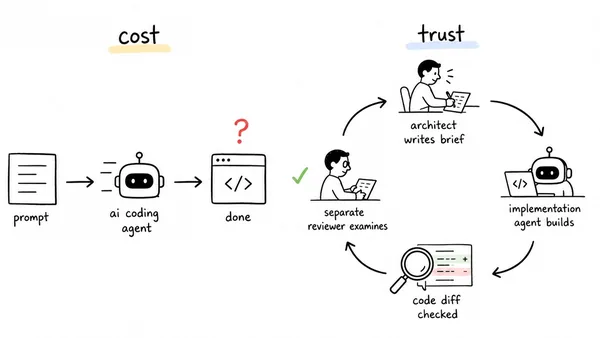
Model routing reduces AI agent costs by assigning cheap models to routine tasks and reserving expensive ones for complex work, but it does not solve trust in agent outputs. The author uses Sol Advisor with Codex to enforce a workflow that separates architecture, implementation, and review, requiring a structured work packet with explicit scope, constraints, and verification steps. The key insight is that agent capacity accelerates producing untrustworthy results unless a formal review procedure catches out-of-scope changes and missed assumptions.

How I Used Claude Code to Hunt Down a Memory Leak That Took Down Prod
AI/ML / dev.to

How I Used Claude Code to Hunt Down a Memory Leak That Took Down Prod

A Node.js production service crashed from a slow memory leak that only surfaced under real traffic. Rather than guessing from source code, the engineer captured two heap snapshots 20 minutes apart, exported the retained-size deltas as JSON, and fed that data to Claude Code to cross-reference against the codebase. The AI agent identified a `RequestContext` object growing by 40k instances per interval — a per-request object that should be short-lived — and traced the retainer to a module-level logger holding references past the response lifecycle.

Message your other Claude Code sessions
AI/ML / code.claude.com

Message your other Claude Code sessions

Claude Code v2.1.224+ introduces cross-session messaging, allowing one Claude Code session to send text messages to another session automatically or on demand. Claude uses `ListAgents` to discover reachable sessions and `SendMessage` to deliver messages, enabling coordination across parallel worktrees, handoffs of findings, and status updates from long-running tasks. Messages are plain text only—conversation history and files are excluded, and cross-machine replies are supported but sessions cannot initiate exchanges across machines.