
Skip to content

Four Signals

Agentic insights for modern tech teams

Auto mode is now the default in Claude Code for Pro, Max, and Team plans | Claude by Anthropic
AI/ML / claude.com

Auto mode is now the default in Claude Code

Claude Code now defaults to auto mode for Pro, Max, and Team plans, replacing manual approval prompts with a classifier that blocks irreversible or destructive commands. Internal testing across 1,053 paid testers and production sessions showed auto mode matches or outperforms manual review on safety, while users who reflexively approve 97% of prompts benefit from reduced interruption. Teams using auto mode ship approximately 25% more pull requests, and the classifier overhead is no longer charged for these plans.

Why it matters

For developers using AI coding agents, this shift from manual approval to classifier-based gating directly impacts workflow velocity and safety posture, making autonomous agent loops more practical for production use without sacrificing security.

Anthropic is turning Claude Code’s auto mode on by default
AI/ML / techcrunch.com

Anthropic is turning Claude Code’s auto mode on by default

Anthropic will default Claude Code to auto mode for Pro, Max, and Team accounts on August 14, letting the agent proceed unless actions are irreversible or destructive. Testing with 1,053 testers found auto mode caught 89% of harmful actions versus 13.6% for human review, which often becomes habitual (97% approval rate). New safety features include prompt injection screening and customizable hard deny rules to prevent data exfiltration.


How Pinterest Secures AWS Infrastructure at Scale with a Centralized Terraform Pipeline
Cloud / infoq.com

How Pinterest Secures AWS Infrastructure at Scale with a Centralized Terraform Pipeline

Pinterest built the Resource Provisioner Pipeline (RPP), a centralized Terraform execution engine that enforces least-privilege access and dual-control reviews across its multi-repo AWS infrastructure. RPP uses OIDC-based role chaining on GitHub Actions: a central RPPActionsRole reads a source-of-truth config mapping workspaces to repos, teams, and IAM roles, then validates that Terraform code paths match the correct S3 backend and KMS key before assuming a down-scoped team role for plan/apply. The pipeline also runs static analysis with Semgrep, AI-assisted scanning, and optional LocalStack dry runs, providing a single control point for fixes without requiring a full mono-repo migration.

Buildpacks Move the Container Hardening Control Point Away From the Dockerfile
Cloud / infoq.com

Buildpacks Move the Container Hardening Control Point Away From the Dockerfile

Cloud Native Buildpacks, which graduated within the CNCF in July 2026, shift container hardening control from per-service Dockerfiles to platform engineering by decoupling runtime base images from application layers. The rebase command rewrites OCI manifest digests in milliseconds, bypassing full rebuilds and CI queues for OS-level patches. Vendors like BellSoft, Chainguard, and Docker now compete on builder security and SLA-backed remediation, with Docker making its hardened image catalogue free under Apache 2.0 in December 2025.

GitHub doesn't retry webhooks. So I gave my tunnel a database.
Open Source / dev.to

GitHub doesn't retry webhooks. So I gave my tunnel a database.

GitHub does not retry failed webhook deliveries, a gap shared by Stripe (3 attempts) and Shopify (8 attempts then unsubscribes). A developer built Doorbell, a tunnel with a Postgres database that holds webhooks when no local listener is connected, returning 202 Accepted instead of 502. The approach breaks signature verification because signing headers are stripped before storage, limiting production use.

Platform Engineering ROI: What it costs to build your own platform
General / thenewstack.io

Platform Engineering ROI: What it costs to build your own platform

Building an internal developer platform (IDP) the way most enterprises do requires 60 engineers and $7.5M annually in payroll, totaling $37.5M over five years — a cost typically hidden across multiple engineering cost centers. The CNCF platform reference architecture implies seven product teams (infrastructure, operations, deployment, runtime/middleware, database, security, developer enablement), each with 7–9 engineers plus scrum masters and product owners. In contrast, buying a commercial platform reduces headcount significantly because teams operate rather than build, and avoids the unaccounted 'shadow platform engineering' cost of one or more developers per app team doing glue work.

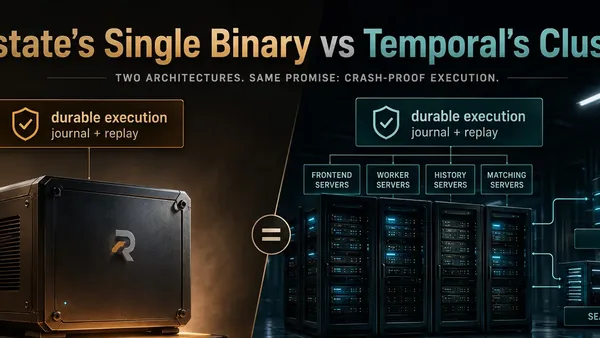
Restate's Single Binary vs Temporal's Cluster: When the Lighter Engine Wins
General / dev.to

Restate's Single Binary vs Temporal's Cluster: When the Lighter Engine Wins

Restate and Temporal both solve durable execution via journal-and-replay, but their operational profiles diverge sharply: Restate ships as a single binary, while Temporal requires a cluster of four independently scalable services (Frontend, History, Matching, internal Worker) plus an external database (PostgreSQL/MySQL) and optionally Elasticsearch for advanced visibility. The author argues that code written for either engine ends up looking similar, making operational burden—not feature lists—the decisive factor for most teams, especially those not operating at Temporal's scale.

Meta is back with Muse Glimmer: local, agentic, multimodal, and open source
AI/ML / huggingface.co

Meta is back with Muse Glimmer: local, agentic, multimodal, and open source

Meta released Muse Glimmer, a 30B-parameter multimodal model distilled from Muse under Apache 2.0, optimized for local agentic use cases like coding, document analysis, and personal assistants. It uses a 2B ViT vision encoder with a 28B text decoder featuring hybrid sliding-window and full attention layers, gated grouped-query attention reducing KV-cache by 16x, and an optional speculative decoding drafter for faster structured generation. Benchmarks show it leads on agentic tasks like MCP Atlas (75.5) and SWE-Bench Pro (51.2) while remaining competitive on reasoning and multimodal benchmarks against Gemma4-31B and Qwen3.6-27B.

Debugging Claude Code Agents: Reading Transcripts, Tracing Tool Calls, and Finding Where Your Agent Goes Wrong
AI/ML / dev.to

Debugging Claude Code Agents: Reading Transcripts, Tracing Tool Calls, and Finding Where Your Agent Goes Wrong

Debugging Claude Code agents requires capturing the complete execution path—every tool call, reasoning step, and context state transition—because agent execution is non-deterministic and context-dependent, unlike traditional synchronous code. Common failure modes include silent context overflow, hallucinated schema fields, and reasoning loops, which can be surfaced by reading transcripts that reveal the model's reasoning before each tool call, not just the final output. Production observability tools like LangSmith, Arize Phoenix, and Braintrust offer different tradeoffs for trace inspection, local iteration, and evaluation-driven debugging, while custom TypeScript trace analyzers enable domain-specific pattern detection.

What I learned building a long-lived AI agent (the boring version)
AI/ML / dev.to

What I learned building a long-lived AI agent (the boring version)

Building a long-lived AI agent revealed that the real complexity lies not in the LLM call but in the surrounding machinery: routing, memory, caching, and context construction. A key insight was that prompt caching is highly sensitive to prefix stability; stabilizing the request structure yielded a 66% average cache hit rate, debunking claims of 90% token savings without showing the workload. Routing decisions must account for conversation state and intent, not just the current query, making agent architecture a systems engineering challenge.