
Skip to content

Four Signals

Agentic insights for modern tech teams

Google is making private AI practical with homomorphic encryption
Security / blog.google

Google is making private AI practical with homomorphic encryption

Google open-sourced HEIR, a compiler that converts pre-trained AI models to operate on encrypted data using homomorphic encryption, enabling private inference without exposing user data. HEIR partners with hardware accelerator companies like Belfort and Niobium to reduce the computational overhead, and has been adopted by universities for research, resulting in four peer-reviewed publications. This shifts the privacy trade-off from capability vs. security to a question of cost, making cryptographically-secure AI practical for regulated sectors like healthcare and finance.

Why it matters

For a platform engineer evaluating privacy-preserving architectures, HEIR offers a path to deploy AI inference on sensitive data without hardware enclaves or shipping models to devices, directly addressing compliance and IP protection concerns.

Maximizing the value of your Claude Code sessions | Claude by Anthropic
AI/ML / claude.com

Maximizing the value of your Claude Code sessions

Anthropic's guide on optimizing Claude Code sessions focuses on token efficiency through session hygiene: running `/clear` between tasks prevents context bleed, setting model/effort level upfront avoids prompt cache busting, and using `@-mention` for files reduces API calls. Key commands like `/context` reveal loaded artifacts (CLAUDE.md, MCP tools) to trim unnecessary overhead, while `/compact` before idle periods leverages the one-hour prompt cache window to cheaply summarize conversations. The post frames token cost as a function of model size, input vs. output phase, and cache state, urging developers to align model choice with task complexity and avoid dragging stale context across turns.
AI/ML / cncf.io

Eleven minutes, zero humans: Building a self-healing Kubernetes upgrade pipeline on Kairos

This article likely describes a fully automated, self-healing Kubernetes upgrade pipeline built on Kairos, achieving zero-touch upgrades in approximately 11 minutes. It appears to contrast this modern approach with the traditional manual, error-prone process of upgrading control planes node by node, highlighting how automation and self-healing mechanisms can eliminate human intervention and reduce downtime risk.

Your Coding Agent Probably Doesn’t Need a Memory SaaS
AI/ML / dev.to

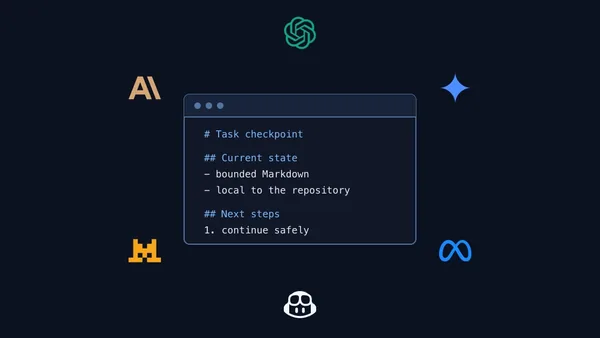
Your Coding Agent Probably Doesn’t Need a Memory SaaS

A developer argues that most coding-agent memory problems don't require a SaaS solution, instead proposing a bounded Markdown scratchpad file stored directly in the repository. The `.ai_scratchpad.md` file, capped at 80 lines, stores only task-continuity state—what was attempted, why it failed, which processes are live—rather than long-term semantic memory. This pattern avoids the overhead of external SDKs, databases, and synchronization layers while preventing agents from repeating investigations or acting on stale assumptions.

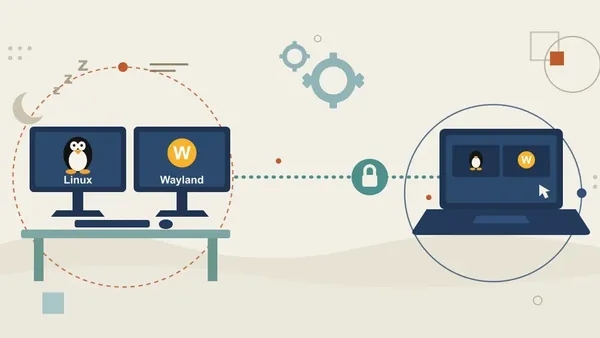
RustDesk now supports true unattended remote access on Wayland
Languages / rustdesk.com

RustDesk now supports true unattended remote access on Wayland

RustDesk released a preview build enabling true unattended remote access on Wayland for x86_64 Debian/Ubuntu systems, supporting multi-monitor setups and connections from the login screen after reboot. This fills a gap where competitors like AnyDesk require Xorg and TeamViewer still labels Wayland support as experimental. The feature will expand to Fedora and Arch Linux once stable.

Reviving Open Source Giants: How I Brought Weave Scope Back with Multi-Platform Docker Support in One Afternoon Using Antigravity
Cloud / dev.to

Reviving Open Source Giants: How I Brought Weave Scope Back with Multi-Platform Docker Support in One Afternoon Using Antigravity

A developer revived the archived Weave Scope container monitoring tool by modernizing its build pipeline for multi-architecture support (ARM64 and AMD64) using Antigravity, an AI platform. The project, now at github.com/mario-ezquerro/scope, produces Docker images for both x86 and ARM infrastructure, including AWS Graviton and Apple Silicon. The entire restoration—from dependency audit to Docker Hub publishing—took a single afternoon, demonstrating AI's potential for open-source software archaeology and modernization.

App Shield: Your Server Should Not Trust the App Calling It
Languages / dev.to

App Shield: Your Server Should Not Trust the App Calling It

Codename One's App Shield moves device attestation decisions from the client to the server by attaching a short-lived ES256 token, verified through Apple App Attest or Google Play Integrity, to protected API requests. The framework's Enterprise layer ensures that a modified app cannot bypass security by faking a local boolean, as the server enforces the final policy. This approach is already deployed with several banking customers, leveraging Java's single-codebase model for iOS and Android to reduce audit surface.

Dogfooding BlocSignal on the Web: Building a 100K Ops/sec Reactive App with Jaspr and Dart 3.13
General / dev.to

Dogfooding BlocSignal on the Web: Building a 100K Ops/sec Reactive App with Jaspr and Dart 3.13

The BlocSignal team rebuilt their documentation site using Jaspr, a lightweight Dart web framework, replacing manual subscription callbacks with declarative consumer components from bloc_signals_jaspr. This eliminated the double re-render penalty and UI thrashing from raw setState calls, achieving 100,000 operations/sec in compiled JavaScript. The migration leveraged Dart 3.13 primary constructors and a NavigationCubit state machine to model routing declaratively, avoiding ad-hoc URL parsing across components.

Curl Performance
General / daniel.haxx.se

Curl Performance

Daniel Stenberg launched a lightweight, self-hosted performance regression testing suite for curl, running every 20 minutes on his local machine via cron and gnuplot, after rejecting Grafana and cloud infrastructure due to complexity and noise. The initial tests measure download throughput for a 100GB file from localhost and memory allocation counts, with results published live on the curl website. Within hours of going live, the visibility triggered developer contributions that improved performance metrics.

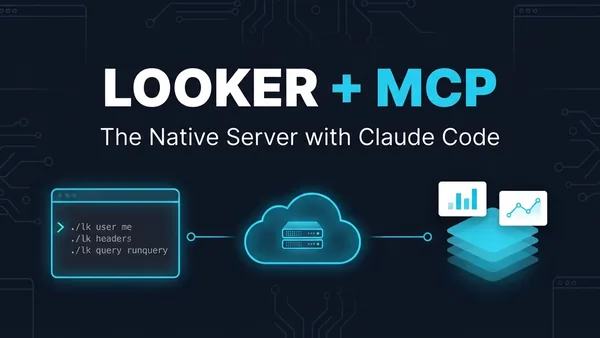
Looker's Native MCP Server with Claude Code
AI/ML / dev.to

Looker's Native MCP Server with Claude Code

Looker now natively hosts an MCP server, eliminating the need for developers to run the 292 MB MCP Toolbox binary locally. The server is accessible at a per-instance URL, requires admin enablement and API3 credentials, and supports Claude Code via a simple HTTP-based configuration. Key limitations include no support for customer-hosted instances, a global tool allowlist without per-user scoping, and ~30-second propagation delays for tool-list changes.